


The national radio and television authority has recently published a number of initiatives to further enrich television screen content and promote the availability of content on television. These include 21 reform measures such as “elimination of the 40-episode ceiling” “no severe restrictions on the number of classical plays”, “capturing the production of documentaries”, “supporting the production of fine cartoons”。
What are the considerations behind these new initiatives? What will happen to the tv industry
Strengthening content building
Increased quality content supply
The initiative emphasizes the need for a combination of measures to strengthen content building and to increase the availability of high-quality television listening —
Implementation of the “content renewal programme” to enhance content innovation
(a) improving management policies such as the number of television dramas and the length of time between the airing of quarterly dramas
Improving the review of television content, optimizing mechanisms and improving efficiency

(b) strengthening the dissemination of high-resolution programming
Strengthening documentary and animation productions
Encouraging support for the introduction of good micro-shorts to television
Promotion of the introduction of outstanding overseas programmes, etc。
Untie length frequency
Unleash the creativity
The initiative provides for the appropriate liberalization of the upper limit of 40 episodes for future television drama creation, a policy that will open up creative space for high-quality drama。
With regard to the return of the ultra-long drama, the deputy researcher at the centre for development studies of the national general directorate of radio and television noted that the television director himself was an important artistic feature. In particular, the historical content of major revolutions, time spans, and so on, are long enough to show complex and varied historical time and space, and to show the rise and fall of individual destiny as the great times change。
“the return of the ultra-long drama is to give the works of these topics a more expansive expression and space to express themselves, without the need for a substantial reduction in the limitation of time at the expense of the artistic effects.”

It is also clear from the initiative that “super-long dramas can be specially reviewed”, reflecting the “resolute prevention” orientation of the national radio and television service, and the strict application of closures to avoid a return to “water-filling dramas”。
“the original purpose of the series, which was limited to 40, was to avoid the appearance of a “water-filled play”. Since the introduction of this policy, there has been a proliferation of high-quality dramas in the industry and a change in the concept of professional creativity. New initiatives are now being put in place to avoid “one size fits all” from the practical point of view of concrete creative production。
In terms of unleashing creative energy, the initiative also calls for the liberalization of seasonal broadcasting, flexibility in the regulation of classical dramas, direct response to market pains and the elimination of the mandatory one-year interval。
In the area of content creation, the initiative encourages the opening of subjects and promotes the introduction of programmes abroad. Encouraging adaptation of outstanding works abroad and supporting high-quality indigenous creation -
Allowing the selection of outstanding works from abroad for high-quality indigenous adaptation is not limited to the liberalization of japanese and korean ip
Support for the introduction of high-quality overseas television dramas, documentaries, cartoons to be aired during the golden hour of the vvd
Optimizing the distribution of indicators for the drama series, supporting the introduction of high-quality television programmes for key subjects, such as the security video channel, and eliminating the quantitative limitation of single-subject indicators。
Once the new initiative has been launched, there has been a strong industry response. Initiatives have broken down the policy constraints of the previous industry and have focused more on industry-based practices. This reform has been positively adapted to the dual nature of the media and the aesthetic character of the audience。
“the aesthetic characteristics and psychology of the audience are rapidly changing and the traditional television industry is facing a great deal of shocks at a time when media patterns are rapidly changing, particularly in new business situations such as dramas, games and live broadcasts. This requires the further release of industry productivity through top-level design.” holy shit。
Optimizing the review mechanism
Improving review efficiency
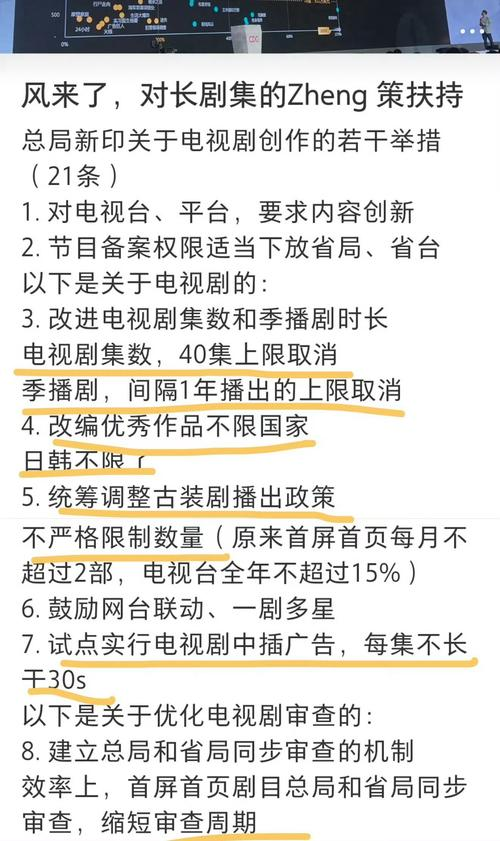
With regard to the review mechanism, the directorate-general and the provincial directorate will establish a simultaneous review mechanism for the protection of the gold slot and the front screens of the priority web site; the time frame for the completion of the film review will also be optimized; historical, medical and other subjects will be pre-empted by experts and will be reviewed with a duration of no more than 50 days; and new review mechanisms will be piloted in the types of series, scenario and modular dramas。
The innovations in these review mechanisms will significantly increase the efficiency of the review, saving time costs for producers and promoting innovation in production methods。
The initiative encourages the focus of explicit statements that support access to television for high-quality micro-shorts. For example, support for the broadcasting of outstanding micro-syncs through television platforms has broadened the availability of content, and provincial guards have seen policy support for the opening of micro-sync theatres。
Industry believes that a range of policies have fully recognized the emerging media position of the micro-short play and have helped to improve its current state of brutal growth at the mobile end and achieve a two-way flow of the content of the screen. In the future, good micro-facility landing television will bring about a change in content patterns, whose fast-paced and strong-intensity features will certainly be a useful complement to traditional television drama narrative models。
A series of related new initiatives constitute a comprehensive system-wide policy mix, according to joaquin. “these are intended to provide better audio-visual experience and a better supply of content to the audience, with a greater focus on the pattern of respect for artistic creation and the market pattern of the development of the audiovisual content industry itself.”
China voice of the central radio and television service, an integrated news service



