


Principles of operation of the generalized bed boiler:
Process of conversion of solid particles to a similar fluid state in contact with gas or liquid, known as fluidization pass
Cheng. Fluidation is used in fuel combustion, i. E., in the form of fluid combustion, and its stove is called a fluidized bed boiler。
Cyclical fluidized bed boilers are new furnaces developed based on drumbone fluidized bed boilers technology, and they're also bubbling
The greatest difference between the boiler is the higher rate of fluoride in the furnace (generally 4 〜8 m/s), which is exported from the furnace
Air solids separators have been added. Small solid particles that are discharged from the furnace by gas, separated by separators, then
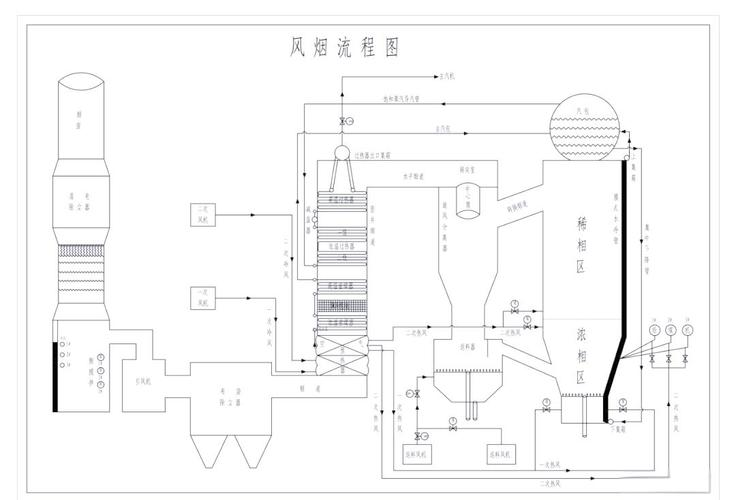
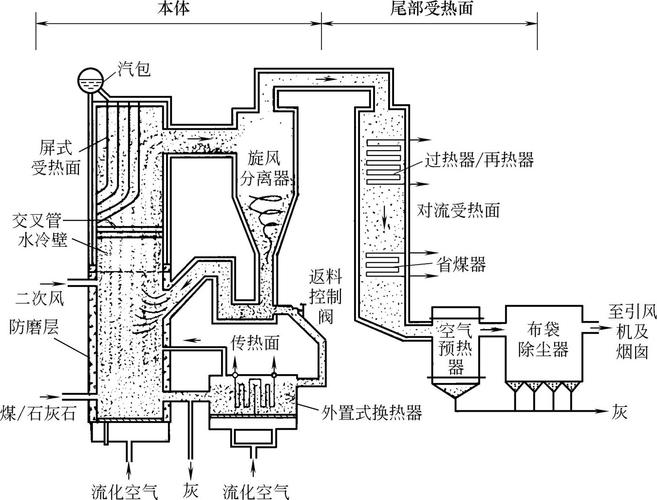
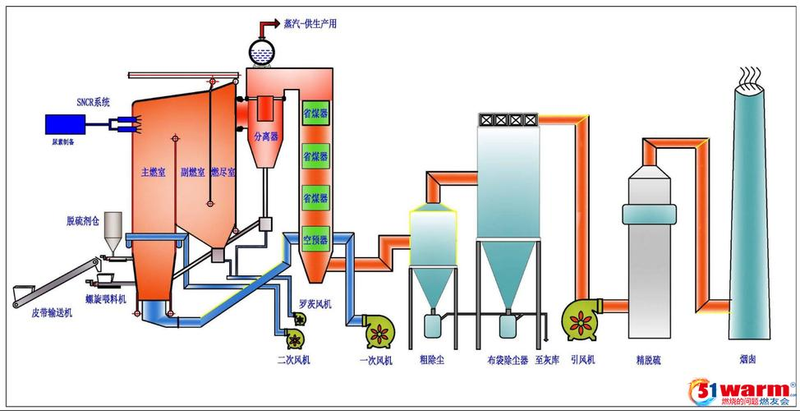
Return to the burning cycle inside the furnace. The circulatory fluidized bed boilers can be divided into two parts: the first is by the chamber (quick fluidized bed)
Gas solids separators, solids recycling equipment and external heat exchangers (some cycling fluidized boilers do not have this)
The components consist of, inter alia, the formation of a solid material loop. The second part is a pyrotechnic
There were heaters, reheaters, coal-savings and air heaters, etc., similar to other conventional boilers。
One wind and two winds required for the burning of the circulatory fluidized bed boiler are fed from the bottom and side walls of the furnace, respectively, and are burned
The combustion of the material was mainly completed in the furnace, where water cold walls were laid around to absorb part of the heat generated by the combustion。
Solid materials brought out of the furnace by the air flow are collected in the gas-solid separation device and returned to the furnace through the refractive device。
Basic technical characteristics of circulatory fluidized bed combustion boilers:
(1) low-temperature power control combustion
Cyclical fluidized bed combustion is a highly disturbed flue gas that moves at high speed inside the furnace and the current that it carries
Solid particles are in close contact and have a flow-combustion reaction of large amounts of particles; at the same time, they will be eliminated outside the furnace
Most of the high-temperature solid particles are captured and returned to the furnace for re-participation in the combustion process, and vice versa
Recycle the burning. It is clear that the time spent burning the fuel inside the furnace has been prolonged. In this way of burning, the stove
The internal temperature level is generally around 850 c due to the optimal temperature limit of devulcanization. This temperature is far below the normal coal powder furnace
The temperature level in it is lower than the ash melting point of ordinary coal, thus freeing the ash melting from all the troubles. This "low"
Temperature combustion is a very good way of doing it, and both the slag and the alkaline metal are much better than in coal powder furnaces
Sensitivity is reduced and no space is required to cool down high-temperature ash, with low nox generation in the oven. Group
Cheap and efficient devulcanization processes, etc. Flammation in circulatory fluidized bed boilers from the point of view of combustion reaction dynamics
Burn reaction is controlled in the power burning area (or transitional area). Because of the relatively low temperature in the circulatory fluidized bed boiler
And there's a huge mixture of solid particles, and the rate of combustion in this case depends mainly on the rate of chemical reaction, as well
It is determined by temperature levels, and the physical factor is no longer the dominant factor in controlling the burning rate. Cycle fluidized bed boiler
The internal fuel has a high level of combustion, usually with a high performance of 95 〜99% combustion efficiency in the circulatory fluidized bed boiler
Go on。
(2) high speed, high concentration, high flux flow cycle of solid material
As can be seen from figure 3, solid materials in circulatory fluidized bed boilers (including fuel, charcoal, ash, stripping)
Sulphur agents and inert bed materials, etc.) have undergone an external cycle consisting of furnaces, separators and refillers. It's in the oven
Internal circulation also exists because of the wall effect, so that materials in the circulatory fluidized bed boiler are involved in the outer cycle and internal circuits
Ring two cycles. The whole combustion process and the devulcanization process are dynamics in both forms of circulation. Pass
Phased。
(3) high-intensity heat, mass and momentum transfer processes
In circulatory fluidized bed boilers, large amounts of solid material pass through the furnace in a strong stream, which can be operated by humans
Changes in material circulation and changes in the distribution patterns of materials within the furnace to accommodate different combustion conditions. In this group
Under weave, the heat, mass and momentum transfer in the furnace is very strong, which makes the whole chamber high
The temperature is evenly distributed。
Advantages of circular fluidized bed boilers
(1) wide adaptation of fuels
This is one of the main advantages of a circulatory fluidized bed boiler. Fuel is only available by weight in circulatory fluidized bed boilers
Three percent of the bed material, the rest of which is non-flammable solid particles such as desulphurizers, ash, etc. Therefore, add
Fresh coal particles reaching the bed are surrounded by hot ash particles equivalent to a “big hot pool”. Because of the bed
It's so intensely mixed that these hot ash particles actually act as an endless "ideal arch" for coal
Heated to the temperature of the fire and started burning. In this heating process, only the total heat capacity of the bed layer is absorbed
And the burning of coal particles releases heat, which allows for the release of heat
The bed is kept at a certain temperature level, and the fluid bed is usually on fire, and the coal species are highly adaptable
The reason。
(2) efficient combustion
Circulation fluidized bed boilers burn more efficiently than drumbone fluidized bed boilers, usually in the range of 95 〜99%
It's like a coal boiler. Circulation fluidized bed boilers are more efficiently burned because of the following characteristics: good mix of air-solids
The rate of combustion is high, followed by the recycling of fly ash。
(3) tritium devulcanization
As a result of the cycling combustion process of flying ash, no devulcanization reaction in the bed material was blown out of room lime
Stones and lime can be returned to the bed for reuse; in addition, the devulcanization component has occurred, producing large particles of calcium sulphate
Collision breaks during cycle combustion, exposing the new calcium oxide particle surface to the atmosphere of sulphide reaction。
This greatly improves the devulcanization performance of circular fluidized bed combustion compared to drum bubble fluidized bed combustion. When
At a calcium sulphur ratio of 1. 5 〜 2. 0, the devulcanization rate can be as high as 85 〜90%. And the drum-blowing bed boiler, the devulcanization efficiency is 85%
〜90% calcium sulphur is twice as high as calcium 3〜4. No tails required compared to coal powder boilers
The devulcanization device, investment and operating costs have been significantly reduced。
(4) nox (low nox emissions)
Low nox emissions are another very attractive feature of cycling fluidized boilers. Operational experience
No for gcb boilers with a range of 50 〜150 ppm or 40 〜120 mg/mj circulation fluidized boilers
Low nox is due to two reasons: first, low temperature combustion, when nitrogen in air is not normally generated nox;
The second is sub-combustion, which inhibits the transformation of nitrogen from fuel into nox and enables some of the generated nox to be recovered。
(5) high fire intensity, small blast area
The high heat load in the chamber area is another major advantage of the circulatory fluidized bed boiler. It's got a cross-section heat load
C. 3. 5 〜4. 5 mw/m2 approaches or above coal powder furnaces. The furnaces required for the tubing bed boiler under the same heat load. Front
The accumulation is two times greater than the circulatory fluidized boiler。
(6) large and fast load adjustment
When the load changes, the amount of coal, the amount of air and the amount of material to be recycled need not be like a drum-blowing boiler
That's how we use the bed-to-fire technique. Nor is it the case with coal powder boilers where low loads are fueled and stable combustion is maintained。
Generally, circulatory fluidized boiler loads are more adjusted than can be achieved (3〜4):1. The load control rate is fast, general
4% per minute。
(7) easier to achieve integrated use of ash sludge
Cyclical fluidized bed combustion is low-temperature burning, while excellent conditions of combustion in the furnace make ash in the boiler ham
Low carbon (less than 1 per cent carbon content), low-temperature burning, easy to use as a mixture of ash, e. G. As cement
Material or construction materials. At the same time, low-temperature burning also facilitates the extraction of rare metals in ash。
(8) no burial tube laid in bed for heating noodles
The circulatory fluidized boiler does not have a hot surface in its bed, so there is no tubing fluidized boiler. Yes
The problem of the hot side being worn. In addition, due to the lack of hot surfaces in the bed, the start-up, the furnace, and the short processing of the focal point
You can press fire for a long time。
(9) simple fuel pre-treatment system
Circulation fluidized bed boilers usually have less than 13 mm of coal, so fuel is prepared compared to coal powder boilers
The fragmentation system is considerably simplified。
(10) less coal
The size of the circulatory fluidized bed boiler is small, while the expansion of good mixing and burning areas makes it necessary here
The number of coal points has been significantly reduced. This facilitates combustion and simplifys the delivery of coal systems。



