01
Basic structure of the road
The roads are the main building blocks of the road. The basis is the geotechnical structure of the natural surface, which is dug or filled according to the design linear (location) of the route and the design cross-section (geometric dimension), and is the basis for the road and bears the load of the vehicle that is transmitted from it. The road surface is a layered structure for vehicle travel that is partly paved with mixed layers on the top of the base。
Roadbeds: roadbeds are referred to as part of a roadbed within a range of 0. 8 m below the bottom of the surface structure. Road beds are divided into upper beds (0-0. 3 m) and lower beds (0. 3-0. 8 m)。
Upper embankment: the filling section of 0. 8 to 1. 5 m below the bottom of the surface structure is called the upper embankment。
Downway embankment: the section below the upper embankment is referred to as the lower embankment。
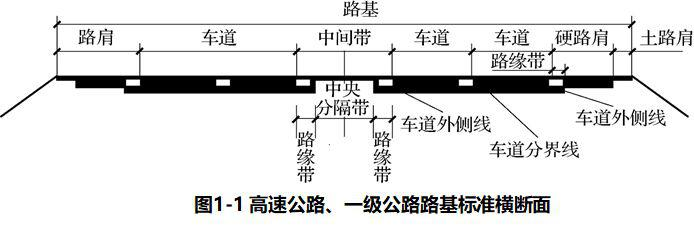
The base width of highways and level i roads is typically made up of lanes, intermediate belts and shoulders, as shown in figure 1-1。
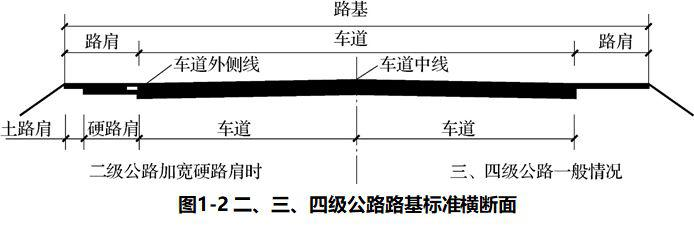
The base width of the second, third and fourth roads is typically made up of lanes and shoulders, as shown in figures 1-2。
[construction code] high-speed, primary road lime shall not be below level ii, secondary road lime shall not be below level iii, and lower secondary roads shall not be below level iii. At the grass-roots level of the high-speed, first-class roads, it is advisable to use the grinding of lime. When external lime is used on the lower secondary road, the effective calcium oxide content shall be above 20% and the mass strength of the mixture shall meet the requirements。
It's got enough load
Cars travelling on roads pass vertical, horizontal and car-generated vibrations and shocks to the surface through the wheel to generate stress, variability and shift within the surface structure. If the entire or part of the road structure is not strong enough or resistant to deformation, the road surface is affected by diseases such as fractures, sinking, waves or road tracks, which affect its normal use。
(b) [construction code] high-speed, first-stage road heavy, and over 4. 75 mm of crude aggregates at the level of heavy transport load should be based on single particle specifications。
In general, flexible materials (e. G., graded gravel, asphalt concrete) are used to express carrying capacity by bending and rigid materials (e. G., cement concrete), semi-rigid materials (e. G., inorganic composite stabilization material) are used to express carrying capacity。
[construction code] combination stalls should ensure sufficient thickness, which should not be less than 160 mm for each layer after crushing。
The test of the pressure material during the construction process shall be based on the maximum dry density determined by the results of the daily field sampling, and the daily sampling test shall conform to the following provisions:
The test for a shall be not less than three parallel tests, and the maximum dry density difference between them shall not be greater than 0. 02 g/cm3; otherwise, the test shall be retested and the average shall be taken as the test for the daily pressure。
This value for b should be analysed and processed in a timely manner when the maximum dry density margin of 0. 02g/cm3 is greater than that determined during the design phase。
There's enough stability
The stability of the surface structure means that the surface structure, acting by natural factors such as water and temperature, is better able to maintain the geometric and physical, mechanical properties required by its engineering design. The stability of surface structures includes, inter alia, overall stability, water stability, temperature stability (high or low temperature stability)。
Periodic changes in temperature have important implications for the stability of road structures. The softening of the asphalt surface during the high-temperature season will result in larger deformations with the impact of the load on the wheel. Cement concrete road panels are warp-deforming during high-temperature seasons and are prone to cracks or breakboards as a result of repeated effects from the load on wheels. In the cold and freezing seasons in the north, asphalt roads, concrete concrete roads and semi-coercive grass-roots areas produce large condensed cracks due to low temperatures。
Sufficient surface level
The surface flatness of the surface is an important utility that affects the safety, comfort and transport benefits of motor vehicles. The incomplete surface of the surface increases the resistance of the vehicle and creates additional vibrations for the vehicle. Such vibrations can cause vagaries and affect the speed and safety of the vehicle, the smoothness of the driving and the comfort of the passengers. In addition, the uneven terrain will stifling rain and speed up its destruction。
Good road-level integrity, guaranteed by good construction equipment, fine construction processes, strict construction quality control and regular and timely maintenance, and receiving and inspection at all structural levels of the road surface。
Have enough surface resistance
The surface is flat, but not smooth. Cars travel on smooth roads, lack of sufficient strength (reflective force) between wheels and roads, and in rainy days, when high-speed vehicles are brakeed or suddenly start, climb or turn, wheels are prone to empty turns or slips, resulting in reduced speed, increased fuel consumption and even traffic accidents。
The anti-sliding capacity of asphalt surfaces is usually achieved by hard, grinding, rough surface aggregates, while some technical measures (e. G. Slots) are applied to concrete concrete surfaces。
Enough durability
The surface structure, which is repeated by vehicle loads and cold-hot, dry-wet climatic factors, produces aging and decaying surface materials, which will gradually reduce the performance of the surface, thus gradually causing fatigue and plasticization to accumulate and reducing the life of the surface. Road structures must therefore have sufficient resistance to fatigue and to ageing and cumulative transformation to maintain or extend the life of the road。
In order to improve the durability of the surface, regular and timely maintenance, maintenance and restoration of road performance are also essential, in addition to careful design, selection of materials and fine construction。
It's as low as possible
The vacuum in the back of the car will draw small particles out of the road and cause dust to fly, causing loose, falling and pit damage. Dust on the roads can affect the distance and speed of travel, with adverse effects on environmental health along the routes. As a result, roadways are required to minimize dusting while travelling。
02
Road structure level
Road structures are usually layered, i. E. They are divided into several layers depending on the requirements of use, the stress profile, the earth-based support conditions and the degree of influence of natural factors。
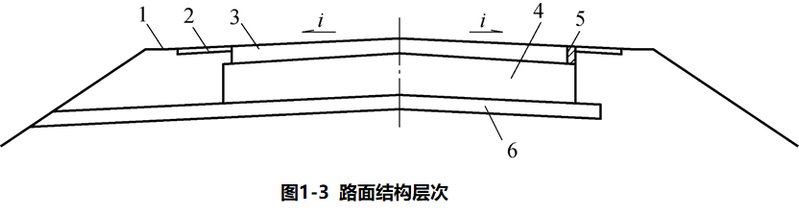
Depending on the function of each layer, the surface structure is generally divided into layers of surface, grass-roots, bottom and mattresses, as shown in figures 1-3。
Layer
The surface layer is a structural layer directly affected by the repeated effects of wheel loads and natural factors. It suffers from the vertical, horizontal and impact effects of larger car loads, as well as from rainfall erosion and temperature changes. Therefore, the surface should have a high structural strength, anti-conformity, better water stability and temperature stability, and should be resistant to grinding and impermeable; its surface should also have a good smoothness and integrity。
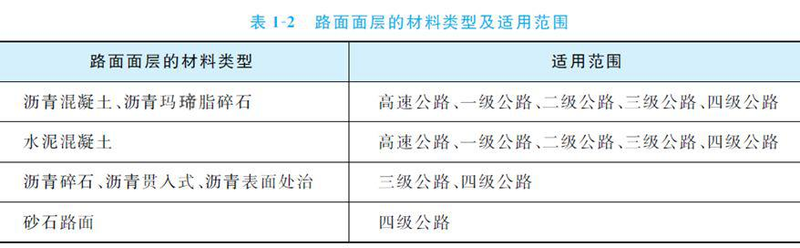
The material used for the construction of the layer consists mainly of concrete concrete, asphalt concrete, asphalty gravel, gravel mixed (or non-taneous) material, etc. The type and scope of application of the surface layer are shown in tables 1-2。
Base and bottom
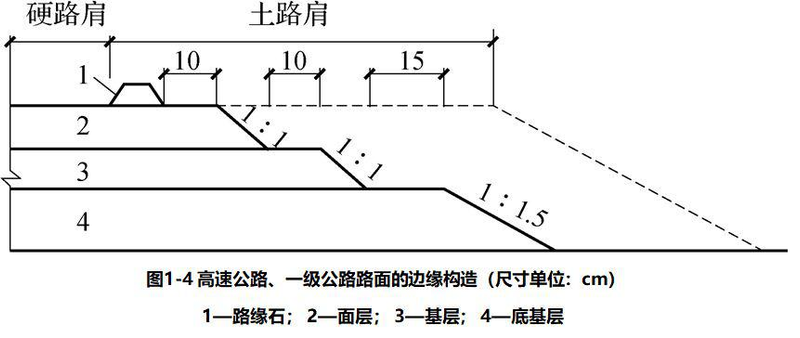
At the grass-roots level, the vertical capacity of the vehicle loads from the surface layer is borne and spreads to the gaskets and earth foundations below. When the floor is too thick, it can be constructed into two or three layers to ensure the quality of the project. When different materials are used to construct the grass roots, the lower layer is the bottom. When the bottom floor is double-layered, it can be referred to as the top-floor bottom-floor and bottom-floor, respectively。
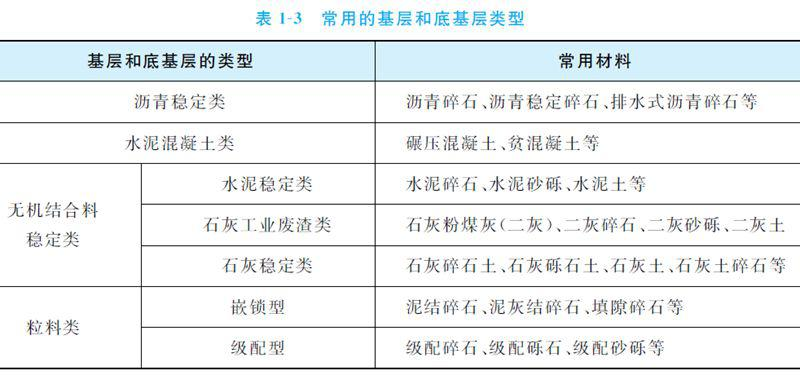
The material for the construction of the grass-roots and bottom-roots levels consists mainly of a combination of material (e. G. Lime, cement, asphalt, etc.) stable earth or stable debris (brush), poor cement concrete concrete, natural gravel, rubble, gravel, piece of rock, stone, industrial sludge (e. G., slag, ash, mine slag, lime slag, etc.) and a mixture of earth, sand and stone. The types of grass-roots and bottom-up that are commonly used are shown in tables 1-3。
[construction code] when used at the grass-roots level, the maximum particle size shall not be greater than 26. 5 mm for highways and level i roads, and at the level ii and below, at 31. 5 mm; at the base level, the maximum particle size shall not be greater than 37. 5 mm
At the grass-roots level, there are cracks in the breeding process, which, after bending tests, can continue to build the asphalted surfaces above when the capacity of the structural layers meets the design requirements, and can be addressed by the following measures:
1) sewing at crack position。
2) placing of a fibreglass grid in a crack position。
3) thermally modified asphalt。
The stitches are not, in principle, extended. The integrated treatment of glass fibre-breathing and thermally modified asphalt of the spill is currently the best measure to address the upward reflection of the cracks and is suitable for the more severe sections of the ground-level cracks。
The mat
The main role of the mat is to improve the humidity and temperature of the earth-based base in order to ensure that the strength, intensity and stability of the surface and grass-roots layers are not affected by changes in the temperature of the earth-based water conditions, and to spread the load capacity of vehicles from the grass-roots base in order to reduce the stress and deformation generated by the earth-based base, while also preventing the flow of road-based soil into the grass-roots level to affect the performance of the grass-roots structure。
Since the mats should have drainage, water insulation, anti-frozen, anti-fouling, etc., the intensity of the materials used to build the mats is not very high, but they require better water stability and insulation. There are two types of material commonly used in the mats。
Arc and arc slope
In order to ensure that rainfall on the roads can be released in a timely manner and to reduce the immersion and penetration of rainwater on the roads, thereby ensuring the structural strength of the roads, the surface of the roads should be shaped in a medium-high and low-side shape, known as the arches, as shown in figures 1-3. On the cross-section, road arches are often in the form of straight-line shapes ( straight-line lines) and straight-line parabolic combinations ( straight-blanket-line lines)。
Road drainage structure
The purpose of road drainage is to rapidly remove atmospheric precipitation from the surface of the road and to infiltrate water into the surface structure, to prevent damage (water damage) to the surface layer and to ensure the strength and stability of the surface structure。
Road drainage should be designed in accordance with such factors as road grade, precipitation, and route slopes, in conjunction with drainage of road-based and bridge-based structures, with a reasonable choice of drainage programmes, the installation of drainage facilities, the formation of a complete and accessible drainage system and the stability of the road-based and road-based systems. Road drainage includes surface drainage, central partition drainage and internal drainage。
The drainage of surface surfaces often takes the form of decentralized drainage and centralized drainage. Dispersed drainage consists of the protection of road slopes, shoulders and slopes, and is applied to road segments where the slopes are flat, where the amount of water is smaller and the length of the embankment is low. The concentrated drainage consists of road slopes, slabs or rectangles, vents and flash tanks and applies to the high height of the embankment or to the groundside of the embankment that is easily washed, to the base of the sandy dirt section and to the cone。
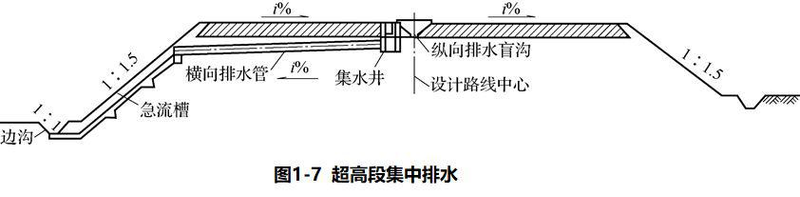
For concentrated drainage in the super-high segment of the new highway, it would be useful to have a pre-fabricated whole-size u-concrete grate or sewn-down drain, with reinforced concrete lids on the left side of the road edge, with a catchment well for each 25 to 50 m, and to be directed through a horizontal drainage pipe to an emergency stream or a dark tube on the slope, as shown in figures 1-7。
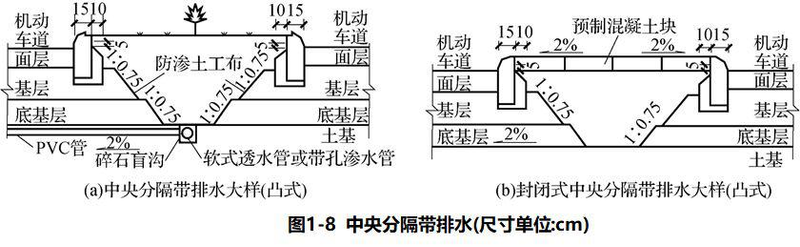
The drainage facilities in the central partitioning zone consist of drains (clutters, ditches), seeps, rainwater wells, catchment wells, horizontal drains, etc. Central partitions may be amplified (see figures 1-8), flat or dented, generally not closed, but also closed。
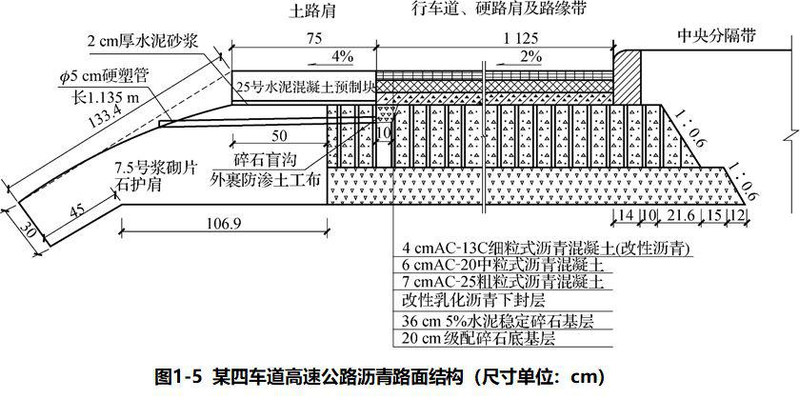
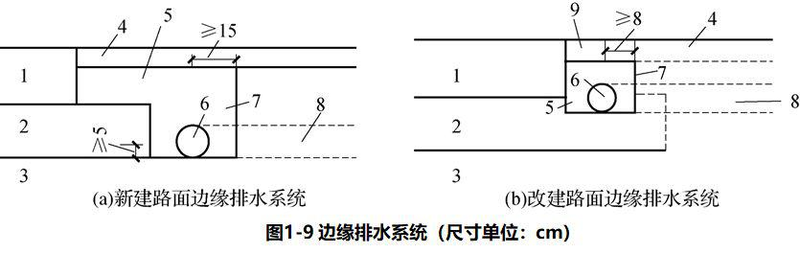
1) the drainage system on the edge of the road consists of vertical drainage pipes, horizontal discharge pipes, catchment ditches and anti-filtration fabrics, as shown in figures 1-9。
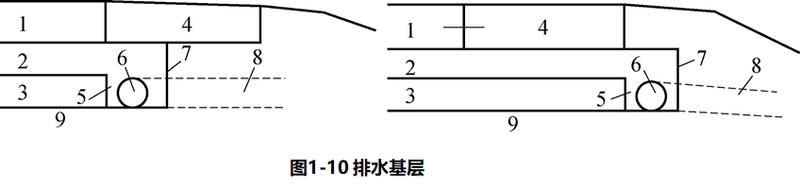
2) sewage base. When free water is likely to be found inside the road, the drainage base may be used for tarcrete or emptied concrete or classed gravel。
Vertical catchment ditches can be located on the outer side of the edge of the face layer, under or outside the edge of the shoulder, as shown in figure 1-10. Filling in catchment ditches should use the same permeable material as at the drainage base. The lower part of the ditch is equipped with a longitudinal drainage tube with a chute or a convection, with a horizontal discharge tube without a chute at an appropriate distance。
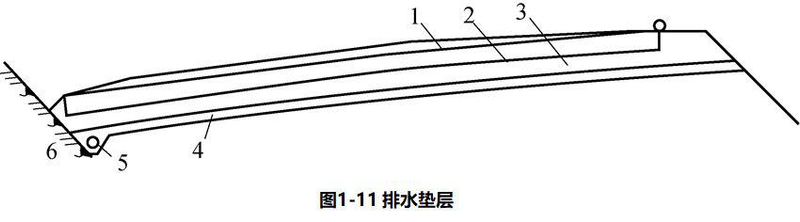
3) sewage mats. In order to intercept groundwater, demurrage or springs into surface structures, or to excrete free water that accumulates in the upper part of the road base as a result of negative temperature differentials, permeable drainage mats can be installed directly at the top of the road base, with the appropriate configuration of vertical catchment ditches, drainage pipes or discharge pipes, as shown in figure 1-11。
03
Levels and classifications of roads
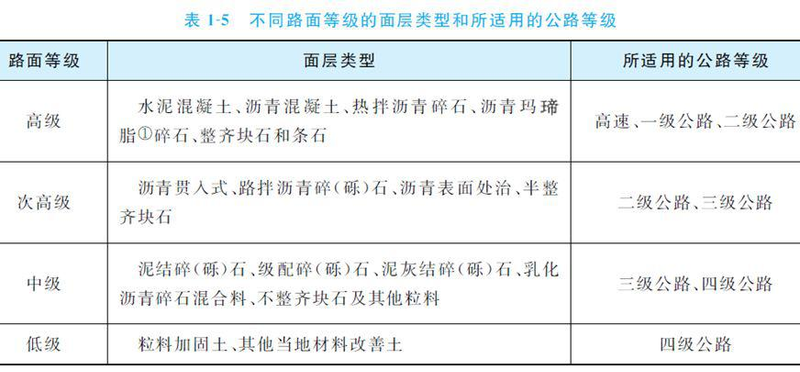
The level of surface is classified into upper, lower, intermediate and lower levels, and the types of layers of different classes and the applicable road levels are shown in tables 1-5。