The five platforms actually measure reports of "the more expensive" airline tickets, "the big data kill."
When is the cheapest ticket ever bought
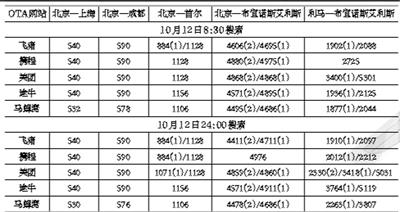
Price of tickets on ota website for the same period of time
Recently, a tweet by author wang xiaoshan, who suspected that he had been “hard of big data” on an internet booking site, was once again popular, despite the fact that the website had made it clear that many netizens were still dissatisfied with more volatile airline tickets, which had changed so quickly that it was not the airline that was messing with them? A short time ago, a tweet, “board tickets buy in the middle of the night, don't frenzy,” was transmitted to many online users for comment, and statements like “search a price increase once” and “seize a price drop in the middle of the night” triggered a discussion: when was the ticket price the lowest? Is there really a situation like “search more expensive” “big data killing”? In response, the beijing youth report financial laboratories conducted experiments。
Experiment
The internet is mostly incorrect
North qing newspaper journalists have chosen five of the country's main internet ticket purchase platforms, including flying pigs, escorts, troupes, hives, beehives, etc.; the location has been chosen to travel from beijing to two parts of the country — shanghai, chengdu, beijing to two places abroad — - air tickets for seoul and buenos aires, far from it, as described by the above-mentioned netizens, wang xiaoshan, “lima to buenos aires” and so on; the day of departure, for example, 10 november, one month after the time of the experiment; the duration of the experiment, mainly in the morning, afternoon and early morning of october 10; and the hours of 12, noon, evening and four hours of the morning。
The investigation found that the statements that tickets were cheap in the morning, cheap in the morning, cheaper in the early hours and more expensive in the search were not entirely correct。
Buy a plane ticket in the morning
Sometimes it's expensive
Experiments have shown that it is sometimes cheaper to buy tickets in the morning, but not for the most part; different platforms, different flights, are different and need to be discussed differently。
Of the five two-day platform experimented with north qing newspaper journalists, the u. S. S. Network's fare from beijing to chengdu was $650 per day at 24 o ' clock and $678 per day and the u. S. Group lima to buenos aires was the lowest in the morning, 5170 per day for direct flights and $5234 per morning and $1774 per morning for the same route, although the minimum price for two flights was $3446 and $3434 per afternoon。
The 10-day check by the mabee nest for beijing to chengdu costs $2 in the morning, from $692 to $690 in the morning, and the cheapest flight from beijing to buenos aires, from $4493 to $4605 in the morning and $452 in the afternoon。
But there are examples of early morning purchases that are expensive. For example, the 10-day check-up of tickets from beijing to chengdu was $709 in the morning, up from $695 in the morning and $696 in the afternoon; the minimum ticket price from beijing to buenos aires was also higher than that of $4880 in the afternoon and $4975 in the afternoon, at $4990; and the 12-day check-up of direct flights from lima to buenos aires was 5119, far higher than the price of direct flights at other points at $2125。
The word "search more expensive" is not valid
While more than 200 airline tickets were searched during the time of the north qing press survey, which was far higher than the number of enquiries made by ordinary passengers prior to the purchase of tickets, it was not observed that the notion of “searching more expensive” was not self-defeating in general as the number of searches increased significantly。
The increase in the price of airline tickets does occur mainly on international routes, such as beijing to buenos aires, where there are no direct flights, where passengers can choose to switch only once or twice, and where they can switch from dallas, new york and doha, where there are more options for doing so, and where the price of the flights varies significantly from one flight to another。
The minimum price for a pig to search for the route twice at noon on 12 december was $4411, which rose to $4606 at night, although the price of a plane to switch only once remained constant at $4695, and then dropped to $4411 at dawn; the price of a transport network to search for the route twice at noon on 12 december was $4817, rising late at $4944, and the price of a switch twice in the morning was higher than the rate of $4976 at once。
In contrast, the minimum prices for the 12-day morning voyage were $488 (twice) and $4975 (twice), which fell to $4817 (twice) and $4909 (twice) at noon when the search was repeated。
The sooner the ticket gets cheaper
Following an experiment with north qing newspaper journalists, it is not yet possible to find the cheapest point in time for the purchase of airline tickets, as the prices do not seem to follow a uniform pattern, with different platforms and routes。
The argument that air tickets are the cheapest in the morning has been refuted above, although there is also the argument that “the cheapest in the morning” is the one where some websites are said to be “freezing”. However, the morning price is not the lowest in the day, such as the 12th search for target day beijing-buenos aires, the price for flying pigs is $4606 in the morning, but for the rest of the time there are $4411 low fares; for the journey, there are 4880 in the morning, and for the rest, there will be 4817 in other tickets. Therefore, it is not absolutely true that tickets are cheapest in the morning。
Domestic airline fares are almost identical across platforms
In the experiment, north china newspaper journalists found that the prices of domestic flights were almost identical for all platforms, such as beijing-shanghai, which had remained at $540, that the prices of the platforms had been more consistent, that the beehive had sometimes given “tickets” and that the prices of the 10-dollar margin had been reduced, although the basic fares had been uniform. Prices from beijing to chengdu were also more consistent at 12 days of inquiry, stabilizing at $590。
In international short-distance routes, some platforms offer options for switching to more favourable prices, albeit with a considerable increase in time, with the lowest prices varying from one direct to another, but also in the range of several dozen dollars. For example, from beijing to seoul, the direct flight price for target days ranged from $116 to $1156。
Picture production/wing hui
Decrypt
Why is the price of tickets so different
In fact, as early as february 2016, the civil aviation authority issued a circular requiring that “sale agents shall not charge passengers any additional fees for services other than passenger fares” and that “the interests of consumers and air transport enterprises shall not be infringed by maliciously tampering with irregularities such as the published fares and applicable conditions, tied sales”. In other words, these ota websites, internet reservation platforms, etc., cannot sell airline tickets at a higher price, but only on the basis of airline fares。
So, how do these websites make money? One industry person admitted that the airline ticket business on the ota website or travel platform was “near profitable”, mainly “profit-making” and that the airline tickets brought them to the target users, who then sold them other higher commissions, thereby making a profit. However, proxy tickets are not entirely “free” and the division still pays fees for these websites, which, according to the civil aviation authority, are “payable at a flat rate per ticket”. That is to say, for each ticket sold, the money earned on the website is fixed and does not increase because of an increase in air tickets due to “big data cut-off” or other reasons。
So, why does everyone feel that fare prices have changed so much? This requires an understanding of how tickets are priced as they are seen on the website。
The sale price of airline tickets is a very complex pricing system, which is diverse and changes in real time. According to industry sources, air fares are in the hands of the airline, the full fare is subject to review by the price department, and air fares of various classes, i. E. Different discounts, are based on a combination of historical circumstances, market demand, capacity, etc., such as a golden week's hot-door route, with a minimum price price of about 60 per cent; however, the price is subject to real-time adjustments, such as poor sales of the six discounts, with fewer enquiries, and the airline will again release lower-price tickets, such as around 4 per cent, and continue to follow market conditions。
So the price we see when we buy tickets from the ota website is the real-time price of the airline. The answer is no. It was stated that air tickets issued by airlines would be integrated into the gds (global distribution system), and that there was currently only one gds “chinese shipping letter” in china, and that there were several gdss worldwide whose resources could be exchanged. And the price of these ota sites is “retarded” from gds. When consumers search for airline tickets, gds obtains an air ticket price at the site, and most importantly, when consumers determine that they will purchase a ticket under the ticket, the ota website will again confirm the latest fare with gds and return it to the consumer as the price actually paid。
Why do consumers sometimes search for airline tickets at different prices than when they are placed on the order? The key here is that ota needs to confirm air fare prices twice with the distribution system, and the time lag for updating them is that consumers see price changes. In one case, the untimely update of the airline on the gds resulted in a lack of conformity between consumer enquiries and the price at the time of purchase, and in another case, the late submission of the consumer's order, during which the coupon was sold or adjusted, leaving only higher-priced space. It was stated that prices were changing faster than the hottest routes and flights. There are, of course, cases where the price of a consumer's order is lower than the price of a search。
Following wang xiaoshan's complaint about higher prices with the flight itself, the flying pigs have also explained that flight price changes tend to be misunderstood by the general public as being sophisticated in terms of big data, and that in practice changes in flight prices are usually caused by two factors: first, by changes in shipping prices, and so-called price fluctuations resulting from changes in the division's seat inventory and shipping prices, regardless of the existence of search tickets in the network of aviation officials, platforms or agencies, which may be higher or lower. For international flights in particular, global passenger bookings and more frequent changes in accommodation and prices make it easier to change prices; second, as a result of the search cache, user refreshing usually eliminates the situation。
Views
The airline ticket's "big data scramble" has been rumoured
Dr. Liu shi-min, a researcher at the centre for cultural and creative industries studies at beijing foreign language university, stated that, with regard to the claim that large-scale data on airline tickets were familiar, the civil aviation authorities had previously made rumours and had themselves tested and found that they did not correspond to the facts. Reports from the civil aviation newspaper at that time indicated that global gds outages ranged from 80 per cent to 95 per cent and that there was a 10 per cent probability of volatility (including changes in prices, taxes and charges and accommodation), which was mainly caused by the problem of data delivery. One example is the low user success rate of the agents who found multiple offers on the platform in 2017 when they obtained a quote for a thai lion flight. At the most serious point, the route was one of less than 20 per cent success when the user of the platform offer was on the route, “we immediately reported the situation to the agent's preferred use of the gds, and found that the reason for this result was the problem of access to data transmission by the gds”
“why do consumers still want to believe this? The lack of integrity of some online traders may now affect consumer perceptions of the whole consumer environment and confront these rumours with a “better trust” attitude. As the whole society becomes more honest, so will the number of people who believe in these rumours.” according to liu, prices displayed on the ota website are generally search prices, not necessarily the same as real-time prices for distribution of gds, and prices seen by consumers may differ for reasons such as caches, which are due to technical problems and are not “big data cut” on the ota website。
“these gds messages are directed at the world, the number of low-priced tickets is limited and not long-term, and there is a possibility that by the time you put it on the list someone else had already placed the order and locked it up, the price you saw rose; but others might have failed to pay it, and the ticket came back later, and then you might have found the low-priced ticket after buying it.” he also states that “the fare agency, commission, etc. Are in the hands of the division, and that it is not for you to sell a ticket that you can earn the difference”
Financial observation
Why would you believe that the ota website is a big data kill
The term “big data cut” entered the public view early this year, referring to a differentiated pricing model for the internet industry. For the same goods or services, older users see prices that are much more expensive than new users, and internet companies use “big data” to kill acquaintances. Many netizens have heard the word, and seem to have found answers to price questions, citing examples of cases in which they were killed by big data。
However, the ota website's air ticket, which is now proving to be a rumour, has been rumoured by the civil aviation sector, and has repeatedly been explained by experts and the ota side as to why air fare prices fluctuate and the ota website, which charges a flat fee for each ticket, has no reason to raise the fare to the detriment of others. But internet users seem to be difficult to convince, many prefer to be credible, and each time such a topic comes out, it causes a great deal of attention and discussion, and even the ota website is a little overstretched。
So why would everyone want to be credible? According to north qing newspaper journalists, the price of a plane ticket is indeed “unsettled” and the internet has no sense of how much it should be”. Interviewers in north china have learned that the prices of airline tickets vary from one platform to another, from time to time to flight, that airlines have the right to adjust their prices and numbers at any time in response to market changes, that more people buy low tickets, that they raise the price, that no one asks for higher tickets, and that the price of tickets may be significantly different from that of two people in the flight's neighbourhood。
Second, because of the various “precedents” of internet companies, many netizens are sceptical about the integrity of internet companies and are reluctant to trust them. Whether it is the price of the ota website, or the “set” or the fake goods of the electrician website, or the “price rise and fall” at the time of the event, it reduces the credit score of internet companies to consumers. In short, consumers are scared and think internet companies have too many cats to fuck。
Thirdly, the misuse of big data by internet companies is widespread. There is no big data complication in the ota area and no similar problem in other areas. As previously described by leading data experts, the use of big data differential pricing is real, for example, when some electrician websites issue large coupons to new users, while older users do not see the benefits, and some operators launch packages for new users, with no choice。
How are these issues resolved? Experts expressed the view that there was a need not only for society as a whole to create a climate of good faith, but also for self-regulation by internet enterprises, as well as for strong regulation of enterprises by regulatory authorities to prevent situations that were detrimental to consumer interests. All of this is not a day's work, and it takes time to sharpen and constantly modify the image of internet enterprises in the consumer's mind。
This edition