New things were born out of the combination and variation of old systems, the critical hub function of the general component (gpt) and the inevitable trend of increasing efficiency and individualization from the production to the application end。
With this, we can refine this process into a three-stage theoretical model that is more interpretative: knowledge reorganization paradigm solidification, ecological emergence。
A three-stage model: the “growth algorithm” of a new technology system
Phase i: “knowledge decomposition and creative reorganization” under the old paradigm
This is the “conception” moment for new productivity. It occurs within the old system, but is usually at the edge or where it is inefficient。
• process: the old system, in addressing its own problems, produced a large amount of modular knowledge, tools and components (e. G. Medieval water truck mechanics, eighteenth century metallurgical technology, twentieth century semiconductor physics). Some explorers (e. G. The authors of the watt, tesla and transformer papers) reorganized these seemingly unrelated modules with new purposes and structures。
• key: reorganization is not random, but revolves around a new core principle (e. G. Conversion of thermal energy to mechanical energy, generation of electricity by electromagnetic sensory, understanding of context with attention mechanisms). The innovation at this time is essentially “to use old lego to spell out new drawings”。
Phase ii: validation of key generic components as "new paradigm operating systems"
That's what you're talking about. They are critical because they consolidate the results of the first phase of reorganization into a stable, reliable and widely accessible “interface” or “power source”。
• impact: they do not directly produce end value per se, but they are “operating systems” or “standard power sources” for new productivity. The steam engine provides a standardized power unit, electric motors achieve precision transmission and control of power, and the ai large model provides “standardized cognitive and generating capacity”。
• meaning: the birth of these universal components marks the completion of the “0 to 1” test of the new technological paradigm and the preparation of the proliferation from 1 to n. They define the “grammatics” of the new era。
Phase iii: indexation and personalization of applied ecology
Once the “operating system” is in place, the real revolution erupts on the application level. This is the process by which the old system was fully reconstituted and the new system was established。
• mechanisms: developers, entrepreneurs, users based on this new and powerful “common interface” to solve tens of millions of specific problems of the old system with extremely low marginal costs and high levels of creativity. Textile machines, cars, and programming tools (such as github copilot) have emerged as a result。
Outcome: this leads to an exponential increase in production efficiency (because generic components solve the lowest common denominator) and to the extreme personalization of the product (because the application layer can focus on scenes and experiences and the bottom complexity is sealed). Ultimately, the production, organization, lifestyle (production relations) of society as a whole has been reshaped to adapt and maximize this new productivity。
Ii. Historical evidence: from steam to intelligence
The revolution, the knowledge modules of the old system, the key generic components (the new operating system), the application of eco-creasing relationships with production
Industrial revolution metallurgy, mechanical clocks, coal mining, steam engine (standardized power source) plant replacement workshop, railway restructuring of geography and markets, birth of the urban proletarian class, establishment of capitalist production relationships。
Electrical revolution electromagnetics, mechanical engineering, chemical power motion/network (precision, transferable power) fluctuation line production (fort), domestic electricity diffusion, urban lighting and elevator-driven skyscrapers, management science (for taylor)。
The information revolution mathematical logic, semiconductor physics, communication theory microprocessor/internet protocol (standardized information processing and transmission) pc, software industry, globalizing supply chain, platform economy, and the rise of the intellectuals class。
Intelligent revolution (ongoing) big data, parallel calculator, in-depth learning almage large model (standardized cognitive and generating capacity) productive relationships are being explored: new social contracts, such as association organizations, distribution of data and intellectual property rights, and basic income for all (ubi)。
Insights from the current “smart” phase
Your framework precisely points out the coordinates of our current history:
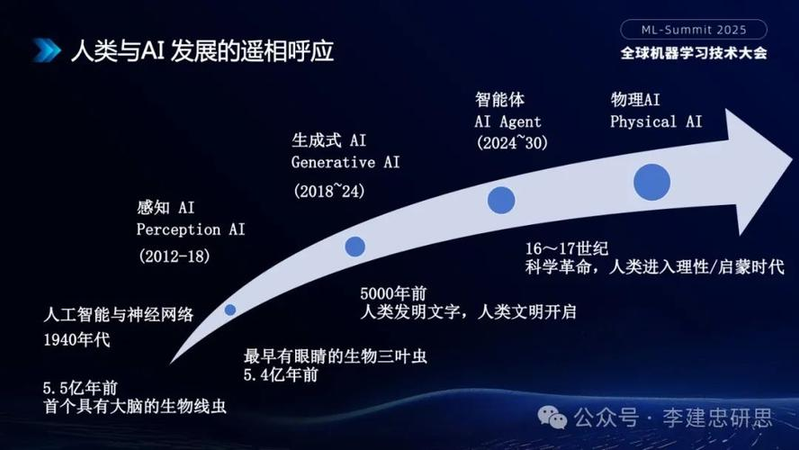
We are at the critical nodes of the second phase of the transition to the third phase: the “cognitive power source”, represented by large models such as gpt, has been largely solidified and is waiting for its “grids” (cheap and adequate smart computing networks) and “application appliances” (killer-level applications) to explode。
The paradox of efficiency and individualization is being addressed: the industrial age is “efficient but standardized” and the information age is “personalized but dependent on human resources”. For the first time, the intelligent age may be able to achieve efficient and highly personalized harmonization through a combination of “standardized intelligence plus personalized scenarios”. Ai can generate customized products, services or content in real time based on individual data and preferences。
The greatest challenge lies in the suitability of productive relationships: old production relationships (employability based on the industrial age, platform based on the information age) are facing enormous difficulties in managing highly personalized values created by “standardized intelligence”. How to measure, distribute and stimulate the contribution of “people” in this new paradigm (e. G., providing high-quality data, making key decisions, giving meaning) is fundamental to building sustainable new systems。
Conclusion: the technological evolution of civilization follows a near-calculable path: deconstructing old knowledge, re-constructing the new inner core, solidified into a universal platform, detonating the application of eco-reforming social rules. We stand at the beginning of the “activation application ecology”, holding the most powerful universal tool in history (ai)。