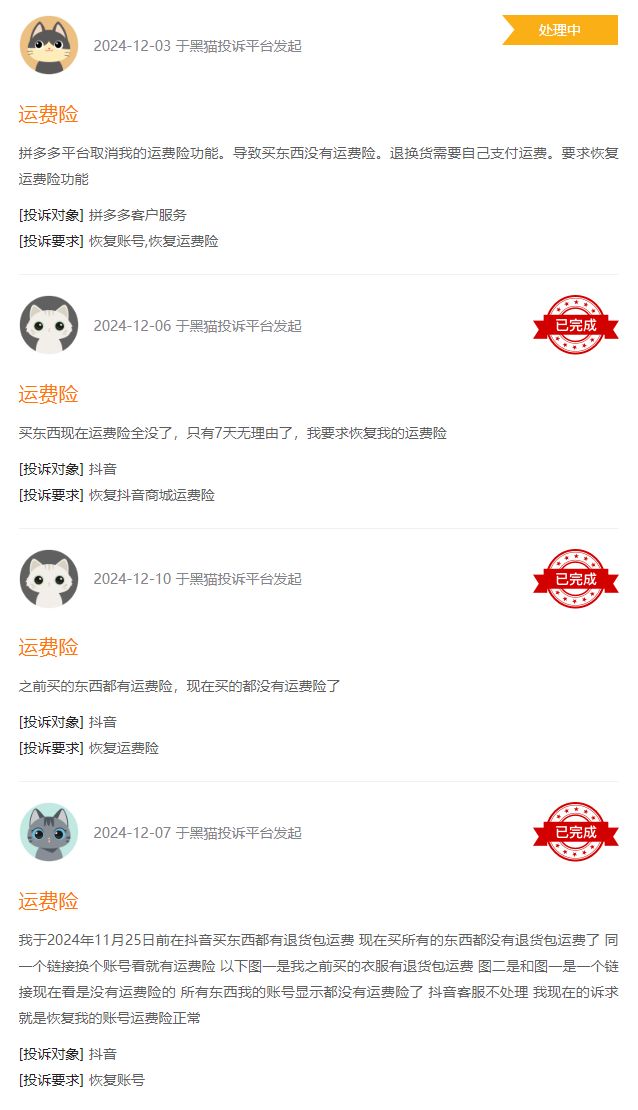
A search by journalists on the black cat complaints platform found that there had been an increasing number of recent consumer complaints about the mandatory closure of freight insurance. Many consumers have stated that freight insurance is already a “speculation” for their own network, and that it is suddenly not adapted. “this time, the thick coat i bought was inappropriate, and it was only when the goods were returned that the freight had to be paid for itself because the clothes were too heavy and the freight costs were more than thirty different”. Ms. Zhang, the buyer, was moved to say that freight insurance did provide additional security for purchases。
Ms. Hu believed that online shopping was necessary and was one of the key factors in her decision to purchase commodities. “if i buy clothes and shoes, i only buy goods that are freight-risk. Now there are many, if not all, of these kinds of online shopping, and there's nothing good or bad about it. In the event that it is not appropriate to return the goods for exchange, freight risk may free the shopping from fear.” ms. Hu said that there were particularly many instances of non-conforming, coloured and unscaled purchases on the internet, and that the cost of refunding goods had a significant impact on the experience of shopping without freight insurance。
Jin
Buyers can't get enough money back
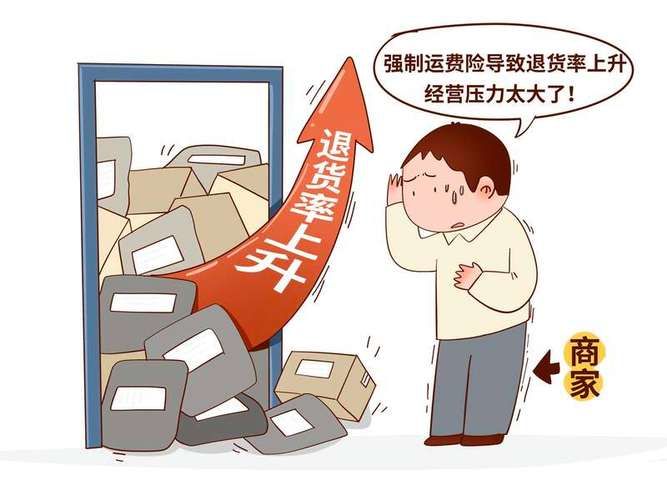
Why would some merchants prefer to “offend” consumers and close freight insurance? A number of businesses indicated that their freight, packaging and freight insurance costs were increasing year by year as a result of the “free return” of freight insurance。
“there are too many refunds and freight and insurance costs are constantly rising. The higher the settlement rate, the higher the premium our shop will bear.” ms. Chen, the treasure shopkeeper who runs women's clothing, said that she had to close “freight insurance” after the second eleventh of the year. After closing, there were fewer disputes and the refund rate declined, “it was a real saving”
“the cost of freight insurance is higher than the cost of freight and the return rate is not profitable.” one of the women shopkeepers stated that she had passed a freight insurance policy for her participation in the platform's activities and had subsequently closed it because the platform had made her vulnerable to the buyer's “underline tolerance”. For example, after receiving the goods, some buyers came a few days later to apply for an unjustified return, after being rejected by the shop, wondering how the buyer communicated with the platform's passenger uniforms, the buyer changed the reason for the return to a quality problem, the platform immediately passed a return request and the shipping costs were paid by the vendor, making her feel miserable and less afraid to open a freight risk. “in addition to the high cost of closing freight insurance, there is also the hope that the buyer will consider carefully and then issue a bill to avoid a similar unjustified return. Our shop is small, our supply capacity is limited, and we prefer to sell our clothes to people who really need them, rather than just to try”
“the rate of return of women's clothing is high per se, with an average return rate of around 30 per cent. With freight insurance, the rate of return increased to 50 per cent at a time, and the rate of return for individual models even exceeded two thirds of the orders.” one of the shop owners of fashionable clothing revealed that this year, at the double-eleventh, the platform offered 1111 free freight charges to the shop in order to encourage businesses to take part in its activities, but after accepting it, she found a sharp increase in the return rate. “twenty-two, and then i said i'd given freight insurance, and i didn't open it, and i lost my money.”
Many vendors believe that the costs incurred by consumers as a result of the refunds should not be borne by sellers alone. “this is like in the age when, in the absence of a net purchase, you bought clothes at a real store and came home to find it inappropriate to re-offer。
Solve
The buyers and sellers need to find a balance
It is understood that freight insurance is in fact a freight insurance policy that is divided into two categories: buyers and sellers, and, depending on the distance of delivery and the weight of the goods, freight insurance generally ranges between $10 and $25, and will automatically lapse upon successful transactions。
Almost all of the buyers interviewed believed that freight insurance should be provided by the merchants. But ms. Lee, as a consumer, also expressed her concern: “although i believe that the merchant should pay for the freight insurance, it is likely that `shell will come out on the sheep' and that the cost of the freight insurance will ultimately be factored into the cost of the commodity, ostensibly borne by the merchants and actually by all the buyers together.” ms. Lee felt that freight insurance was necessary, but that a more balanced approach should be found between merchants, platforms and consumers. “in my view, insurance is the purchase of greater security with small sums, which is what freight risk means. There was a time when, on a shopping platform, additional freight insurance could be purchased at a cost of $34,000 on the page, and the first weight could be waived if the switch occurred. Now i think that's a good way to do that, so that freight insurance is transparent and self-selected.”
In recent years, electric power platforms have also been working to address the problem of the consumption of net buy-back freight charges. In september this year, poaching announced that it would be open to all poaching cats. Data from the treasure survey show that “repatriated treasures” are expected to reduce the return freight cost by $2 billion for businesses throughout the year. In contrast to the current return fee for the merchant, ordering the return price would reduce the return cost by 10-30 per cent。
This year, ms. Wang spent 88 dollars on the treasure-hunting platform, and “up to 25 dollars per credit” “platform subsidizes the return package service” “infinitely available” so that ms. Wang would no longer have any concerns about online purchases. This year, ms. Wang bought three pairs of pants of different sizes and colours in a shop, leaving only one item of her heart. “not only is there nothing to worry about, but more can be tried through internet purchases, and i am satisfied.” to date, ms. Wang has received 10 subsidies totalling $86. 1。
During this year's two-hundredth anniversary period, kyoto also fully upgraded its commercial freight insurance policy, with its upgraded “free-in-home” service, which has resulted in an overall reduction in the price of freight insurance, which is seen as a fine balance between user experience and business interests. In addition, traditional freight insurance covers only the top priority, and consumers bear a high return cost for orders containing large weights or multiple items. To address this pain, kyoto has introduced policies of “over-one-sum” and “renewal of claims”, which both optimize consumer shopping experiences and effectively ease the burden on businesses after sale。
Consumers should be rational about shopping
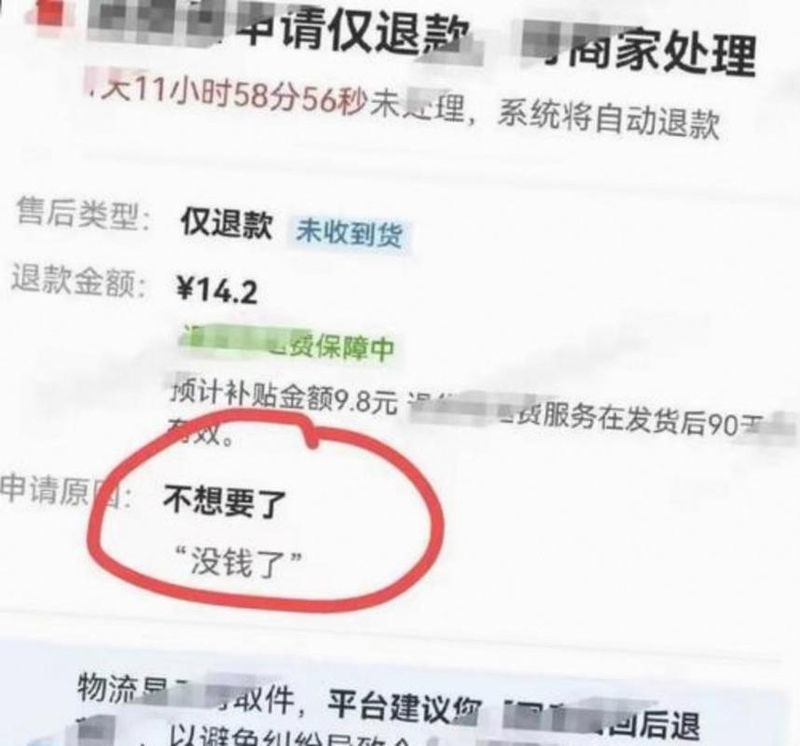
According to peng yan jun of changhong law office in beijing, freight insurance was originally intended to serve the purpose of upgrading orders by lowering the consumer return threshold through insurance products. However, in the face of irrational consumers with a higher frequency of refunds, it is difficult for businesses not only to meet the objective of upgrading orders but also to increase the cost of premiums. If there is no cost to a malicious return, it actually encourages a malicious return, such as the “show-backing group return” that occurred recently. As a result, merchants have been ostracizing freight insurance, a change that reflects, to some extent, their mistrust of consumers. This phenomenon is also a reflection of the weak oversight of the platform, which should strengthen controls over unusual accounts for multiple returns, such as the detection of malicious returns, with certain checks and penalties。
In recent years, there has been a proliferation of news stories such as “men owns their own shop and buys their own freight insurance”. The peng ying army has analysed that fraudulent freight insurance may involve multiple offences such as theft, fraud and insurance fraud. In any case, it is punishable by law. The peng yan jun suggested that electrician platforms and insurance companies should overhaul existing freight risk policies and fill possible gaps, in particular by improving their ability and technical means to detect fraudulent transactions。
Refusal of freight charges, which are the protection of the electrician after sale, is now the focus of the controversy, as it is intended to bring the business and the consumer to win. In his view, the platform could reduce the burden on businesses by introducing large data analysis techniques, introducing smart wind control, real-time monitoring and early warning of malicious purchases and refunds, by optimizing rules and enhancing regulation; by improving vigilance and prevention, by regularly analysing and assessing the data on refunds, in particular the timely reporting of unusual refunds to the platform and insurance companies; and by making rational purchases and reducing arbitrary returns. Only then can freight risk remain healthy。