I. Composition and classification of substances
1. Microforms of substances
The substance consists of molecules, atoms, ion. The molecules are the smallest particles that maintain the chemical nature of the substance, and the atoms are the smallest particles in chemical change; the atoms consist of the atomic core (protons, neutrons) and extranuclear electrons, with the protons equal to the extranuclear electrons, so the atoms are electroneutral. The ion is divided into anthon (loss of electron, positive charge) and anion (access to electron, negative charge)。
The element is the sum of one class of atoms with the same proton number (i. E. Nuclear charge number), and the type of element is determined by the proton number. Element symbols can represent both an element and an atom of the element, and some element symbols can also represent the corresponding individual mass, such as fe, c。
Macroclassification of substances
The substance is divided into pure substances and mixtures consisting of one substance and a mixture of two or more substances. Pure matter is divided into monoliths and compounds, which are pure things consisting of the same elements, and pure things consisting of different elements。
Oxygen is a compound consisting of two elements, one of which is an oxygen element; acids, alkalis and salts are important categories of compounds, and acids are released from hydrogen ion and acid root ion in aqueous solutions, alkalis from metal ion (or ammonium ion) and hydrooxy root ion, and salt from metal ion (or ammonium ion) and acid root ion。
Ii. Chemical terminology
1. Element symbols
The writing rule is “one or two”, such as h, cu, mg. The name and symbol of the first 20 elements are the basis。
Chemical formula
An elemental symbol and a number shall represent the form of the substance, and shall be written in accordance with the combination price rule: the algebraic of the elements in the compound at a positive or negative rate and zero. The chemical form of the monotonous is relatively simple. Metals, solid non-metals (other than iodine) and rare gases are expressed directly in elemental symbols, and gaseous non-metallic monotonouss are typically added to the lower right corner of the elemental symbol, such as oxygen (o2), nitrogen (n2), sulphuric acid (h2so4), ethanol (c2h5ah)..。
3. Chemical equations
The chemical expression of the chemical reaction is based on two principles: one is based on objective facts and the other is compliance with constant laws of quality. The writing step is "writing, making, labelling, noting" that is, writing the chemical formula of the reaction and the product, the formula of the equation of the equation, indicating the conditions of reaction, and indicating the state of the generator (gas using "pollium" and sedimenting with "pollium"。
Example: calcium carbonate reacts with rare hydrochloric acid (laboratory carbon dioxide) to produce calcium chloride, water, carbon dioxide
Caco3+2hcl═cacl2+h2o+co2↑
Example: reaction of copper sulphate solution and sodium hydroxide solution
2 naoh+cuso4═na2so4+cu(oh)2↓
At the heart of the constant law of quality is that before and after the chemical reaction, atoms of all kinds, numbers and mass remain the same, so that the overall mass of the substance before and after the reaction remains the same。
Iii. Air and oxygen
1. Air composition
Air is a mixture, with about 78 per cent nitrogen, 21 per cent oxygen, 0. 94 per cent rare gases, 0. 03 per cent carbon dioxide and 0. 03 per cent other gases and impurities, in volume fractions。
2. Nature and extraction of oxygen
Oxygen is a colourless and odourless gas, which is slightly more dense than air and is not soluble in water; it is flammable and supports combustion, such as charcoal, sulphur and wire, which can burn in oxygen and which requires the pre-positioning of a layer of sand or a small amount of water at the base of the aggregate cylinder to prevent high-temperature melted fracking。
There are three methods of laboratory oxygen production: potassium permanganate heated, potassium permanganate heated and manganese dioxide mixtures, hydrogen peroxide decomposition with the catalytic effect of manganese dioxide; collection methods may choose either drainage (using oxygen that is not soluble in water) or up-air (using oxygen density over air)。
3. Air pollution objects
Major pollutants include harmful gases (sulphur dioxide, nitrogen dioxide, carbon monoxide, etc.) and inhalable particulate matter, which can cause environmental problems such as acid rain, haze, etc。
Iv. Water and hydrogen
1. Composition of water
The electrolytic water experiment demonstrated that the water consists of hydrogen and oxygen elements, with a positive oxygen generation at the polar level, a negative hydrogen production at a volume ratio of 2:1。
2. Water purification
Common methods of depuration include deposition, filtering, adsorption, distillation, with the highest degree of distillation. The glass instrument that is required for filtering operations is a boiler, glass bar, funnel, which acts as a diversion; activated carbon is adsorbing, capable of adsorbing pigments and aerobics in water。
Hard water is water that contains more soluble calcium and magnesium compounds, but soft water contains less or does not contain them. Soap water can be used to distinguish between hard water and soft water. Foams are produced by soft water and less by hard water; life reduces the hardness of water by cooking。
3. Nature of hydrogen
Hydrogen is a colourless, odourless gas with a smaller density than the air and is insoluble in water; it is flammable, produces light blue flames during combustion, releases large amounts of heat, and must be pure before it is lit to prevent explosion。
V. Carbon and carbon oxides
Carbon monomas
Common carbon monoliths include diamonds, graphite, and c60, which vary widely in physical properties due to different atoms of carbon. The roughness of diamonds is large and can be used to cut glass; graphite is conductive and lubricant and can be used to make electrodes, pencil cores; activated carbon is adsorbed and can be used for water purification and gas masks。
The chemical properties of carbon include flammability and remission, carbon combustion when oxygen is sufficient to generate carbon dioxide, carbon monoxide when oxygen is insufficient, and carbon reduction of metal oxides such as copper oxide and iron oxide。
The nature and capture of carbon dioxide
Co2 is a colourless and odourless gas, which is more dense than air and soluble in water; it cannot and does not support combustion; it produces carbon acids that react with water, which makes it clear that lime water is so obscurous that it can be used to test co2。
Laboratory co2-producing drugs are marble (or limestone) and rare hydrochloric acid, which are collected by cutting air upwards, full by placing the burning wood in the mouth of the gas cylinder, and full by slinging it out。
Nature of carbon monoxide
Carbon monoxide is a colourless and odourless gas with a slightly smaller density than the air and is insoluble in water; it is flammable, generating blue flames and generating carbon dioxide during combustion; it is reductive and capable of reducing metal oxides; and it is toxic, combined with haemoglobins in human blood, which causes oxygen deficiency in humans。
Vi. Metals and metal materials
1. Physical properties of metals
Most metals have metallic photology, conductivity, conductivity and persistence, and metals are solids except for mercury at constant temperatures。
Chemical properties of metals
Metals react with oxygen, such as iron burning in oxygen to produce tritium oxide, and aluminium in air to form a layer of dense aluminium oxide thin membrane that prevents further oxidation of internal aluminium; metals react with rare acids (fresh hydrochloric acid, rare sulphate) to produce salt and hydrogen, and metals that flow in front of hydrogen in the sequence of metallic activity can only react with rare acid; metals react with some salt solutions, and metals that rank in front can be replaced by metals that rank behind with their salt solution。
3. Order of metal activity
The activity order of common metals is k, ca, na, mg, al, zn, fe, sn, pb, h, cu, hg, ag, pt, au. This sequence can be used to determine whether metals react with acid, metals and salt solutions。
4. Corrosion and protection of metals
The conditions for iron rust are that iron is in contact with oxygen and water at the same time, and iron rust is prevented by keeping the surface of iron products clean and dry, oil coating, spray paint, coating of a layer of metal, alloying, etc。
Vii. Solvent
1. Composition of the solution
Solvents are uniform and stable mixtures consisting of solvents and solvents, which can be solids, liquids or gases, which are usually water。
Dissolving degrees
Solid solubility is the quality of a solid substance dissolved when saturated in a 100g solvent at a given temperature, which is influenced mainly by temperature, with most solids increasing with temperature, and with a few solids (e. G. Calcium hydroxide) decreasing with temperature。
Gas solubility decreases with higher temperatures and increases with pressure。
Solvent mass fractions
The solute mass score is the ratio of the solute quality to the solute quality, calculated as: the solute mass score = 100% solute quality / solute mass x. Formulate a solution with a certain solubility mass fraction, which is labelled as calculated, measured (or taken), dissolved, bottled。
Viii. Acid, alkaline, salt
1. Passivity of acids
The 1-acrylic acid can make the purple prism test red and not the non-colour phenol test test coloured
2. Be able to react to live metals to produce salt and hydrogen
Example: 2hcl+mgcl2+h2
Be able to react to metal oxides to produce salt and water
Example: cuo+2hcl═cucl2+h2o
4 is capable of producing salt and water in a neutral and reactive manner with alkali
Example: naoh+hcl═nacl+h2o
5 can react with certain salts to produce new acids and new salts。
Example 2kno3+(heavy) h2so4=2hno3+k2so4
Common acids are hydrochloric acids, sulphuric acids, sulfuric acids that are hydrophobic, dehydrated and corrosive, and diluting sulfuric acids, are slowly injected into water along the walls of the sulfuric acid and are constantly mixed and cannot be poured into the sulfuric acids。
2. Generality of the base
1-alkali can make purple prisms blue and non-colour phenols red
2. Be able to react with non-metal oxides to produce salt and water
Example: 2 naoh+co2═na2co3+h2o
3 be able to produce salt and water in-situ with acid and react
Example: 2 naoh+h2so4 ═na2so4+2h2o
It reacts with certain salts to produce new alkalin and salt。
Na2co3+ca(oh)2═2naoh+caco3↓
The common alkalis are sodium hydroxide (naoh), calcium hydroxide (ca(oh)2), sodium hydroxide solids that are hydrogenic and highly corrosive, commonly referred to as alkali, pyroline, caustic sodium; calcium hydroxide, commonly known as corroded lime, and lime, can be produced by lime and water reactions。
3. Moderate response
The response of acid and alkaline activities to produce salt and water is called neutral reaction。
Example:
Response substance: h+ + oh-= h2o
The reaction is heated and is widely applied in practice, such as the improvement of acid soil, treatment of plant wastewater and treatment of excess stomach acid。
Nature of salt
1 salt reacts to certain metals to produce new salt and metals
Example: cuso4 + fe ═ feso4 + cu
2 capable of generating new acids and new salts with acid reactions
Example 2kno3+(heavy) h2so4=2hno3+k2so4
Be able to react with alkaline to generate new alkyl and salt
Na2co3+ca(oh)2═2naoh+caco3↓
Two new salts can be produced in reaction to certain salts。
Example: na2co3+cacl2═caco3↓2ncl
Common salts are sodium chlorinated (nacl), sodium carbonate (na2co3), calcium carbonate (caco3), sodium chloride is the main ingredient of salt, and sodium carbonate is commonly known as pure alkalin, soda and calcium carbonate is the main ingredient of marble and limestone。
Ix. Chemistry and life
Nutrition
The six major nutrients required for the human body are proteins, sugars, greases, vitamins, inorganic salt and water, in which protein is the basic substance that makes up the cell and sugar is the main source of energy for the human body。
Chemical elements and human health
The higher concentrations of elements in the human body are o, c, h, n, etc., and trace elements are fe, zn, se, i, etc., iron deficiency causes anaemia, iodine deficiency causes thyroid swelling and calcium deficiency causes osteoporosis or osteoporosis。
3. Organic synthetic materials
Organic synthetic materials, including plastics, synthetic fibres and synthetic rubber, are used to facilitate human lives, but they also bring about environmental problems such as white pollution, which is addressed through reduced use, reuse, recycling and development of degradable plastics。
X. Chemical laboratory foundations
Use of common instruments
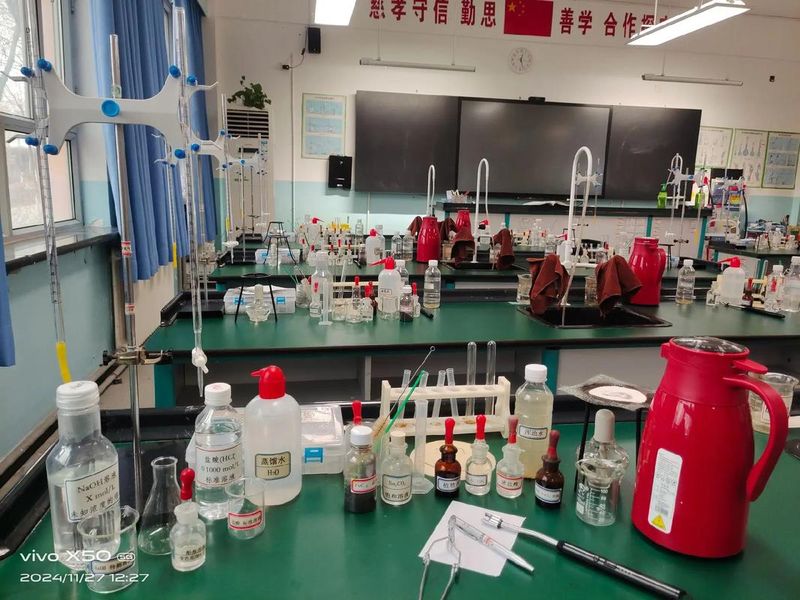
Test tubes, cups, alcohol lamps, quantum cylinders, tray scales, glass bars, etc. Are common chemical instruments, which are used in a manner that is sensitive to the scale of the instrument and to the taboos of use, such as the fact that the cylinder cannot be used for heating, and the "right size of the left" of the pallet scale。
Basic experimental operations
Access to medicines follows the “three nos” principle: no hands can be used to access medicines, no nostrils can be held in the container to smell them, and no drugs can be tasted; when heating liquids in a test tube, the volume of the liquid cannot exceed one third of the volume of the test tube, and the test vent cannot be directed to humans; the method of checking the air-conservation of the device is to immerse the end of the tube in the water, hold the outer wall of the container with the hand, and if the catheter has a bubble, the device is well air-constructed。
3. Inspection and identification of common gases
Oxygen is tested on wood bars with mars, and re-flaring on wood strips is oxygen; carbon dioxide is tested on graphite water, which is clarified, and lime water is turned into carbon dioxide; hydrogen gas, carbon monoxide and methane are identified, which can be distinguished by testing their combustion generation。