On 17 may 2012, google officially introduced the knowledge graph concept, which was originally intended to optimize the results of the return of the search engine and enhance the quality and experience of the search by users。
In fact, knowledge mapping is not an entirely new concept, and as early as 2006, the concept of semantic network was introduced in the literature, calling for the promotion and refinement of the use of home-based models for the formalization of implicit expressions of data, rdf (resource des)Cription fRamework, resource description framework) model and owl (web o)Ntology language, web-based language) is based on the above. In the original paper of professor xu jinlin of the university of electronic technology:
The emergence of knowledge mapping techniques is based on the above-mentioned research and represents an abandonment and upgrading of semantic standards and technologies。
Currently, as the application of intelligent information services continues to evolve, knowledge mapping has been widely applied in areas such as intelligence search, smart questions and answers, and individualized recommendations。
Definitions
Knowledge mapping is essentially a semantic network that reveals relationships between entities。
Look at a simple picture of knowledge:
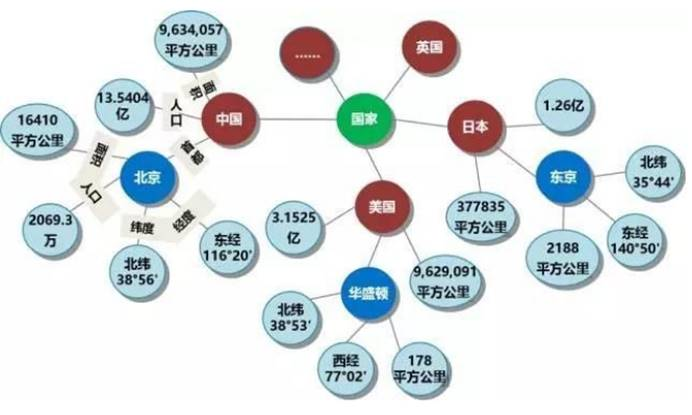
As the figure shows, if there is a relationship between the two nodes, they are linked together by one side, and then this node is called the entity, the side between them is called the relationship。
If you've seen the online choreography queue no. 17, season 5: are you supporting a second of knowledge sharing for all of humanity, you may be impressed by the debate of the dialectics. He distinguished between two concepts of information and knowledge in the programme:
Information refers to objective external facts. For example, there's a bottle of water, and it's now seven degrees。
Knowledge is a summary and summary of external objective patterns. For example, water freezes at zero degrees。
“summary and summary of objective patterns” seems somewhat difficult to achieve. There is another classic interpretation in quara that distinguishes between “information” and “knowledge”。
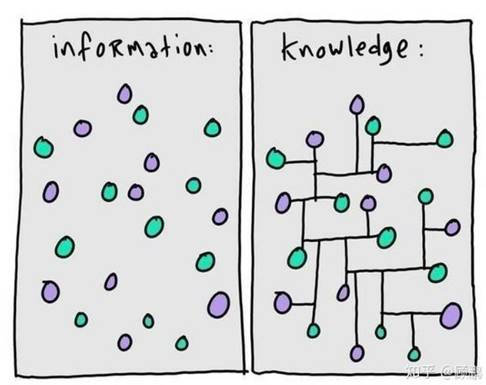
So we can easily understand that, on the basis of information, it is more appropriate to establish a link between the entities to become “knowledge”, or to call it fact. In other words, the knowledge map consists of a body of knowledge, each of which is expressed as a spo triad (subject-predicate-object)。
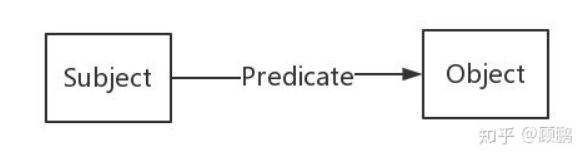
This is actually how knowledge maps work. Used to be a very popular top-down construct. Top-down refers to the definition of a good home and data model for a knowledge map and the addition of entities to the knowledge base. This build-up needs to build on existing structured knowledge bases, such as freebThis is the case for the project, where most of the data is obtained from wikipedia。
Currently, however, most knowledge maps are built from the bottom up (bottom-up). The bottom-up refers to the extraction of entities from some open-link data (i. E. “information”), the selection of which is a high confidence addition to the knowledge base and the construction of links between the entity and the entity。
3. Type and storage of data
There are three general types of raw data for knowledge mapping (also three types of raw data on the internet):
How do you store these three types of data? There are usually two options, one for storage through a standardized storage format such as the rdf (resource description framework), and another for storage using a map database, commonly known as neo4j。
4. Institutional framework
The architecture of the knowledge map consists mainly of its own logical structure and architecture。
Knowledge maps can be structured logically into two levels: the model layer and the data layer, which consist mainly of a series of facts, while knowledge will be stored in fact units. If three-dimensional groups (entities 1, relationships, entities 2), (entities, properties, attribute values) are used to express facts, graphic databases can be selected as storage media, such as neo4j open source, flickr, janusgraph, etc. Model layers are built on the data layer, mainly to regulate a set of factual expressions of the data layer through the base library. The matrix is a conceptual template for a structured knowledge base, which is not only structured more at a hierarchical level but also less redundant。
The architecture of the knowledge map refers to the structure of its construction model, as shown in the figure below:
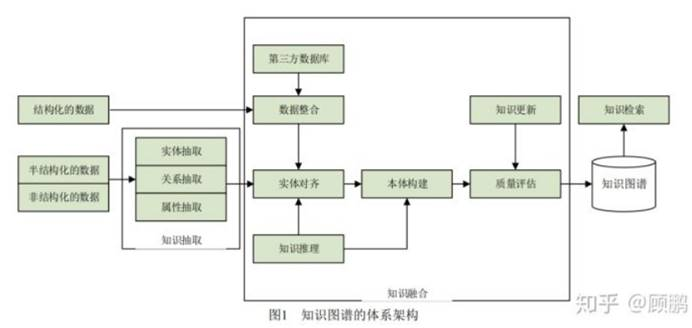
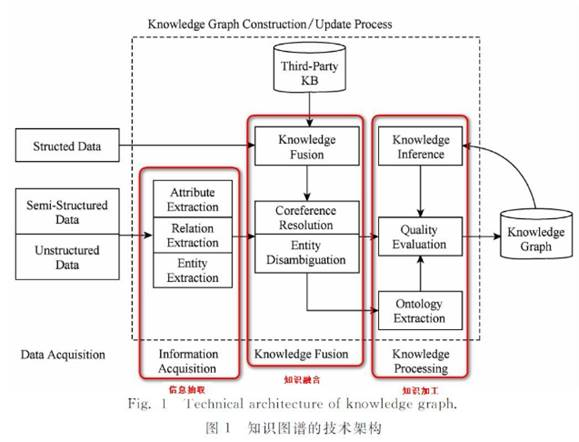
The construction and application of a large knowledge base requires the support of a variety of smart information-processing technologies. Through knowledge extraction techniques, knowledge elements such as physical, relationships, attributes can be extracted from open semi-structured, non-structured data. By integrating knowledge, differences between the entity, relationships, attributes, etc., and the de facto audience can be eliminated and a high-quality knowledge base developed. Knowledge reasoning builds on the existing knowledge base by further developing and expanding the knowledge base. Distributive knowledge indicates that the combined vectors formed are important for the construction, reasoning, integration and application of the knowledge base。
5. Knowledge extraction
Knowledge extraction is primarily open-oriented, linked data, and the available knowledge modules are extracted through automated technologies, which mainly include the three knowledge elements of the entity (the extension of the concept), the relationship and the attributes, and are based on them, leading to a series of high-quality factual expressions that provide the basis for the construction of a hierarchy of upper models. Knowledge extraction has three main tasks:
6. Knowledge expression
In recent years, significant advances have been made in learning technology, represented by in-depth learning, where semantic information of entities can be expressed as dense, low-dimensional vectors, thus efficiently calculating the entities, relationships and complex semantic linkages between them in low-dimensional spaces, all of which are important for the construction, reasoning, integration and application of the knowledge base。
7. Knowledge convergence
Because of the wide range of sources of knowledge in the knowledge map, the uneven quality of knowledge, the duplication of knowledge from different data sources and the lack of clarity about the linkages between knowledge, it is important to integrate knowledge. Knowledge convergence is a high-level knowledge organization that enables knowledge from different sources of knowledge to form a high-quality knowledge base through the integration of isomeric data, dissimilarity, processing, reasoning validation, updating, etc. Under the same framework. Knowledge convergence consists of two components: physical links, and knowledge consolidation。
8. Knowledge processing
Facts do not in themselves amount to knowledge. The ultimate acquisition of structured, networked knowledge systems also requires a process of knowledge processing. Knowledge processing consists mainly of three components: physical construction, intellectual reasoning and quality assessment。
9. Update of knowledge
Logically, the updating of the knowledge base includes the updating of the conceptual layer and the updating of the data layer。
The content of the knowledge map is updated in two ways:
10. Knowledge mapping applications
Knowledge mapping provides a more effective means of mass, isomeric, dynamic and large data expression, organization, management and use on the internet, making networks more intelligent and closer to human cognitive thinking。
Intelligence search, smart questions and answers, social networking, personalized referral, intelligence analysis, anti-fraud, etc
11. Summary
Technically, the difficulty with knowledge mapping lies in the nlp, because we need machines that understand mass text messages. But in engineering, we face more problems, arising from the acquisition and integration of knowledge. The search area is getting better and better because there are thousands (in millions of millions) of users, who are actually optimizing the search results in the search process, and that is why 100 degrees of english search cannot exceed google because there are not so many english users. The same is true of knowledge mapping, which can only go further if user behaviour is applied to updating knowledge mapping。
Knowledge mapping is certainly not the ultimate answer for artificial intelligence, but knowledge mapping, which combines the application of computer technologies, must be one of the forms of the future of artificial intelligence。
References