In 2025, the national uniform examination for admission to general higher education was held, and the ministry of education's institute of educational examinations conducted a total of two written examinations in languages. What are the characteristics of the test
Presentation by the head of the institute of educational examinations of the ministry of education, and follow-up to the report of the secretary-general of xi jinping on “construction”Education for powerful nationsThe key discourses of the “cultural heritage development” focus on “the great renaissance of the chinese nation” and focus on linguistic literacy, the sense of the times and the circumstances of the home, stimulating curiosity and imagination, encouraging individualized expression and helping to develop innovative talent. The following features:
Sticking to values, keeping pace with times. The theme of a national book entitled “the spirit of the nation”, which revolves around the theme of the 80th anniversary of the victory, is based on the literary memory of the country's suffering, which points to the new nation, which is sorely reborn, and leads to the emotional resonance of the candidates with the spirit and spirit of the nation at the emotional level. The second volume, “dream gift”, encourages candidates to “dream, pursue their dreams, and work with their dreams” and leads candidates to observe life and care for others, to think about the connection between the individual and the times and society, and to add a strong youthful energy to the chinese dream。
Widening the space for reflection and encouraging personal expression. The writings are relevant to the life of the candidates, and each of them has a wide range of space and entry points, and the candidates can write on the theme of their time or from their own life experience. The material points to both imagination and reality, to the imagination of reality, to the imagination of reality and to the creation of the desired multidimensional space for candidates。
Focusing on emotional experiences and highlighting people as human beings. The material that makes the subject of the essays chooses modern and ancient poetry, which is simple and informative. Both subjects emphasize the immersion of the classics of literature, and lead candidates from aesthetic experiences, syntheses, graphics, or in-depth reasoning. In the age of intellectualization, the questions focus on quality that cannot be replaced by artificial intelligence, such as emotional experience, sedimentation, practical participation, and the depth of reflection of the test examiners, highlighting core people-centred concepts。
The writing threshold is low and the difficulty gradient is reasonable. In 2025, the two high examination essays were carefully selected and succinctly presented, without setting a threshold for the subject matter. Candidates at different levels can find entry points for writing together with everyday reading, historical awareness, life experience or social issues; but candidates with clear logic, sincere expression and fluent language will emerge。
General baccalaureate, 2025
I've been working on this paper
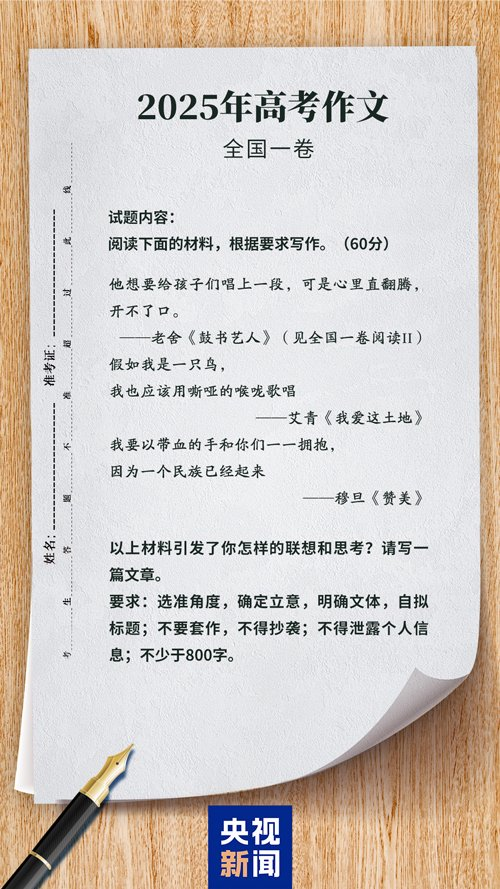
Design thinking:
This year marks the 80th anniversary of the chinese people's victory in the war against japan and the world's people's anti-fascist war. The three materials selected for this topic are related to the fight against war。
Material 1 comes from the first version of this trial paper, " drum book artists (selections) " , a novel by the house reflecting the traditional performers ' quest for a new life during the war. The material's "he" is the master's festivities. In the face of a child in distress, fong po's sense of “failure to speak” is both a reflection of his feelings for the child and an expression of the resilience and warmth of a common man in the flood of history。
The second material comes from the teaching materials, i love the land, which compiles the last poem module of the ninth grade. Even if students can't remember the whole poem, they can see that it's a poem of the song of the land, a poem of the poets, born of the birds, and dying without a trace, and a poem of the bitterness of his throats, still loves the land with sincerity and commitment。
The third is the phrase in the mudan poem, "a nation has risen" — which is very clear in the sense that it is directed towards the new nation. It is worth noting that “i” “you” “blood hands”: “i” “you” are all part of a national group; and the notion of “blood hands” refers to the spirit of struggle and indomitableness in the process of “getting up”。
Materials i reflect the battle, and materials ii and iii are written during the fighting. Although the material does not refer directly to the context of the times, the relevance of the text suggests that it naturally gives rise to reflection on the spirituality of the nation. Candidates can find the most sensitive points in three materials to discuss, document or articulate. The topic does not set a threshold, and national suffering and national renewal, love for the homeland and people, adherence to ordinary people, the national backbone, etc. Are within the bounds of writing. On the occasion of the 80th anniversary of the victory, it is both a commemoration and a good education for students to revisit these themes. It is important to note that each of the three materials is focused and interwoven, and that the in-depth perception of any material will necessarily involve the content of other material. As in material one, although fong po qing was unable to speak in detail, his sense of responsibility vis-à-vis the children's divinity coincided with the two poets' song. Candidates can also reflect on the intrinsic links of the three materials, look back to history, follow through, and reflect in depth on the relationship between individual and collective, ordinary and great, suffering and hope, history and the future, expressing a deep sense of the richness of national spirituality。
The topic focuses on a sense of purpose, whether discourse, narratives, narratives, history, commentary, myths, or even creative, non-fictional writings, to be truly “moderate in words”。
Writing is not just about the power of reason, but about the need to “leave”. Emotional experience, sedimentation, practical engagement are qualities that are not replaced by artificial intelligence in the age of intellectualization. Of the three materials, the writing of details, the image of the bird, the hand with blood, focus on the sincerity and uniqueness of the content, and convey the truth in precise language, rhythmic text, typical detail and a senseable image. This design is also a counterproductive response to the “really expressed” core of language education by writing “for new words”。
As general secretary xi said, “a nation, a people, cannot have no soul”. "because i love this land very much." "because a people has risen!" and the question is designed as the language of the "national spirit"
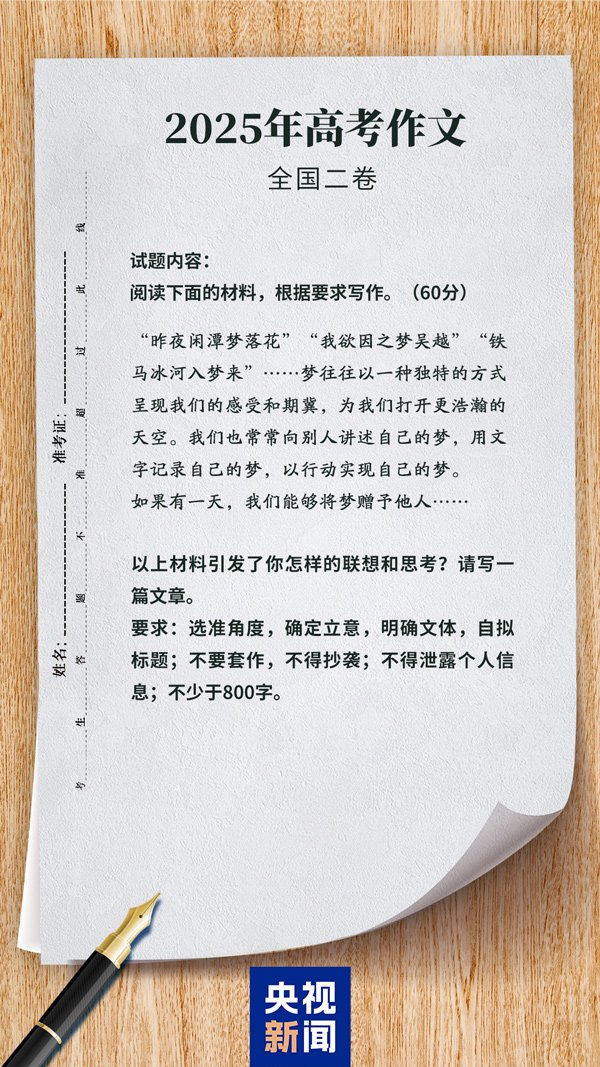
Design thinking:
General secretary xi said: “the chinese dream is historical, realistic and future.” “swisting dreams for every adolescent, lighting them up, making more young people dream, chasing them, working hard, and giving every adolescent a strong youthful energy to realize the chinese dream.” the theme revolves around a “dream gift” scenario that encourages young people of the new age to dare to have dreams, to share them with themselves, to communicate them and to realize them。
In the context of “dream gift”, “dream” and “gift” are two key elements. How do you understand "dreams"? The three verses quoted at the beginning of the material suggest this. The three poems are from tang dynasty, zhang dynasty, tang dynasty lee baek, dreams and dreams, and song dynasty land cruises, the 4th of november. All three poems are classics and have been chosen to produce language materials. The three poems are inherently edifice: “dreams last night”, written by the original poem, are more about the beauty of individual life to nature and the way life works; the original poem “i want to dream of wuchong” is a gift to a friend, and in the expression of my spiritual quest, the expression “to seek his friend's voice” is obvious; the original poem “the iron horse enters the river of dreams” is written by one person, “to speak in the world, to shape the winds of the world”, and it is both a personal thought and a national spirit. As a result, these three poems provide a space for the candidates to understand, conceptualize and express themselves. They draw the attention of the examiners to the fact that “dreams” are both specific in nature, that is, “dreams”, and universal in nature, that they are “dreams”. When writing, the examiner needs to be careful to combine these two aspects in order to discover the universal meaning of a personalized dream or to place the grandest and far-reaching dream in a living dream。
“gifty” is another key element in the context of this trial. As a daily act, a candidate is not new, but combined with a “dream” has a strong imagination. In writing, candidates need to pay attention to the imagination of the “dream gift”, and the exercise of imagination needs to be based on day-to-day experience, looking at the core of the “gift”: the gift consists of donors, grantees and gifts, and the flow of gifts creates some kind of previously unknown connection between “we” and “others”. The material reminds the examiners that, before giving a dream to others, we “spoke in” “records” and “realizes” or “realizes” our dreams, through “gifts”, which are no longer just ours, but become something for others and become something for “others”. In writing, candidates need to pay attention to the link between “we-others” through “dream gifts”, not only in their hearts, but also in others。
Candidates also need to pay attention to the unique meaning of “dreams” suggested by the material. First, there is the notion of feeling and hope, which is not the logic of abstract concepts, but of the many dimensions of the human spiritual world; secondly, the uniqueness of the dream lies in its individualization, in its close interlocking with the individual life of the dreamer, in its appearance of “our” feelings and expectations; and thirdly, the dream is an act, an “dream”, open to the future, able to break through the fence with an unbridled imagination, “opening the wider sky”。
The topic is conceived of by reality, and it is imagined by reality to open up a broad space for candidates. The candidates can discuss what we can give to others, “what the world will be” or “what will we be”; they can read out three lines of ancient poetry drawn from the material, and discern that “some dreams are for one's own sake, some for friends, some for the whole nation; others for the whole nation”; they can also focus on one aspect of the deep-seated nature of the dream, such as its revelation of our deep emotional feelings, its re-emergence of our past experience, its inspiration for our future actions, etc. Candidates can speak in favour of debate, or use narratives to express their thoughts and feelings; so long as it is based on the context of “dream gift”, it falls within the parameters of the subject。
The standard for language courses in general upper secondary schools (revised in 2017, 2020) proposes that students look carefully at the life of society and enrich their life experience, and use thought and imagination in expression and communication to enrich their feelings and understanding of real life. The integrated language materials set up learning activities in various sections, including writing, to guide candidates to the reality, to think about life, to think and imagine, to understand the connection between the individual and the times and society and to express their unique feelings and experiences. The topic reflects the call for curriculum standards and integrated teaching materials. The central “dream gift” of the test is both fresh and lively. Writing based on this situation can greatly activate the active imagination of young people, fully open the subject space for writing, and fully mobilize their vast experience in learning and life, leading them to write true feelings and avoiding generalizations。