The year 2025 marks the beginning of a “do-do-do-do-do-do-do-do-do-do-do-do-do-do-do-do-do-do-do-do-do-do-do-do-do-do-do-do-do-do-do-do-do-do-do-do-do-do-do-do-do-do-do-do-do-do-do-do-do-do-do-do-do-do-do-do-do-do-do-do-do-do-do-do-do-do-do-do-do-do-do-do-do-do-do-do-do-do-do-do-do-do-do-do-do-do-do-do-do-do-do-do-do-do-do-do-do-do-do-do-do-do-do-do-do-do-do-do-do-do-do-do-do-do-do-do-do-do-do-do-do-do-do-do looking back at 2025, together, we feel the “strength” of vocational and adult education reform, the “efficiency” of the enabling industry, the “temperature” of touch skills。
The programme for building the power of education (2024-2035) was officially launched, providing a blueprint and direction for vocational education and adult education
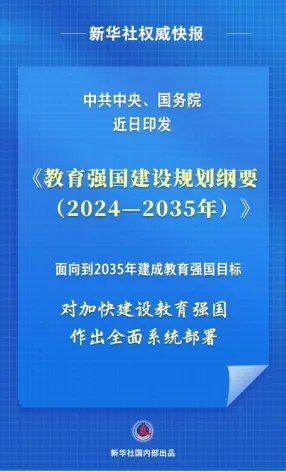
Programme for the education of strong nations (2024-2035)
In january 2025, the central committee of the communist party and the state council issued the outline of the plan for the construction of the power of education (2024-2035) (hereinafter referred to as the platform), highlighting the integrated deployment of education, science and technology, and talent, and launching a series of innovative initiatives to promote the country's transition from a large to a strong education system. The platform clearly accelerates the construction of a modern vocational education system that fosters large-scale craftsmen, craftsmen and highly skilled people; shapes new forms of multi-purpose learning and integration in the labour market, broadens the path of development into talent through job inclusion, upgrades the critical skills of vocational schools and optimizes the policy environment for the growth of skilled personnel; builds a learning society in which the digitalization of education opens up new paths to development and shapes new strengths; and upgrades public services for lifelong learning。
Implementation of the “skill cluster development programme” to build a new paradigm for the development of highly skilled people in vocational education
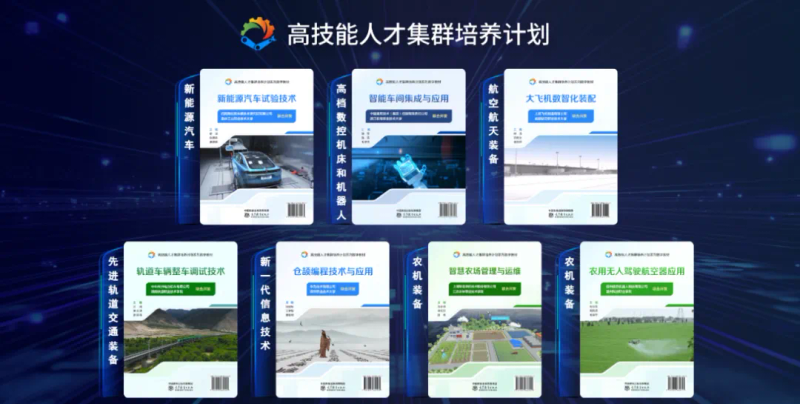
The ministry of education promotes the implementation of the high-skill cluster development programme around six focus areas
The ministry of education has launched a “skill cluster development programme” around key strategies and focus areas. As one of the first pilot projects for comprehensive reform of the three-year plan of action for the building of a strong educational power, the project involves the establishment of reform clusters through the leadership of the head enterprise, high-level vocational schools and the “triple leader” of the authoritative trade organization, which combines the design, systematic promotion of the vocational education profession, curricula, teaching materials, teachers and hands-on training, among other key elements, to promote a shift in talent development from the transfer of traditional knowledge to the development of integrated competencies. As a new, systematic and synergistic paradigm, clustering is not an extension of the traditional model of school cooperation, but is based on the theory of systemicism and human capital, a combination of diverse subjects, depth of resources and factor systems that combine vocational education from a “basket view” to a “situation”, thus creating a “ecological” of high-level competence and high-quality integration。
Innovative implementation of the second issue of the “two-high construction programme”, creating a “national team” for skilled institutions of higher learning
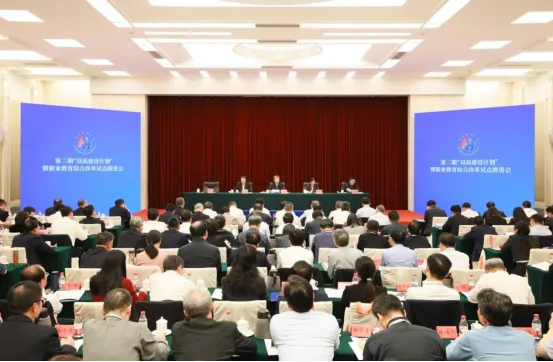
The second two-high construction programme and the pilot vocational education reform will be held in guangzhou
In december 2025, the second two-high construction programme and the pilot reform of vocational education were launched in guangzhou. In the context of the goal of “high school performance and high quality of integration of teaching and learning”, the establishment of 60 “two-high” schools and 160 “two-high” professional groups has led to the transition of vocational schools from “good-grounded, well-conditioned” to “good-serving, well-supported”, from “small logic” of self-development to “big logic” of serving the economy, and to the creation of a “national team” of skilled higher schools. The school structure of the second two-high construction programme covers 31 provinces (districts, municipalities) and xinjiang production construction corps, and services are being developed more effectively. The construction of schools is closely linked to national and regional development strategies, serving 278 national parks, of which “hundreds of billions” of “hundreds of billions” of regional industries account for 26. 8 per cent, 43. 9 per cent and 22. 9 per cent, respectively, in the form of a system of professional resonance with industrial development. For the “fifty-five”, the second phase of the “two-high construction programme” will continue to work as a model for the “national team” in the five areas of the literian people, the matching of supply and demand, core skills development, shaping international influence and securing the security floor。
4. Synergy mechanisms for integration are well developed and the supply of talent is well aligned
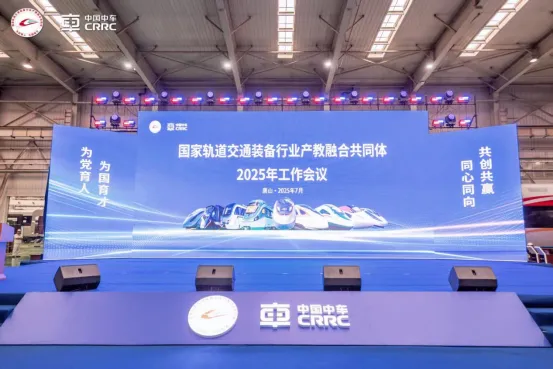
Working session of the national community for the integration of orbital traffic equipment industries in 2025
As a new form and vehicle for further integration of vocational education, the community of municipal and trade-based education institutes brings together political, professional, business, school and other actors to promote interaction among the various elements, and to enhance the “enhancedness” of vocational education and regional development and its “adaptability” to industrial development。
Taikaku xinjiang district (suzhou city, taikura city) established the education development company limited as an integrated business for teaching, using a physical, inventory, market, standardization and project-based operating model to facilitate effective matching of the resource elements of maternity. Chongqing yongchon gao district (western union) established the operating management company ltd. Through the physical establishment of an inventory and billing facility to facilitate the breakdown of the tasks of the municipal union。
The national community for the integration of orbital transport equipment industries led schools at the university of south-west transport, the hunan railway institute of vocational technology and others, together with the central china station, to develop “3+2”-specific innovative skills development practices across regions. The national community for the integration of the non-ferrous metal industry has been developing a “chinese-aluminium straight car” talent orientation to channel much-needed talent to enterprises。
5. 758 new editions of professional teaching standards for vocational education and new needs for the transformation of the fit industry
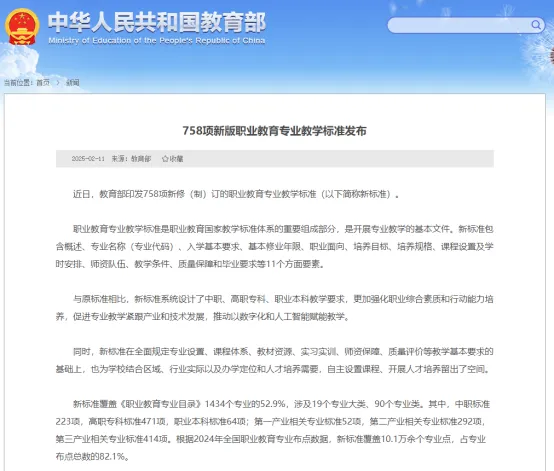
758 new editions of professional teaching standards for vocational education
In february 2025, the ministry of education issued 758 new (formulated) teaching standards for vocational education. The revision of this standard is based on the new edition of the professional directory of vocational education, which aims to adapt to the new requirements for vocational education and human development in the context of the transformation of industry, and covers 52. 9 per cent of the 1434 professional directory of vocational education, covering 19 major and 90 professional categories. The new standards include 223 standards for middle-level jobs, 471 standards for higher-level jobs and 64 standards for undergraduate careers; of these, 52, 292 and 414 professional standards for one or two industries cover more than 101,000 professional vocational training sites nationwide, representing 82. 1 per cent of the total number of specialized places. In comparison with the original standards, the new standard system has designed the requirements for teaching in middle-level, senior-level, vocational and undergraduate subjects, with a view to enhancing vocational integration and the development of operational skills, promoting professional teaching to keep pace with industrial and technological developments and promoting digital and artificial intelligence-enabled teaching。
6. National platform for education on professional intelligence hit 1. 9 billion, increasing service effectiveness
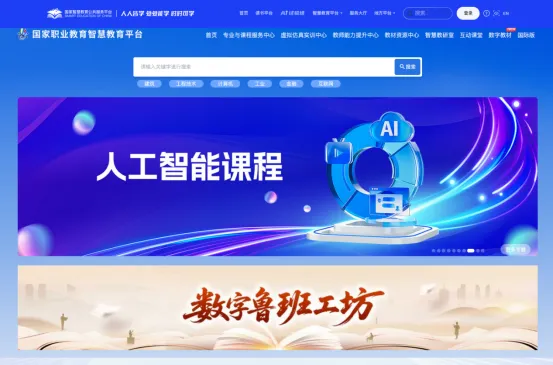
National platform for vocational education and smart education
In 2025, the national platform for education for vocational education and wisdom applied a double leap in both breadth and depth and continued service effectiveness. In its catalogue guidelines, the platform is closely linked to the three main structures that serve regional development, support industrial development, and contribute to the foreign service of powerful countries. It systematically constructs a directory of priorities in 58 areas, including new energy vehicles, industrial robots, and so forth, with a cumulative total of 1,168 core courses and teaching resources. In terms of institutional pull, the innovation led to the introduction of a three-pronged top10 ranking of teacher and student active points, learning points, contribution points, and the first selection of over 300 schools to conduct a test of the linkage between points and performance. In terms of content attraction, 482 courses have been added to the manual intelligence literacy curriculum, 482 courses on “traditional profession + artificial intelligence” to improve students' employability in new and emerging intelligent jobs, and 470 courses have been added to focus 85 core jobs to strengthen students' ability to solve complex on-site problems. By the end of 2025, the cumulative number of platform hits exceeded 1. 97 billion, an increase of 35. 4 per cent over the same period。
7. China's international influence is highlighted by the opening of overseas competitions at the world professional institutes and universities
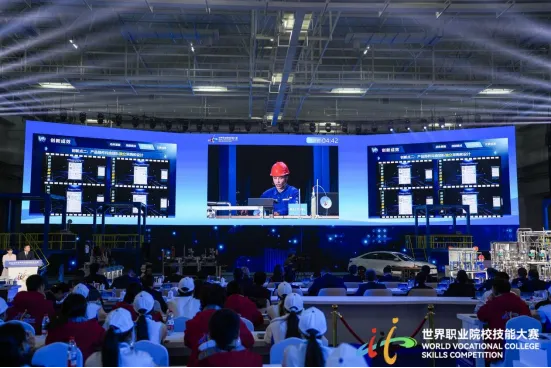
The 2025 world professional college skills championship final in tianjin
In november 2025, the world professional college skills championship finals were successfully inaugurated, attracting 8,956 teams from 76 countries and more than 33,000 candidates. The competition consists of 42 tracks, innovation and the addition of artificially intelligent tracks, with a sharper focus on the core industrial workforce and the cutting edge of technology. For the first time, four overseas competition areas were established in south-east asia, central asia, africa and europe, with 11 tracks tailored to local conditions. The target audience is extended to students attending general high schools and general undergraduate schools. The expansion of the audience shows that skills are increasingly valued and the value of vocational education is more recognized. The contest set the stage for the global youth to achieve their lives with their skills for the benefit of the world. The international recognition of vocational education in china and the impact of its branding have been highlighted. It has further deepened china's international cooperation in vocational education and helped build educational centres with global impact。
8. The luban workshop has made a solid step towards international cooperation in vocational education
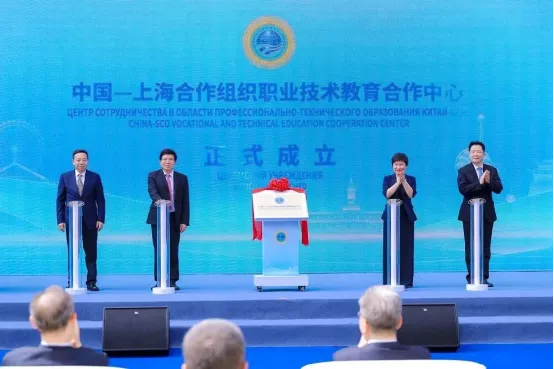
China-sco cooperation centre for vocational and technical education was established in tianjin
In 2025, international cooperation in vocational education took a solid step and achieved a number of practical results. Multilateral cooperation mechanisms have accelerated, and china-sco cooperation centre for vocational and technical education and the china-central asian union for the integration of productive education have successively implemented a project with the united nations children's fund (unicef) entitled “cultural empowerment of adolescents” to further broaden the circle of international cooperation friends。
In connection with the construction of the luban workshop, the second and third ruban workshop in kazakhstan was inaugurated during the sco summit in 2025. The first luban workshop in the americas, the ruban workshop in nicaragua, officially opened its name and opened four specialties, namely, applications for the internet and electrical automation. By the end of 2025, china had built 37 luban workshops in 31 countries on four continents, asia, africa, europe and the united states, becoming an important vehicle for international exchange of vocational education。
Launch of the “digitally enabling and learning-based social building pilot” project, which is within the reach of lifelong education
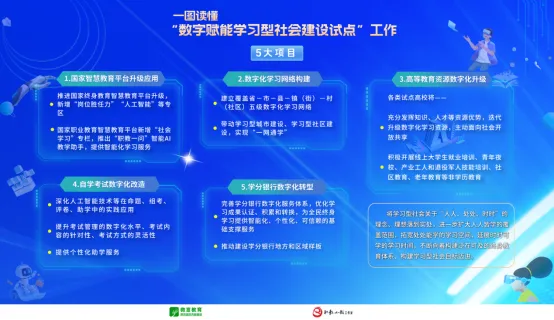
Ministry of education deployment of the digital learning social construction pilot
In june 2025, the ministry of education officially deployed the “data-enabled learning-based social-building pilot” project, which covers five priority projects such as the upgrading of the national platform for lifelong education in smart education, the construction of digital learning networks, the digital upgrading of higher education resources, the digitization of self-learning examinations and the digital transformation of credit banks. Through pilot projects, the concept of learning in a learning society “for all, everywhere and in time” has gradually been put on the ground, expanding the scope of learning for all, expanding the scope of learning for all, extending the time available for learning, and laying a solid foundation for the continued promotion of a accessible lifelong education system and accelerating the building of a learning society。
10. Organization of a week of vocational education activities to promote labour honour, skills and great times
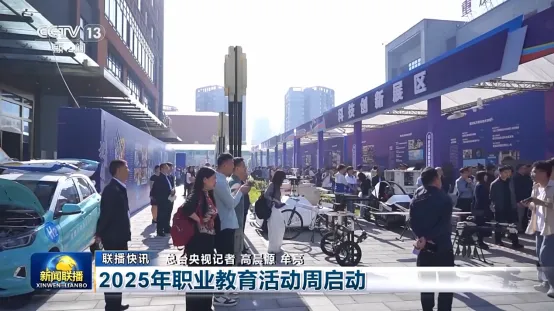
Launch of vocational education activity week 2025
Vocational education activities week 2025 was successfully organized. Nine departments, including the ministry of education, have led the organization of 14 national events, such as the national “professional education fair”, which produced the " ten-year collection of the vocational education week " . The national steering committee for the teaching and teaching of vocational education in industry has conducted more than 80 industry-specific national activities. The seven major themes of education, inclusive employment, integration of labour and education, and access to the sea have been the subject of events throughout the country, which have given rise to an era of “honourful work, valuable skills and greatness” and have created an atmosphere of shared interest and support for the development of vocational education reform。
Since its first launch in 2015, the vocational education week has become an important platform for all sectors of society to learn about vocational education, experience vocational education, participate in vocational education, and learn skills, acquire skills, apply them and transmit them。