The announcement of the 2026 entrance examination in hebei province is about to be issued, and whether it is a first-time tester or a renewed “old chauffeur” who has a clear understanding of the details of the written examination and the interview is a crucial step on the way to the examination. Today, from the two core stages of the written examination and the interview, we will prepare for you a very comprehensive analysis that will help you to prepare for the test with precision and efficiency
2026 admission process
[public announcement]: 30 january 2026
[registration online]: 1 february-2026, 9 a. M.-5 february, 17:00
[online contributions]: early february 2026
[print examination]: 10-15 march 2026
[written examination in public subject]: march 14, 2026
9-11 p. M. Administrative profession test capacity
14:00-16:30 thesis
[written examination in specialized subjects]: march 15, 2026
9-11 a. M. Specialized subjects in the field of public security
[book test results query forecast]: around 9 april 2026
Interview time forecast: late april 2026
Hebei personnel examination network
Previous recruitments
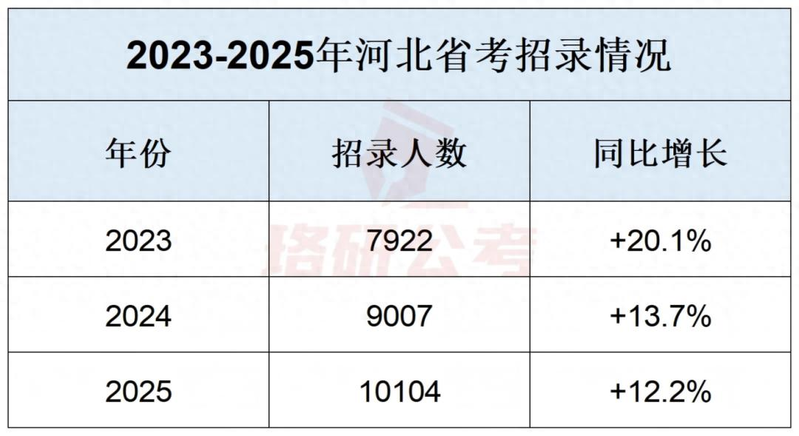
In hebei province, the figures for the last three years show a “stable rise”, with 13. 7 per cent in 2024 and 12. 2 per cent in 2025, the largest in recent years。
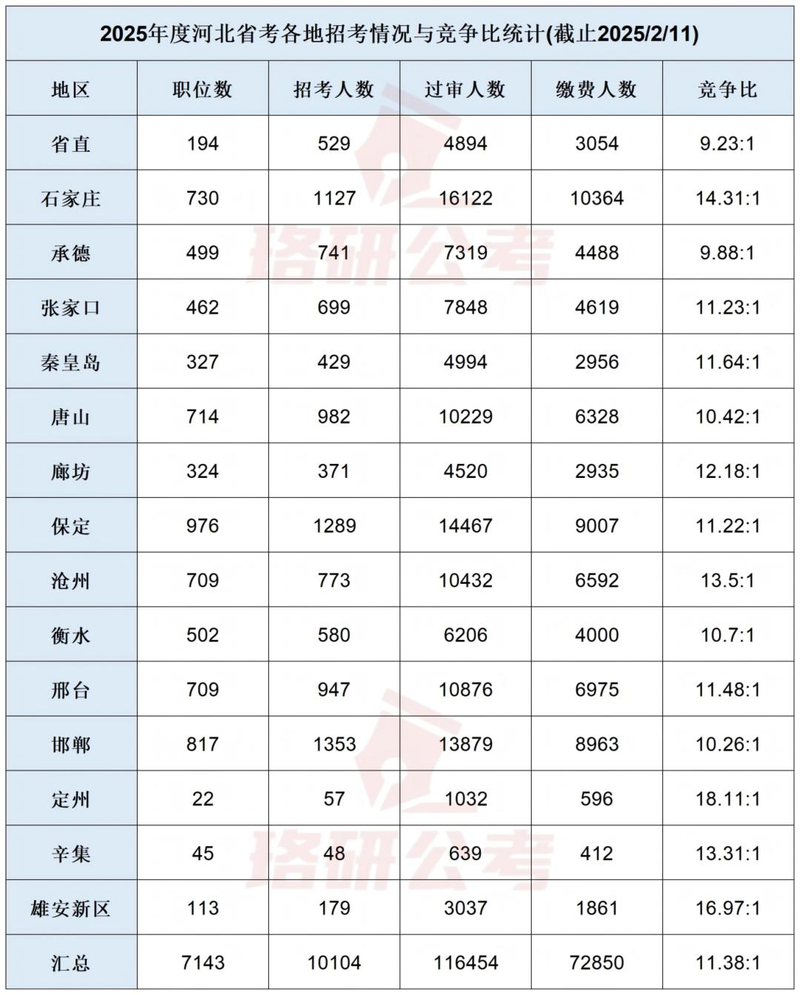
In terms of regional distribution, tsingzhou, yu xinxiang district and ishiko estate are popular areas of competition, as well as in areas such as zhongzhou, xinjiang and the pavilion, which are also highly competitive and require careful selection when applying for the examination。
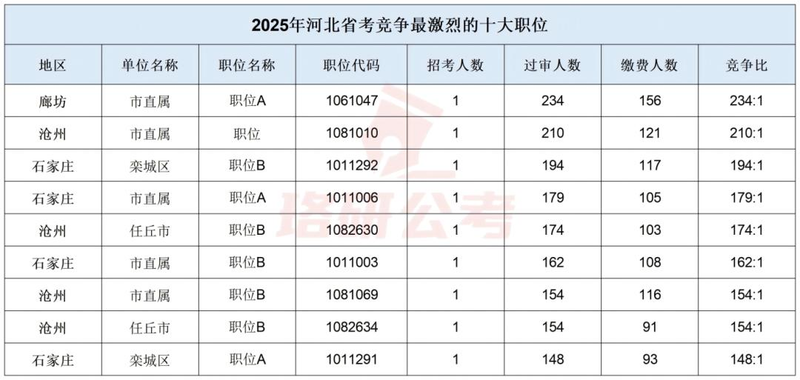
As can be seen from this, the competition for posts a (post code 1061047), which comes to the top of the list, is up to 234:1; the number of candidates for these positions is higher than the number of candidates for one and the number of candidates for trial is 140, which also reflects the high level of competition for these positions。
Post selection proposal
Selection is a “first step” to disembark, and selection of posts can significantly reduce the availability of candidates. Taking into account the experience of previous years and the characteristics of admissions in 2025, the following recommendations are made:
Priority in the use of restricted “screening” conditions: progeny status, domicile, party membership, professional restrictions, etc. Are important conditions for reducing competition. For example, the 2025 proclamation made it clear that “services to grass-roots project personnel” “retired university soldiers” could be regarded as a place of service and a place of residence for service; members of the renegade party could apply as party members, and eligible candidates must make full use of those advantages。
2. Reasonable control of the time of registration: do not submit blindly on the first day of registration, but observe two to three days, with reference to official registration statistics, and avoid too competitive jobs, but do not delay the last day to avoid being unable to re-enter the register because the eligibility review has not passed。
3. Professional matching is accurate: preference is given to jobs that are fully compatible with professional subcategories and, if the range of jobs available is small, consideration is given to jobs that match professional subcategories to avoid being disqualified for professional non-conformity. Attention is also being paid to the gender requirements of posts, particularly in systems such as the public prosecution act, which in part clearly restrict gender and require careful checking。
4. Combining self-positioning: candidates who have a strong advantage in writing can try to apply for a small number of precise positions, with a gap in points; candidates who have a strong advantage can choose a larger number of positions, improve the chances of entry and then flip through the interview。
Avoiding the “hot spots”: not blindly pursuing popular jobs that are provincial, close to home, accessible and often competitive. Candidates with a weak base may give priority to sub-district and sub-district posts and to cold-gate areas, ensuring disembarkation and seeking subsequent development。
6. Following the official job chart: when selecting posts, check the official job chart issued by the hebei personnel examination network and avoid relying on third-party screening tools to prevent the omission of suitable posts。
The written test
The written examination in hebei province is divided into public subjects and special subjects, which are the administrative professional professional competency test and the doctrine, and all candidates are required to take the examination for the people's police post in the public security organs。
In 2025, there were two major changes in the written examination, which required that candidates focus on:
1. Line measurement adjustments
A new “political theory” section was added to the 2025 test volume, which is paralleled by common sense judgements, primarily to gauge party innovation theory and the mastery of party and state policy; political aspects of original common sense judgements are no longer examined, and parts of speech understanding, quantitative relationships, judgement reasoning and data analysis remain unchanged. The test is limited to 120 minutes, with 100 points, and candidates need to be targeted to strengthen the study of political theory。
2. Adjustment of the subject matter of the doctrine
A new response requirement is added to the statement: a single word is required for the answer, which must not exceed the number of words answered under the title. The applications are divided into categories a, b and c, corresponding to posts in the integrated management category at the district level and above, positions in the integrated management category of townships (street offices) and positions in the administrative law enforcement category, with a time limit of 150 minutes and a 100-point score, for which candidates are required to prepare for the examination according to the type of examination for which they are submitted。
Public subjects
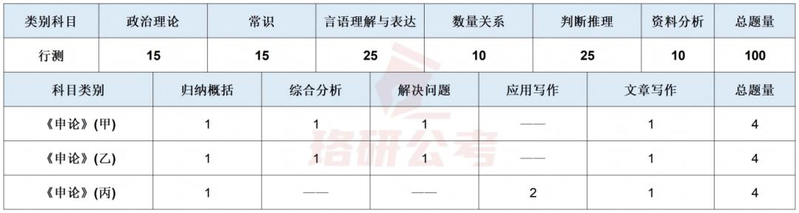
Organisation
(i) political theory
1. Number of topics: 20
2. Distribution of topics: mainly in maharahara, speeches at meetings, major documents, etc
3. Preparatory recommendations: political theory can presumably be divided into theoretical and temporal parts, the difference being that the theory is largely unchanged and that politics is often new. Time is good enough to find institutions for open courses in political theory, which must be new and read in theory. The current policy section can be prepared with common sense。
(ii) common sense judgement
Number of topics: 10
2. Distribution of topics: history 1-2 + science 1-2 (life sciences) + law 2-3 + humanities 1-2 + geography 0-1
3. Recommendations for the preparation of the study: after all the test papers from hubei in the non-temporal sector had been swiped, the general-knowledge recommendations from the non-temporal section of the province in recent years were swiped, including career writing。
4. Time taken for examination recommendations: 8 minutes
(iii) language understanding
Volume: 35
Question 2: logical filling + segment reading
3. Recommendations for the preparation of the study: the session focused on the methodology used in the presentation. Proficiency in methods is gradually achieved in practice. Line the details and do not analyse the structure. The word is chosen according to the logic of the section, with special skills in the basic course。
4. Examination recommendations 30-35 minutes
(iv) quantitative relations
Volume: 15
2. Distribution of topics: in the last four years of examinations, questions of calculation, geometry, itinerary, scheduling, probabilities are examined every year, while the problem of extreme values is examined every three years。
3. Recommendations for the preparation of the study: students need to master and be skilled in applying common formulas that combine the characteristics of the subject with the idea of reconciling it, and to practice with time to do it。
4. Time taken for examination recommendations: 13-18 minutes
(v)judgery
Volume: 30
2 topics: graphical reasoning, definitional judgement, analogyal reasoning, logical judgement
3. Recommendations for consideration:
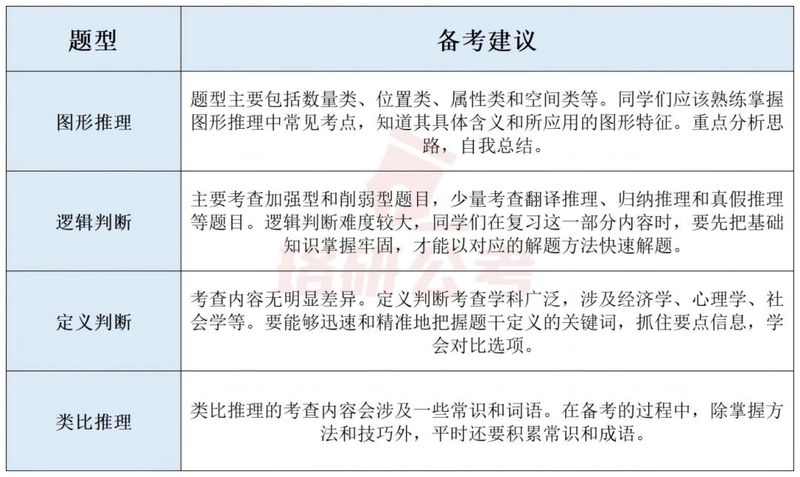
4. Examination recommendations 30-35 minutes
(vi) information analysis
Volume: 20
2 topical: 4 materials, 20 sub-issues
3. Preparatory proposal: to improve the efficiency of the resolution of problems, bearing in mind the information analysis thought map, using the core formula directly. At the same time, fast-calculation techniques were developed and consolidated through exercises。
4. Time taken for examination recommendations: 23-28 minutes
Thesis
Volume 1, a (county volume): integrated management positions at the district level and above use volume a, and category a focuses on integrated analytical capacity, presentation and problem-solving capacity of candidates. Most of the materials relate to rural and urban areas as a whole, and cover more areas, and the subject of the papers is development-oriented and more macro。
Volume b (community volts): integrated management positions in townships (street offices) use volume b, with category b focusing on the implementation and problem-solving capacities of candidates. The material covers the current state of development in rural and district districts, the areas of which are dominated by people, and the subject of the papers tends to be idealistic。
3. Volume c (administrative law enforcement): the administrative law enforcement category uses volume c and category c focuses on examination of candidates and public service capacity. The material is more oriented towards specific law enforcement events and should be based on factual, case-specific material and probably not on research papers。
Calculation of accomplishments
The comprehensive results calculation formula for hebei province is uniform and applies to all positions except for public security posts:
Combined accomplishments = (total results of written examinations) x 40 per cent + interview results x 60 per cent
Total results of written examinations: administrative professional profession test + arguments, 200 points。
Interview results: 100 points with a qualifying line, usually 60 points, with a failure to reach direct phase-out。
Consolidated achievements: two decimal places retained。
Interviews
Basic information
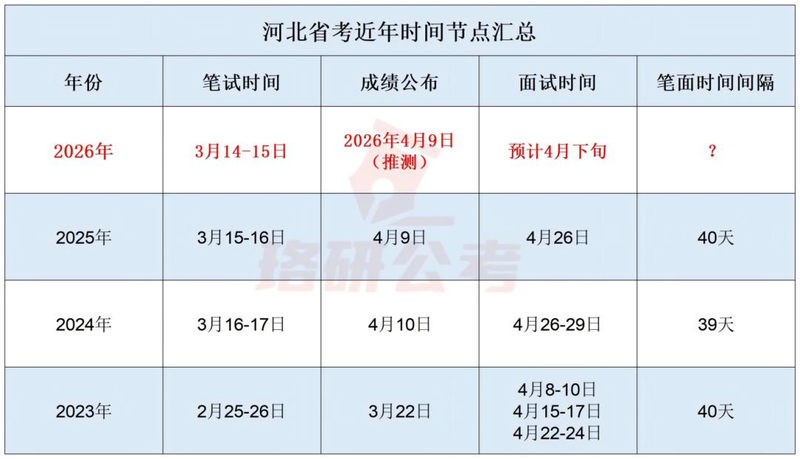
1. Interview format
Interviews in hebei province are based on structured interviews, regardless of specialization. In the field, the subject is read, and some district and municipal examiners do not read the subject, there is a copy, and most of the districts have no paper and pens. There are generally seven examiners, including one presiding officer。
2. Length of interviews
Interviews: one set in the morning and two sets per day
Length of interview: 10 minutes, 3 questions, no limit on the time to think and answer for each item, usually with a reminder for one minute remaining。
3. Interviews
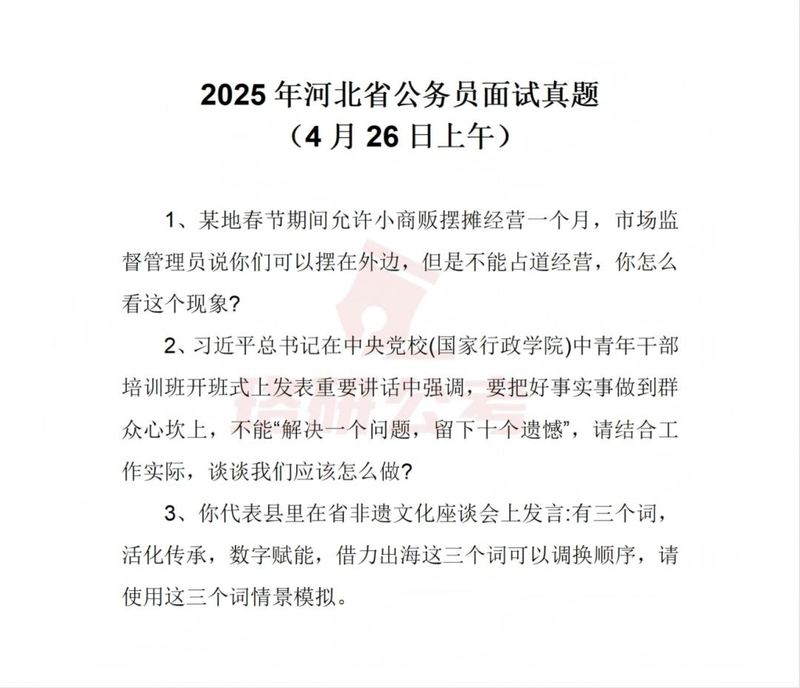
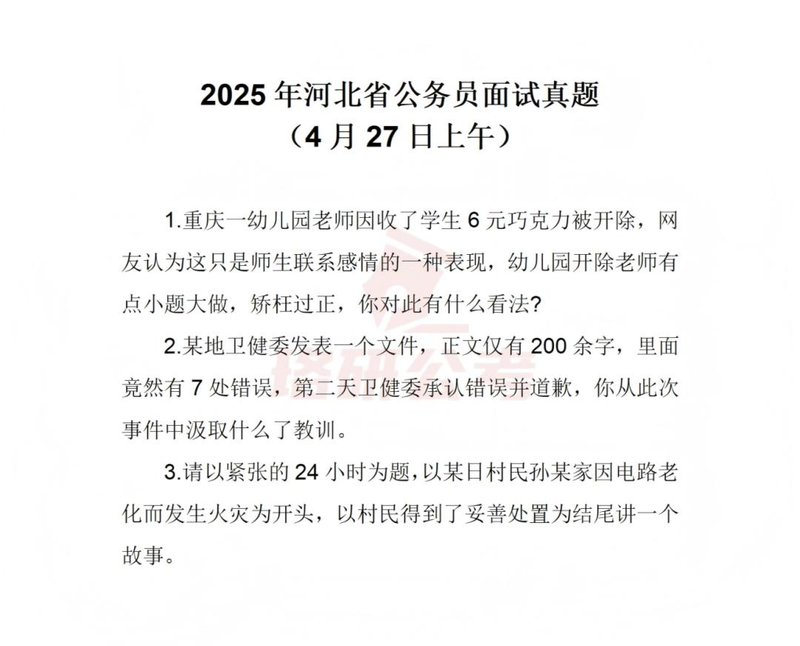
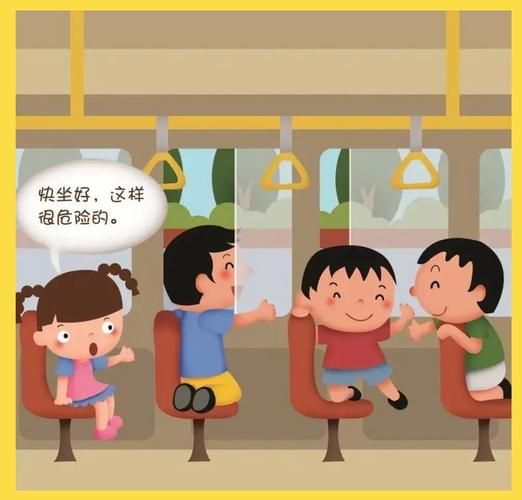
In hebei, interviews were conducted on a variety of topics, including comprehensive analysis, speech understanding, job matching, planning, problem solving, joint analysis, etc. There are more comprehensive analyses of social phenomena and attitudes, which focus on one or two issues per set of topics; comics, which are a feature of hebei provincial assessments, are presented annually and on an irregular basis; and in hebei province, which also has an annual overview, mainly through the organization of day-to-day work programme activities or conflicts with the public/officers/leaders。
4. Interview results
Take out one top score and one bottom score. The results of interviews are published centrally every half day, and comprehensive results and medical examination lists are published on the website around three days。
Recommendations for preparation
A solid foundation, a framework for responding to questions: a systematic learning of the thinking and framework of the various types of questions, a clear focus on the different types of questions, such as the need for a comprehensive analysis of the issues to be “presented, analysed and implemented” and the need for a clear presentation of the process of “preparation of activities, implementation of activities, summary of activities” in the organizational coordination of the plan, but for the avoidance of rigid templates, flexible adaptation of topics。
2. Focusing on local hot spots in hebei: interview topics are often linked to the actual development of hebei province and the theme of hot spots, such as local priorities such as construction of xinang district, rural renewal and ecological conservation. Candidates need to focus more on official platforms such as the hebei daily newspaper and the hebei release, building materials to enhance the relevance and professionalism of responses。
3. Strengthening of field-based simulation training: structured interviews focus on play-off, candidates need to conduct more fully genuine simulations, simulated examination environments, examination examiners ask questions, timed answers, etc., and improve the fluidity, logic of language expression while exercising mentalities and avoiding tension. It is proposed that a preparatory team be formed to assess each other's guidance and identify and improve problems in a timely manner。
4. Focus on detail: time allocation in response to questions, 10 minutes for three questions, rational planning of reflection and response times for each subject, avoiding time overruns; clarity and clarity in language expression, avoiding redundancy; and attention to instrumentation, maintaining integrity, integrity and good mental state。
5. Preparation of documentation documents in advance: prior to the interview, the required documentation must be completed, such as identification documents, diplomas, diplomas, written examination certificates, civil registration materials, proof of job requirements, the provision of employment agreements for graduates of secondary and higher education in 2025, school certificates, etc., for prospective graduates, and the provision of accreditation materials for the ministry of education's centres for study abroad, in order to ensure that they are prepared in advance and avoid omissions。
The real question