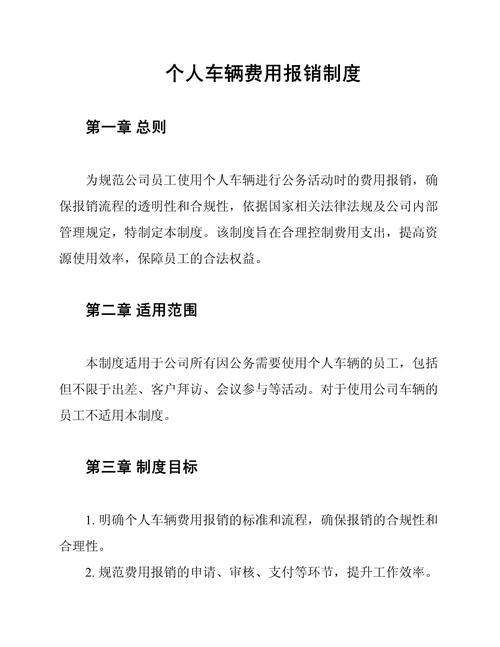
The system of standards and general rules of chapter i of the system for the reimbursement of car fares is based on relevant laws and regulations, industry guidelines and provisions of the company's parent company, such as the accounting act of the people's republic of china, the basic standards for the internal control of enterprises and the management of internal controls of group xx. The system is designed to regulate the management of company reimbursement of car fares, prevent and control financial risks, increase efficiency in the use of fees and ensure the security of funds. At the same time, it promotes the healthy development of enterprises by fine-tuning, institutionalizing and regularizing the management of vehicle reimbursement through clear management standards, business process optimization and enhanced risk management. This second system, which applies to all sections, subdivisions and all employees of the company, covers activities related to the reimbursement of expenses in connection with daily official travel, business negotiations, travel, etc., including, but not limited to, fuel, crossing, parking, vehicle maintenance, etc. The management of the company's unified allocation of vehicles is governed by the vehicle management system of company xx. Article 3 of this system has the meaning of the following terms: (i) xx-specific management, which refers to the management of the company's claims for the cost of the vehicle through the system's design, process optimization, risk control, monitoring and evaluation, etc., to achieve cost compliance, efficient and transparent process-wide management activities. (ii) xx risk: risk events such as financial fraud, budget overruns, document forgery and process irregularities that may arise in the process of reimbursement of vehicle costs. (iii) xx compliance: means strict compliance with national laws and regulations, corporate systems and policy requirements for vehicle reimbursement to ensure the authenticity, reasonableness and compliance of fees. The fourth principle is that the management of vehicle claims is governed by the following core principles: (i) full coverage: all vehicle reimbursement activities are covered by the system and are not left in the regulatory blind zone. (ii) accountability: clarify the responsibilities of managers and staff at all levels in the management of the reimbursement of the cost of the vehicle, and ensure accountability. (iii) risk orientation: focus on focus and key risk points and implementation of differentiated controls. (iv) continuous improvement: dynamic optimization of management systems and processes in response to changes in the internal and external environment. Chapter ii regulates the organizational structure and functions of chapter v, which is headed by the head of the company, who is the first responsible for the management of the reimbursement of the company's expenses and who is responsible for the overall effectiveness of the management of the reimbursement of the expenses; the head of the financial and administrative division is the direct responsible person responsible for the implementation of the organizational system, supervision of the examination and decision-making on major issues. Article 6 company has established a lead team for the management of vehicle reimbursement, headed by the company's main head, who is the deputy head of the management, with the heads of the ministries of finance, administration and audit as members. The steering group is responsible for coordinating the management of vehicle reimbursement, studying key decisions, coordinating cross-sectoral issues and overseeing the effectiveness of the implementation of the system. Article vii treasury, which is the lead department for the management of vehicle claims, is responsible for: (i) developing and revising the vehicle reimbursement management system and operating rules; (ii) reviewing the authenticity, compliance and monitoring of the reimbursement process; (iii) regularly analysing the use of the vehicle fares and making recommendations for their optimization; and (iv) organizing relevant training to raise awareness of staff compliance. The department of administration, which is responsible for the administration of vehicle claims, is responsible for: (i) regulating the management of vehicle usage, supervising vehicle maintenance and cost-sharing; (ii) directing staff to properly complete claims and providing operational advice; and (iii) coordinating with the department of finance in the processing of claims and processing of unusual claims. The heads of the departments and subdivisions of article 9 are the first persons responsible for the administration of the reimbursement of the cost of their own vehicles. They are responsible for: (i) organizing the system for the reimbursement of the cost of vehicles for their own employees and implementing the claims; (ii) reviewing the claims of their own units to ensure compliance with the requirements of the system; and (iii) reporting in a timely manner on significant issues and risks in the administration of the reimbursement. Under article 10, enforcement staff (e. G. Drivers, operators, etc.) are required to comply with the following operational responsibilities: (i) if a claim for reimbursement of the cost of a vehicle is properly filed, it shall not be falsely or falsely stated; (ii) it shall be properly maintained to ensure that the document is validly complied with; and (iii) it shall be discovered that irregularities in the administration of the claim are reported in a timely manner to the head of the department or to the treasury. Chapter iii focuses on the requirements of article xi operational compliance: (i) reimbursement for official vehicles should strictly follow the principle of “who will use, who will apply for and who will bear the costs” to ensure that the costs are related to the actual operation; (ii) the use of external vehicles by employees on official business requires the provision of a lease contract or agreement to be approved by the head of department for reimbursement; and (iii) reimbursement for non-official vehicles needs to be submitted in detail and incorporated into the budget management after confirmation by the finance department. Article 12 prohibits sexual activity: (i) the use of false documents, forgery of documents, and reimbursement of car fares; (ii) the conversion of the cost of vehicles used for official purposes to personal use or the transfer of benefits; (iii) the strict prohibition of over-standard reimbursement, such as fees for excess of authorized mileage, fuel consumption, etc.; and (iv) the avoidance of reimbursement clearance through the breaking of documents, related transactions, etc. Article 13 focuses on protection against: (i) the risk of authenticity of instruments: the treasury needs to verify the consistency of documentation information with the content of claims and to enhance verification of large or unusual claims; (ii) the risk of budget overruns: departments should establish vehicle budgets and submit monthly reports to the treasury department to avoid unbudgeted expenditures; and (iii) process operating risks: electronic flow mechanisms for reimbursement documents should be established to ensure the completeness and traceability of approval nodes. Article xiv vehicle usage management requires that: (i) the company should set up fuel consumption and maintenance desk accounts for the uniform allocation of vehicles, the cost of which should be measured in proportion to the actual usage; (ii) the external rental of vehicles must select a compliance vendor, enter into a lease agreement and specify the manner in which the costs are to be borne; and (iii) the non-official use of vehicles must be submitted with an application for registration of the time, mileage and cost of use after approval. Article 15 is subject to limitation and limitation: (i) the staff member shall submit a claim within x days of the cost and the finance department shall complete the review within x days; (ii) the individual reimbursement exceeding x dollars shall be subject to supervisory approval; and (iii) the total annual reimbursement of the cost of the vehicle exceeds x per cent of the budget shall be subject to specific instructions and corrective measures. Chapter iv is dedicated to the operational mechanism for updating the article 16 system: (i) the department of finance conducts an annual assessment of the implementation of the vehicle reimbursement system and adjusts its provisions to changes in legislation and business needs; and (ii) major system revisions need to be considered by the management of the company and the training materials and system functions are updated simultaneously. Article 17, risk identification early warning mechanism: (i) financial department consolidates data on vehicle cost reimbursement on a monthly basis, analysing risk points such as abnormal claims, over-budget expenditures, etc.; (ii) audit department conducts annual special audits to implement focused monitoring of high-risk sectors; and (iii) issues risk warning circulars, clear list of issues and overhaul requirements. Article 18 compliance review mechanism: (i) reimbursement documents are subject to double review by the head of department and the finance department and cannot be paid without review; (ii) the treasury department has established a spot-check mechanism for large claims and high-frequency claims, which is not less than x per cent; and (iii) in cases where non-compliance claims are found, documents are returned and those responsible are interviewed, subject to the imposition of a systematic penalty in serious cases. The article 19 risk response mechanism: (i) the general risk is coordinated by the treasury department and disposed of within x days; (ii) significant risk is subject to the initiation of emergency procedures, led by the car reimbursement management steering group, to ensure that the issue is resolved in a timely manner; and (iii) the risk incident disposal process is documented in writing and reported to the management of the company. Article 20 establishes liability mechanisms: (i) employees who make false statements of their car fares or counterfeit documents are dealt with in accordance with the company's employees ' manual and the amount of the violation is recovered; (ii) department heads who fail to comply with their audit responsibilities are disqualified from annual ratings and are held accountable for their management; and (iii) the ministry of finance reviews the lack of strict compliance and deducts performance ratings from those directly responsible, subject to disciplinary action in serious cases. Article 21 assessment improvement mechanisms: (i) at the end of each year, the department of finance takes the lead in carrying out vehicle reimbursement management assessments, including system implementation rates, risk incidence, employee satisfaction, etc.; (ii) the results of the assessment serve as an important basis for the optimization of the next year's system and are submitted to the management of the company for consideration; and (iii) in response to process gaps identified by the assessment, there is a need to develop an improvement programme and synchronize the updating of the system. Article 22 of chapter v, which is dedicated to regulatory safeguards, provides for: (i) annual reporting by the principals of the company on the management of the reimbursement of the cost of the car, and coordinated resolution of major problems; (ii) quarterly thematic meetings of the head of the department to study the implementation of the system and the direction of its optimization; and (iii) individual departments to be assigned responsibility for the management of the reimbursement of the cost of the car, ensuring that responsibility is met. Incentives for the examination of article 23 are: (i) inclusion of vehicle reimbursement compliance in departmental annual assessment indicators, which results are linked to performance bonuses; (ii) specific incentives are given to sectors and individuals that are good in claims management and are commended within the company; and (iii) in cases where non-compliance is detected, the person responsible is disqualified from merit and included in the personal integrity file. :: article 24 training and awareness-raising mechanisms: (i) the ministry of finance conducts annual training on the vehicle reimbursement system in x months, covering all employees and new entrants; (ii) the department of administration produces guidelines for the processing of claims, which are posted in a visible location in the office area and are easily accessible to staff; and (iii) organizes regular case sharing to enhance staff compliance awareness and operational skills. Article 25 supports the informationization of: (i) the development of a vehicle reimbursement management information system to enable the electronic submission, approval and automated aggregation of data on file lines; (ii) the system is embedded in a compliance verification function, which automatically intercepts abnormal requests such as ultra-standards and non-papers; and (iii) the department of finance monitors claims in real time through the system to improve management efficiency。article 26 culture development: (i) production of the car reimbursement compliance manual, specifying reimbursement criteria, processes and risk tips; (ii) organization of compliance commitments requiring employees to submit claims after signing a letter of commitment; (iii) creation of a culture of “compensation, accountability” through information boards, intranet platforms, etc. Article 27 reporting system: (i) treasury submits monthly vehicle reimbursement management reports to the management of the company, including the total amount of claims, budget implementation rate, risk events, etc.; (ii) significant risk events are reported within x days to the lead team for vehicle reimbursement management and are copied simultaneously to the audit department; (iii) annual management reports are subject to review by the management of the company and serve as an important reference for subsequent budget preparation