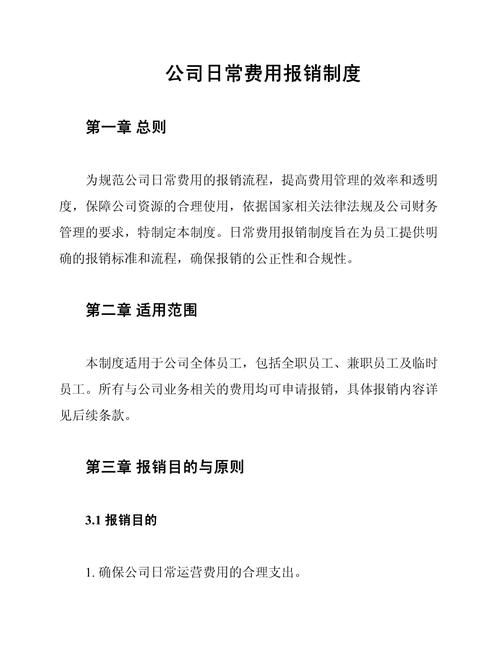
The purpose of the general provisions of the enterprise vehicle reimbursement system is to strengthen the management of company fees, regulate the vehicle reimbursement process, control expenditure reasonably and develop the system. The system is designed to ensure timely and accurate reimbursement of expenses incurred by employees of the company in connection with their work, while preventing unreasonable expenses and increasing the efficiency of the use of the company's funds. This applies to all employees of the company. Basic principle 1. Principle of authenticity: reimbursement of the cost of a car must be based on real business, and false or false reporting is strictly prohibited. 2. Principle of reasonableness: reimbursement of the cost of the vehicle shall be in accordance with the actual circumstances of the company's business and expenses shall be reasonable and necessary. 3. Principle of compliance: reimbursement must be in accordance with national laws and regulations and relevant corporate requirements. The scope of the reimbursement is those costs incurred by staff members in connection with their travel to the field, by means of trains, aircraft and long-distance buses. 2. In-city transportation costs, such as bus, subway, taxi, etc., during the mission (if the company has the corresponding subsidy rate, it is implemented according to the subsidy rate; no subsidy rate, the actual cost is reported). 1. Public transport, subway, taxi, etc., incurred by employees in different parts of the city in connection with their company's business. 2. Fuel costs, road passes, etc. (reimbursed on the basis of standards established by the company) resulting from the use of a private car for the conduct of official business with the approval of the superior. Standard transportation options for reimbursement and standard 1. Aircraft personnel shall select the appropriate flight according to the urgency and actual needs of the service. The cost of economy class travel by air may be reimbursed at the actual fare, provided that valid tickets and boarding passes are provided. If special circumstances require first-class or business-class travel, prior authorization must be obtained from a superior, otherwise the cost in excess of economy-class travel is borne by the individual. 2. Train employees may choose the suitable number of trains according to the organization of work. If you are in a hard-line train, you are reimbursed at the actual fare; if you are in a hard-bed train, you are reimbursed at the hard-billed ticket; if you are in need of a soft-beder for work, you must obtain prior approval from the superior, otherwise the cost of exceeding the hard-bed is borne by the individual. When travelling by car or heavy iron, reimbursement for seats in the first class and below shall be made at the actual fare or, in the case of seats in the second class or above, with the prior authorization of the superior, in excess of the cost of self-care. 3. Long-distance buses are reimbursed at the actual fare, provided that valid tickets are provided. 4. In-city transportation bus fares, metro charges: sale on valid paper. Taxi fares: an employee shall, to the extent possible, choose to travel by public transport and, in exceptional cases, by taxi, shall indicate the reasons on the invoice and shall be reimbursed only upon signature by the head of department. In cases where the cost of a single taxi exceeds us$, it is necessary to inform and approve the department manager in advance. (b) travel allowance standard 1. A certain amount of travel allowance is granted to company employees while on mission, as follows: first-line city: dollar/day. Second-line cities: dollars/days. Three lines and the following cities: dollars/days. 2. The travel allowance covers the cost of transportation, catering, etc. Of the employees while on mission and no further reimbursement is made for the cost of transportation and catering in the city. The travel allowance is calculated on a natural basis from the date of departure from the seat of the company until the date of return to the seat of the company. The reimbursement process completes the claims. 1. An employee should complete the car reimbursement request form in a timely manner upon completion of a mission or official duty in the city. The application form shall contain details of the date, place, cause, means of transportation to be used and details of the costs incurred, as well as supporting documentation such as tickets, invoices, etc. 2. The application must be confirmed by the signature of the head of department in order to prove the authenticity and necessity of the operation. The head of the departmental audit department reviews claims from employees, focusing on the authenticity of the travel or work, the reasonableness of the costs and compliance with the requirements of the company. If problems are identified, staff should be contacted in a timely manner and requested to supplement or correct relevant information. Following the review, the head of department signed the application form for approval. Financial review 1. The financial services review the authenticity, legality and integrity of claims against employees upon receipt of their claims. Check whether the invoices are formal, the content is consistent with the application form, the calculation of the amounts is accurate, etc. 2. Financial staff perform reconciliations of claims against corporate reimbursement rates. In the event of non-compliance with reimbursement rates, the staff member should be contacted and the reasons for the non-reimbursement should be indicated. Following the audit, the finance staff signed the application form. Under the authority of the company, claims are submitted for approval to the appropriate level of leadership. As a general rule, claims from ordinary employees are approved by department managers; claims from department managers are approved by line managers; claims from larger or special cases are approved by the general manager. After approval by the leadership, the application form is signed. 1. Payment of claims is made by the treasury on the basis of the approved claims. Payments may be made by choice of bank transfer or cash payment, in accordance with the financial regulations of the company and the wishes of the employees. 2. In the event that the amounts reimbursed do not correspond to the amounts requested, the finance staff shall communicate with the staff in a timely manner to explain the reasons for the adjustment and shall make payments in accordance with the final approval. Proof of reimbursement requires that invoices be issued for 1. All reimbursement of the cost of the vehicle be provided with a regular invoice. The invoice should be clear and complete, including the invoice number, the date of issuance of the invoice, the purchaser's information, the seller's information, the content of the service, the amount of the invoice, etc. 2. The invoice should be stamped with a special stamp from the seller's invoice, otherwise the invoice is invalid. 3. For electronic invoices, the original electronic invoice should be provided with a clear printable original and ensure that the invoice information is complete and accurate. Electronic invoices are subject to search and validation in the tax system and are not duplicated. The tickets require that the originals of the train tickets, air tickets, etc. Be provided and that the face information be complete and clear. Information on the name, date, number and flight of the ticket shall be consistent with the claim form. A long-distance bus ticket shall provide a valid document indicating the place of departure, destination, date of embarkation, fare, etc. Other requirements 1. Reimbursement documents should be placed in a consistent and chronological manner on the back of the statement of claim and should not be bound, for ease of review and access, by the use of staplers, retrofitters, etc. 2. In cases where formal invoices cannot be obtained for exceptional reasons, such as the use of a private car for official purposes, a statement of the cost of the use of a private car must be completed, detailing the cause, mileage, cost details, etc., and confirmed by the signature of the head of department and the head of finance. 1. Where more than one person travels together and travels by the same means of transport (e. G., chartered vehicles), the cost shall be reasonably shared on the basis of the actual number of passengers and their respective rates of travel. Cost-sharing shall be calculated by reference to the claim and confirmed by signature of all participants. 2. Reimbursement certificates for cost-sharing may be posted on a single claim form by the principals, provided that the name of the individual is indicated on each certificate. 1. Any increase in the cost of a trip resulting from a temporary increase in the staff member's travel requirements shall be reported to the head of department in a timely manner and, upon return to the company, shall be completed as required. 2. Claims for reimbursement of the cost of a temporary increase in journeys are subject to a detailed explanation of the reasons for the increase, the time, location and cost, as well as supporting documentation (e. G., notice of organization of work, statement of adjustment for travel, etc.), which is approved by the head of department, the finance officer and the relevant director. 1. If the employee's reimbursement for the cost of the vehicle exceeds the standards established by the company, the excess is, in principle, borne by the individual employee. However, if the approval of the superior is given in exceptional circumstances, the excess may be reimbursed as required. 2. The company shall not reimburse any portion of the cost of the unauthorized over-alignment or other unreasonable expenses incurred by the vehicle, and shall, depending on the circumstances, impose appropriate disciplinary measures. The internal audit service of the internal audit oversight company (iaoc) conducts regular audit inspections of the reimbursement of the cost of the vehicle, focusing on the compliance of the reimbursement process, the authenticity of the reimbursement certificates and the reasonableness of the expenditure incurred. If problems are identified, the relevant departments and personnel will be required to undergo corrective work in a timely manner and will be held accountable under corporate regulations. The employee supervision company encourages employees to monitor and report irregularities in the reimbursement process. Other employees can report to the company's human resources department or finance department if they are found to have misrepresented the cost of the vehicle, violated the reimbursement system, etc。male