The engine is an energy conversion facility that converts thermal energy from fuel combustion into mechanical energy. So how does it complete this energy conversion process? So how does it convert heat into mechanical energy? To complete this energy conversion, it must pass through gas and introduce the flammable mixed gas (or fresh air) into the cylinder; then compress the flammable mixed gas (or fresh air) entering the cylinder, and impregnate the flammable mixed gas (or create a flammable hybrid gas and ignite it by injection of diesel high pressure into the cylinder) close to the end of the gas tank; burn the flammable mixed gas in flames and swell the piston to perform external functions; and, lastly, remove the flue gas after burning. That is, four processes of infusion, compression, performance, and exhaust. The four processes are called a work cycle of engines, which is constantly repeated, allowing for the conversion of energy and the continuous operation of engines. A cycle is completed, with two curves (720°) and a piston moving up and down four times, known as a four-way engine. Instead, a cycle is completed, with a curve round (360°) and the piston moves up and down twice, known as a two-way engine. The rationale and course of work of the four-way engine is described below。
I. Rationale of the four-way petrol machine
The operation of the four-way petrol machine is constantly revolving in the order of the gas intake, compression, commissioning and ventilation. (1) gas flow (figures 1-22)
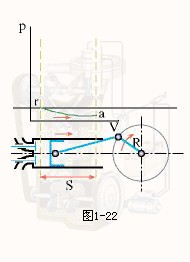
As a result of the rotation of the axis, the piston stopped moving from the top stop point to the bottom, when the vent door was closed and the entry door opened. At the beginning of the infusion process, the piston was located at the upper end, and there was a residual exhaust of the previous cycle, which was not drained, so the pressure in the cylinder was slightly higher than the atmospheric pressure. As the pistons move down, the contents of the cylinder are increased and the pressure is reduced. When the pressure is lower than the atmospheric pressure, a vacuum is created inside the cylinder, the air is mixed with the gasoline supplied by the air filter and flammable gas, and the gas tank is inhaled by entering the gas door until the piston moves down to the bottom. The gas pressure in the gas tank was slightly lower than the atmospheric pressure at the end of the gas intake, which was influenced by resistance such as air filters, petrochemicals, gas intake pipes and gas intake doors, which were approximately 0. 075 to 0. 09 mpa, while being heated by residual exhausts and high-temperature units at a temperature of 370 to 400 k. The gas entry door for the actual petrol machine was opened before the piston reached the stop point and closed after the delay to the bottom point in order to inhale more flammable hybrid gas. (2) compressed process (figures 1-23)
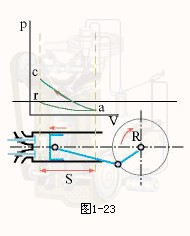
The axes continue to rotate, the piston moves upwards from the bottom stop point, at which point the entry and exhaust doors are closed, the gas tank becomes closed volume, the flammable hybrid gas is compressed, pressure and temperature are rising, and the compressing process ends when the piston reaches the upper stop point. At this point, the pressure and temperature of the gas is determined mainly by the size of the compression ratio, and the combined flammable gas pressure is 0. 6 to 1. 2 mpa and the temperature is 600 to 700 k. The greater the compression, the higher the pressure and temperature in the cylinder at the end of the compression, the faster the combustion, the greater the engine power. But compression is too high to cause explosion. The so-called bursting is due to excessive gas pressure and temperature, the combustion of flammable mixed gases without ignition, and the spread of flames out of the country at a rate that is several times higher than normal combustion, resulting in a sharp banging. It causes overheating of engines, reduced power, increased consumption of petrol and damage to aircraft. Minor combustion is permitted, but a strong combustion is harmful to the engine, and the compression ratio for gasoline is generally = 6-10. (3) course of work (figures 1-24)
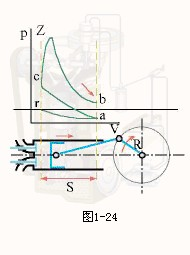
The work process included combustion and expansion, during which the entry and exhaust doors remained closed. When the piston is nearing the upper end of the compressed process (i. E. The early corner of the ignition), the pyrotechnics generate electric sparks that ignite flammable hybrid gases, release large amounts of heat from the combustion of combustible gas, raise the temperature and pressure of gases in the cylinders sharply, up to a maximum of 3-5 mpa, with a maximum temperature of 2,200 to 2,800 k, hyper-temperature high-pressure gases swelling, drive the pistons from the top to the lower point, rotate the axes and export mechanical work through a collage, which is used to maintain the engine itself, except for external functions. As the piston moves downward, the contents of the cylinder increase, and the gas pressure and temperature decrease. When the piston moves down to the bottom point, the working process ends, the gas pressure is reduced to 0. 3 to 0. 5 mpa and the gas temperature is reduced to 1,300 to 1600 k. 4) exhaustion process (figures 1-25)
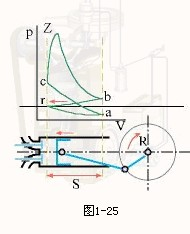
The flue gas generated by the combustion of the combustible gas in the tank must be discharged from the tank in order to carry out the next gas intake. At the end of the exercise, the vent door was opened, the vent door remained closed, the exhaust pressure was used for free vents, the pistons reached the point of cessation and moved upwards, and the pistons continued to be pumped out into the atmosphere, and when the pistons crossed the stop point, the vent doors were closed and the vent was completed. The exhaust process of the actual petroler also opened the exhaust door early and was delayed to close in order to release more exhaust gas. Owing to the volume of the combustion chamber, it is not possible to remove the exhaust from the cylinder. The gas pressure is still higher than the atmospheric pressure at about 0. 105 ~ 0. 115 mpa at a temperature of about 900 ~ 1200 k, when the exhaust is terminated as a result of vent resistance. The axes continue to rotate, the piston moves from top to bottom, and the next cycle begins. It is visible that the four-way petrol machine completes a cycle of work through the four-way journey of gas, compression, commissioning and exhausting, during which the piston moves up and down the four-way journey and rotates two curves accordingly。
Ii. Rationale of the four-way diesel engine
The four-way diesel and four-way petrol machines work the same way, each of which also includes four journeys of gas intake, compression, operation and exhaust, but since diesel fuel is used for diesel fuel, diesel fuel is much different from gasoline, diesel is much more viscous, is less evaporable, has low self-fired temperatures, so the formation of combustible gas, fire patterns, combustion processes and changes in gas temperature pressure are different from those of gasoline, and the following is the main analysis of the different points in the operation of diesel and gasoline engines. The difference between the four-way diesel engines in the gas intake is that the diesel aircraft inhaled the cylinders with pure air rather than flammable hybrid gas, did not have a carburetor in the gas intake channel, had low inflow resistance, and at the end of the gas, the gas pressure was slightly higher than the gasoline and the gas temperature was slightly lower than the gasoline. At the end of the ingestion, the gas pressure was approximately 0. 0785 ~ 0. 0932 mpa and the gas temperature was about 300 ~ 370k. The compressed process is also compressed by pure air, and when the compressed process approaches the end point, the oil dispenser sprays high-pressure diesel fuel in the fog into the combustion chamber, and diesel and air form a flammable mixture of gas and burn in the cylinder. The compression ratio of diesel engines is much larger than that of petrol machines (generally 16 to 22), and the gas temperature and pressure at the end of the compression is higher than that of gasoline, significantly exceeding the self-burning temperature of diesel engines. At the end of the compression period, the gas pressure was about 3. 5 to 4. 5 mpa, the gas temperature was about 750 to 1,000 k, the diesel press was self-fired after compression, and there was no need for ignition, so the diesel press was also called the pressurizer. When diesel oil is injected into the cylinder, it burns immediately after having been mixed with the air in a short period of time, and the combustible mix of diesel gas is formed within the cylinder, rather than in gasoline, mainly in a carburetor outside the cylinder. The maximum pressure in the cylinder during diesel combustion is much higher than in the gasoline machine, up to 6-9 mpa and up to 2000-2500k. At the end of the operation, the gas pressure was about 0. 2 to 0. 4 mpa and the gas temperature was about 1,200 to 1,500 k. The exhaust process for diesel engines is the same as that for gasoline, and the exhaust gas is discharged into the atmosphere via a pipe. At the end of the vent, the gas pressure in the cylinder is approximately 0. 105 to 0. 125 mpa and the gas temperature is about 800 to 1000 k. Compared with petrol, diesel engines are more compact, heat-efficient and fuel-consuming, while diesel prices are lower, resulting in better fuel economy and less exhaust pollution and better discharge. However, its main disadvantages are low speed, high quality, high noise, high vibration and high manufacturing and maintenance costs. In its development, diesel engines continue to build on their strengths, overcome their shortcomings and increase their speed, and are expected to be more widely applied。
Iii. Rationale of the petrol machine for the second trip
The working cycle of the two-way petrol machine is also made up of a process of infusion, compression, combustion expansion, exhausting, but it is done within two journeys in which the curve axis rotates (360°) and the pistons move up and down. As a result, the two-way engine and the four-way engine work in different ways and in different structures. For example, a rotor-box re-air two-way petrol machine, with three vents in the cylinders, which were opened or closed by pistons at a certain point in time for air intake, air exchange and exhaust. Figure 1-27a indicates that the piston moves upwards, closes all three vents and starts compression in the upper part of the piston. When the piston continues to move up, the piston opens the vent below the piston, the combustible gas enters the arc (figure 1-27 b), the piston approaches the upper end point (figure 1-27c), the piston fires the mixed gas, the gas burns up, drives the pistons down, the vent closes, compresses the gas inside the piping box, when the piston approaches the end point, vents open, discharges the waste gas, pushes the piston backwards, re-opens the gas hole, compressestible mixed gas enters through the arcade into the gas vent and removes the waste gas (figure 1-27d)。
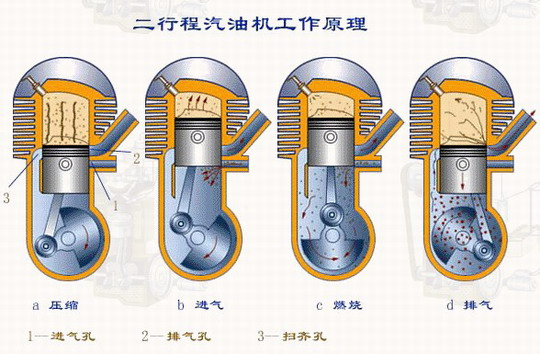
(c) first itinerary: pistols move from point down to point up, gas mixed in the cylinder above the piston is compressed in advance and new flammable hybrid gas is inhaled from the carving tank below the piston. Second itinerary: pistols move from top to bottom, work and gas exchange processes are performed above the piston, while pre-compression of flammable mixed gas is performed below the piston。
Iv. Activation of diesel engines for the second journey
The two-way diesel and two-way petrol machines work in a similar manner, unlike the diesel engines that enter the cylinders not flammable mixed gas, but pure air. For example, a two-way diesel machine with a scavenging pump works as follows (figures 1-28):
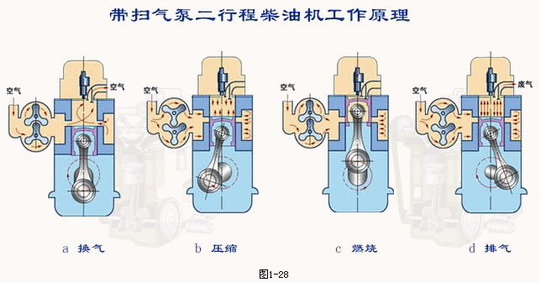
The first process: pistols move from point down to point up, and shortly before the start of the process, the vents and vent doors were opened to use the air flowing from the cleaning pump for air exchange. As the piston continued to move up to the gas vent, the vent door was closed and the air was compressed, and when the piston approached the point of cessation, the oil dispenser sprayed high-pressure diesel fuel into the incendiary chamber in the form of fog, burning the fuel and air mix, increasing the pressure inside the cylinder. Second course: pistols stop from the top stop point down, start with gas expansion, drive the piston down, perform external work, when the piston goes down to about two-thirds of the journey, the exhaust door opens, the exhaust gas is discharged, the pressure in the cylinder is reduced, the gas hole is opened, the gas is replaced, the gas is replaced until the piston moves up to one-third of the vent is closed。
V. The operation of multi-cylinder engines
So what difference does it make between a single-cylinder engine and a single-cylinder four-cylinder engine? With regard to the energy conversion process, each of the cylinders of the engine works exactly the same way as the single-cylinder machine, passing through the four processes of infusion, compression, performance and ventilation. However, only one of the four single-cylinder motors worked, and the remaining three were inactive, i. E., two curved axes, and only half-circleed, so the smoother and more efficient the smoother. In order to operate smoothly, single-cylinders are generally equipped with a large flying wheel. The multi-cylinder engine, on the other hand, works in the order in which it works, i. E. In two circles, and therefore functions smoothly and with little vibration. The more tanks there are, the smaller the angles of working space, and the more cylinders involved, the smoother the engine works. There are four-cylinder engines, six-cylinder engines and eight-cylinder engines most used。