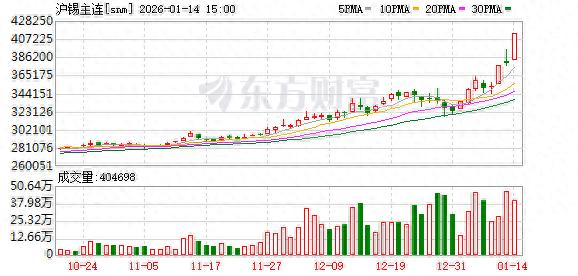
On 14 january beijing time, the price of tin metals continued to soar, and the lme tin plate at one point broke by $52,000 per ton in the futures market, at a historical high. On the domestic market, tung-cing's main contract portfolio was soared that by the end of the day, tung-cing's main contract was soared that 413170 yuan per ton was reported and synchronized to record highs。
Since the beginning of 2026, the cumulative increase during the year of the zion master contract has reached 27. 95 per cent, second only to the broad-term lithium carbonate master contract。
Why is the tin price so strong? On 14 january, during an interview with the daily securities journal, the tin analyst of the shanghai steel union agency for precious metals stated that the price of the tin period was higher than ever before and was the result of a resonance of supply, demand and macro-finance。
Guo zheng further indicated that the strength of the tin price stems from the market's perception of lower-than-anticipated output in myanmar, that the level of imports of tin mines in myanmar has in fact increased significantly than in the previous period, and that many research institutions have been very good at boosting demand, such as ai, light-voltage and new energy sources, and that increased prices of tin have been at the top of the list as a result of increased macro sentiment。
In fact, market risk rebounded at a time when capital markets were active, becoming one of the driving forces behind the recent surge in many metal varieties in futures markets. Yuan wah ming, general manager for the rich, said to the journalist that the fed’s interest rate-rate tempo and geo-risks could also affect the mood of large commodity investors, and that when market risk-averse sentiment increases, capital flows to precious metals, such as gold, silver, and so forth, capital flows backwards to basic metals, such as copper, aluminium, and nickel。
As a result of the strong futures market price rise, the spot market, on 14 january, also experienced a synchronous rise in tin prices, with the mysteel data showing a sharp rise of 7. 6 to 412,000 yuan per day per day。
Referring to the impact of high prices of tin metals futures on the spot market, guo zheng stated to the daily securities news that the prices of tin metals were fluctuating in the same direction, that the current prices of tin futures were more resilient and that futures prices were expected to raise prices。
He said that the market's short-term futures boom would lead to spot price quotations and re-engineered the pricing benchmark, and that the corresponding enterprise risk management situation would increase。
“the current spot market for tin metals is more dominated by futures sentiment, but price transmissions exhibit non-linear characteristics, especially in the context of a concentration of funds, where futures premiums continue to expand, prompting spot prices to follow passively.” kwok cheng indicated, “however, end consumption has not returned to warming simultaneously, it has become significantly weaker because of high price constraints, and the demand for a replenishment has been delayed. While the long-term demand logic, such as new energy sources and electronics, has not changed, short-term industrial chains have limited capacity to withstand, the convergence of springs is approaching and markets are becoming more cautious.”
Various institutional studies have shown that the continued high prices of tin have begun to curb the demand for end-to-end purchases and that the capacity of downstream welding enterprises to withstand the current high prices of tin is at their limit. Market transactions are sustained only with a small amount of rigid demand, which is generally cold, and downstream firms generally turn to viewing because of excessive prices。
“the current excessive increase in tin prices has caused traders and downstream processing firms to suspend their foreign offers, to wait for a high level of emotion, to have little real deal, and to have some early stoppages, which has led to a steady contraction of spot-lifting water.” guo zheng also spoke to the daily securities journal。
With regard to future price trends in the spot market, guo zheng was of the view that, in the short term, the tin metal period was now deflated from risk accumulation and, if funds were to retreat, the spot might be under pressure to fall back. In the long run, however, he believed that there was still potential for high tin prices。
On 14 january, as a result of the sharp rise in tin prices, the a stock market saw a significant increase in the number of tin-related coloured shares, such as the 7. 74 per cent increase in silver tin, the 8. 61 per cent increase in tin shares and the 6. 47 per cent increase in chinese tin colour。