“the exchange rate of the renminbi broke seven”, “the japanese yen depreciated”, “the dollar plunged”.
These are some of the news we've seen in the last two years. But do you really understand the exchange rate? What factors will influence changes in exchange rates? What deeper economic problems do they reflect
Exchange rate
The exchange rate, which refers to the rate of conversion between the two currencies, may also be considered as the value of the currency of one country to another。
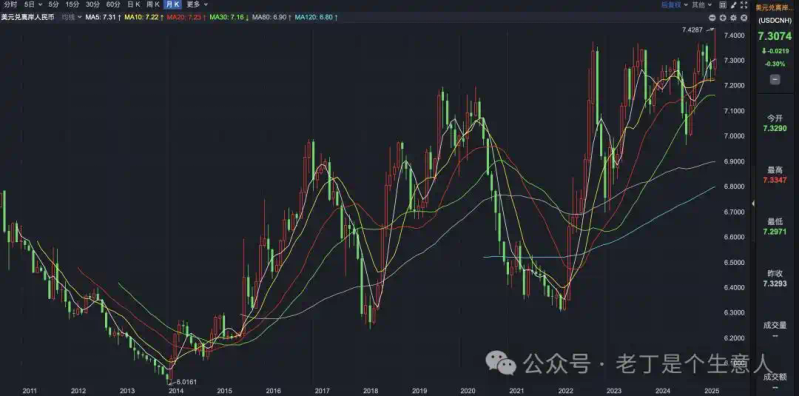
When you see a dollar = 7. 3 yuan, it means you have to spend $7. 3 to get a dollar. This is the exchange rate of the renminbi against the united states dollar. In a few years, eight yuan were converted to one dollar, and the renminbi then went up to six yuan in 2014 to one dollar (as shown in the figure)。
At that time, the media said that the renminbi was not appreciated and would hit exports. When the yuan depreciated to 7. 3 yuan to $1 these years, the media said that the devaluation was bad and that there would be capital outflows. So which is the relative good
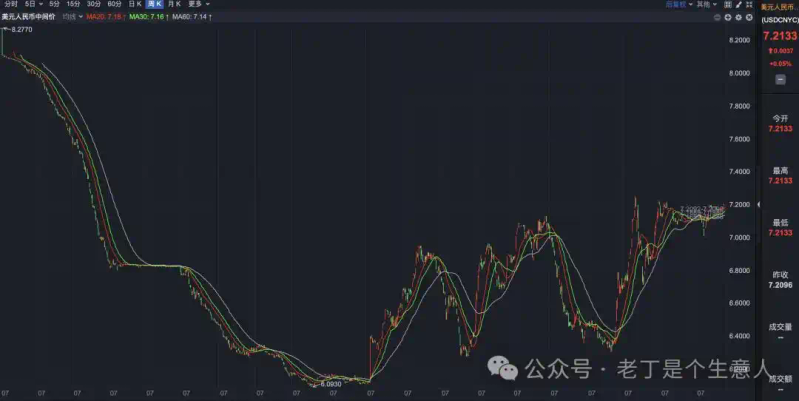
First of all, we need to know that changes in the value of exchange rates are not determined by anyone's head but by global capital flows, so they change every hour。
If you have to travel abroad, study abroad, or you are a trade importer, then you often have to convert the renminbi into foreign currency, because you have to buy overseas goods in foreign currency. At this point, of course, the rmb is more expensive, and more goods can be bought with fewer rmbs in exchange for more foreign currency。
But if you're an export, or if you're a foreigner who comes to china for consumption, then you'd prefer the renminbi to be depreciated more, because you export foreign currencies such as the dollar, the yen, the pound, and so forth. If the renminbi is depreciated, you can get more yuan to pay and consume domestically。
So for individuals, the best thing is that before you leave the country, the renminbi is 1 to 6 dollars, and when you return from your tour, the renminbi is 1 to 7 dollars。
For countries, however, the speed and size of exchange rate changes over time are more complex. Changes in exchange rates will affect the monetary policy of a country, asset prices and even the economic security of a country。
In venezuela, for example, the currency has collapsed – because of the high level of capital outflows, the country’s currency has depreciated by hundreds or thousands of times, and many of the country’s commodities are import-dependent, and when the dollar is used to import goods, it causes imported inflation because the currency depreciates too fast, so that people’s wages are not enough to buy daily consumer goods, which is the downside of a large devaluation。
But why does the media often criticize the appreciation of the renminbi in the early years, before 2014
At that stage, the composition of the chinese economy was dominated by exports. Promoting commodity exports was the best way to boost the economy for private enterprises at that time, and exchange-rate appreciation was precisely what would crush exports, so china did not like currency appreciation that much at that time. By now, china has become an economy dominated by domestic demand, and the chinese economy now needs more exchange-rate stability. So today's renminbi is just as unwelcome if it depreciates。
Changes in exchange rates
International financial flows are the direct cause of exchange rate movements. So spreads between countries are the first factor influencing exchange rate movements. Capital is on a profit-oriented basis, and it always goes to places with higher returns。
As a result, when one country has higher interest rates than others, it is easy to attract inflows of foreign capital, and its currency will appreciate as a result。
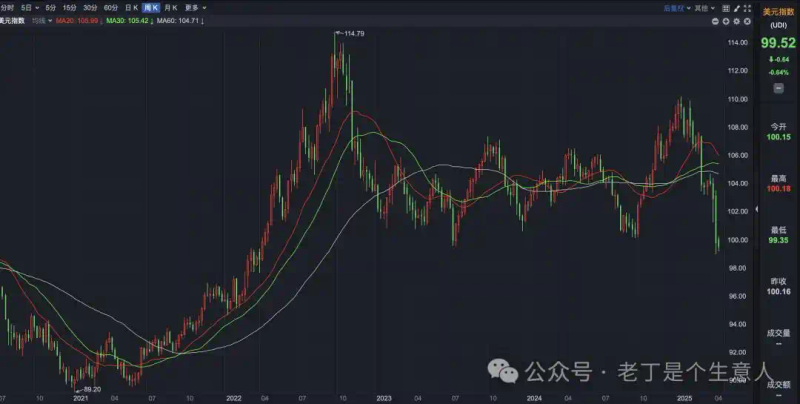
From march 2022, for example, the fed started a radical interest-rate cycle in response to high inflation, raising the benchmark interest rate to over 5 per cent, which means that if the funds went directly to buy the us government debt, they would also have an annualized return of about 5 per cent。
So, this has led to a lot of international capital flows to the united states, so we also see that the dollar index has grown rapidly over this period, at a peak of close to 115, up by almost 20 years (as shown). At the same time, other countries experienced varying degrees of devaluation。
But let's see, argentina and venezuela have very high interest rates. Why don't we all go there? Because its inflation is too high
Changes in exchange rates are ultimately attributable to changes in purchasing power。
So if a country is experiencing high inflation, then the purchasing power of the currency will continue to decline, although interest rates are high, but if investors and consumers hold the currency, the risk of inflation will be higher than interest rates, so even venezuelans would prefer to trade in “hard currency” like the dollar。
On the contrary, some countries with lower inflation rates, such as switzerland, have relatively more stable currencies in the long run and will have stronger exchange rates。
Beyond that, of course, multiple factors, such as international trade, monetary policy, politics and capital expectations, have an impact on exchange rates。
China’s continued trade surplus over the past two decades is also one of the fundamental factors underpinning the long-term appreciation of the renminbi against the united states dollar, namely, the impact of international trade on exchange rates, and the fact that trade has also boosted capital inflows to china。
Moreover, during the russian-uu conflict, russia’s currency, the ruble, was once sharply depreciated, and some businessmen who exported to russia, were in the process of losing their profits. According to their friends in russia at the time of the russian-ukrainian conflict, the goods they sold daily in russia had to be converted into chinese currency the same day, otherwise the ruble’s price could not have been so volatile. Similarly, the british pound fell by more than 10 per cent against the united states dollar following the “deutsche” referendum
Thus, political stability in a country region is also a central factor in the stability of exchange rates。
However, not all countries have fully marketed floating exchange rate regimes. Many countries have “managed floating exchange rates” in place, meaning that, in addition to the exchange rate’s own market fluctuations, when it comes to certain stages, the central bank will also be able to stabilize the exchange rate within a given region。
In china, for example, in 2023, the renminbi experienced a short-term rapid depreciation against the united states dollar, when central banks used to “stable” the renminbi exchange rate several times through the “reverse cycle factor” mechanism, as well as through window guidance。
The exchange rate is therefore not an isolated financial indicator, but rather a change resulting from the dynamic playing of capital flows, macroeconomic fundamentals and market sentiment。
Iii. Current exchange rates and their impact
Then we look at today's exchange rate of the renminbi against the united states dollar at 7. 3. A few days ago, the renminbi was once depreciated to 7. 4 because of a short-term panic in the market as a result of a tariff battle. The mood began to ease these two days, so the renminbi appreciated back to 7. 3。
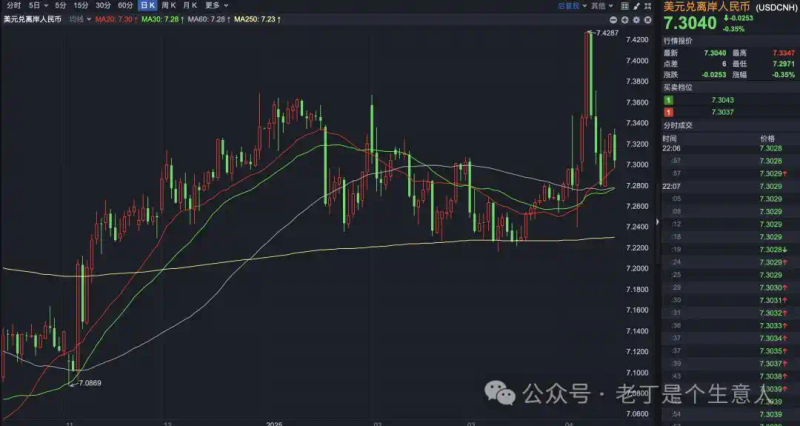
The exchange rate would appreciate only if it began to flow to china, and vice versa, if it continued to flow out of china, it would depreciate。
Then, as everyone knows, china’s economy has been emphasizing stability for the last two years, because the rate of economic growth is now slightly slower than in the past, and capital has come to china, and investment stock markets have not been easy, investment in real estate has not been so bold in the previous two years, and investment cycles have been long。
So now, if much of the money is to be found from around the world in relative assets, china, in the context of interest-rate reductions and higher rates abroad, needs to prevent financial outflows and avoid large exchange-rate fluctuations。
If a region continues to drain, it is prone to a chain reaction, such as thailand during the asian financial crisis in 1998, where international speculative capital began to flow out of thailand for fear of devaluation, but where thailand’s central bank also worked to stabilize it, thailand’s foreign exchange reserves were too small to stop the devaluation。
The sharp devaluation of the thai baht at that time also led to a sharp devaluation of thai assets at thai baht prices, with real estate and equities beginning to devalue, causing further panic and increasing the sale of thai assets and thai baht。
So today we go back to the report on the work of the government, and we can often see the phrase, “to keep the bottom line free from systemic financial risks”。
That means that what happened in thailand, japan and other regions in history cannot happen, and that policy holds the bottom line。
That is also why we believe that the probability of a substantial devaluation of the renminbi this year is very low。
Of course, because of the complexity of the current international situation, we also do not believe that the renminbi will appreciate much later。
It's more likely to be stable between 7 and 7. 5。
It is also interesting to note that if we compare the movement of the renminbi against the united states dollar with the trend of 300 shares of a, there are also interesting phenomena (as shown). As can be seen in the broad trend, from around 2015 onwards, when the renminbi exchange rate shifted from appreciation to devaluation, it tended to correspond to the chinese stock market’s highs, such as when the chinese stock market began to fall in may 2015, and when the renminbi’s exchange rate began to depreciate. When the exchange rate shifted from devaluation to appreciation, it tended to correspond to the low point in the chinese stock market. By the end of 2018 and the end of 2019。
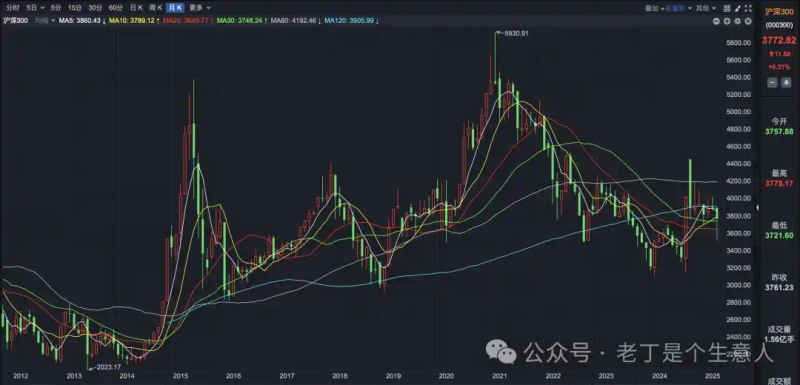
This, however, is only a phenomenon that i have observed, and it corresponds to a large trend, and we do not have more data to support it. Since international capital inflows to china would result in a renminbi appreciation, those flows would not necessarily flow to the chinese stock market. It is also possible to buy chinese property or invest in business. However, such funds, if more, would indeed contribute to improving china’s economy, which, as long as it is well, tends to improve its stock markets。
Thus, the relationship between exchange rates and stock markets can only be said to be a phenomenon and a logic of indirect impact, but the conclusion cannot be fully defined as a negative correlation。
End:
Here, i think you know more about exchange rates。
For us in general, understanding exchange rates and understanding the logic of their change will help us to make future decisions in our favour at a time when exchange rates change。
Bearing in mind that exchange rates rise, tourism abroad is more economical, exchange rates fall and exports are easier to carry out
In the future, if the rmb exchange rate is broken again, or if you see another currency depreciated dozens of times, i hope you will take better advantage of that timing。
I'm ding, my friends. See you next time