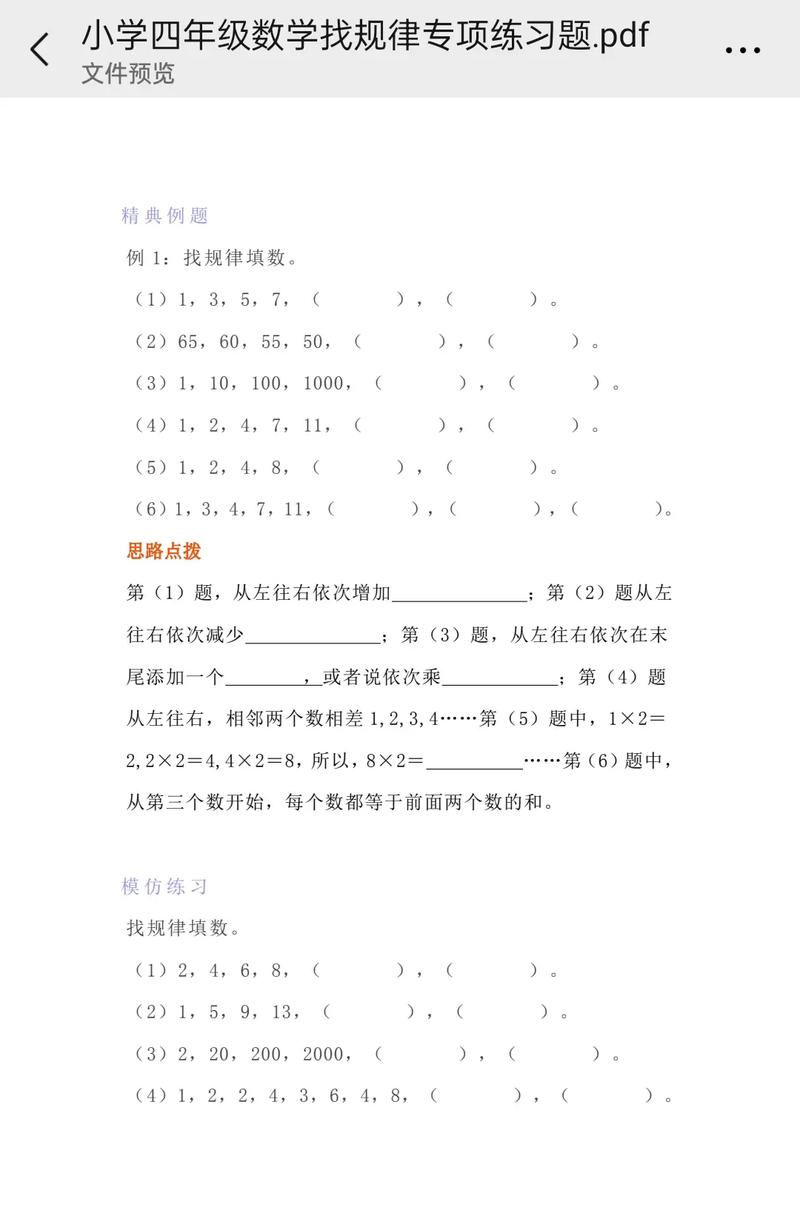
(ii) page1page2 1. The analysis of the number of series of numerical patterns requires us to think flexibly, without a static approach, and sometimes with a combination of other knowledge, a method that does not work, adjusts thinking in a timely manner and re-analyses it in a different way. 2. For the numbers distributed in some maps, the patterns of change between them tend to be related to the special position of these numbers in the graphics, which is a breakthrough in the resolution of such problems. 3. For a pattern to be found, it should be appropriate for all numbers in this group or for all algorithms in this group. Ii. Exact [question 1] fill in the appropriate number at zelig according to the order in the following table. [guide navigator] the numbers in the table are carefully observed and analyzed: 12+6 = 18,8+7 = 15, i. E. The number in the middle of each row equals the sum of two on both sides. In this pattern, the number of spaces to be filled is: 4+8 = 12. Practice 1: find a pattern and fill in the appropriate number at zegli. [answer 1 13 (2) 2 (3) 20] [case 2] on the basis of the relationship between the numbers in the previous graphics, what should be added in the brackets of the third figure? The thought-based navigation, carefully observed and analyzed, reveals a relationship between three numbers in the first two circles: 5x12÷10=6
4x20÷10=8 based on this pattern, the number to be filled in the bottom right corner of the third circle is 8x30÷10=24. Practice 2: on the basis of the relationship between the medians of the preceding graphics, think about the number to be filled in by the cyres of the third graphic. The full text of rule (ii) is currently page 1. (1)
The full text of rule (ii) is currently page 1. (2)
(3)
[the answer] (1) 15 (2) 7 (3) 60,20 [case 3] calculates the first of the next set of algorithms, then identifies the pattern in it and writes directly the scores of the latter according to the pattern. 12345679 x 9=
12345679 x 18=12345679 x 54=
12345679 x 81 = the first factor for each algorithm in the [wielding navigation] question is 1234679, which is an interesting “negative 8”, multiplied by 9 and results in nine digits consisting of nine one, namely: 111111111. It is not hard to see that the rule in this cluster is that, as long as the second factor in each equation includes several 9, the multiplier contains several 1111111. For: 12345679 x 9 = 111111, so: 12345679 x 18 = 12345679 x 9 x 2 = 2222222212345679 = 54 = 12345679 x 9 x 6 = 6666666666
12345679 x 81 = 12345679 x 9 x 9 = 999999999. Practice 3: find a pattern, write a number. (1) 1+0x9 =
2+1x9 =
3+12x9 =
4+123x9=
9+12345678x9=(2)1x1=
11x11=
111 x 111 =
11111111111111 = (3) 19+9x9 =
118+98x9 =
1117+987x9=11116+9876x9=
11115 + 98765 x 9 = [the answer] (1), 11, 111, 1111, 1111111(2) 1, 121, 12321, 12345678987654321 (3) 100, 1000, 10,000, 100,000, 100,000 [case 4] for regular calculation. (1)81-18 = (8-1) x 9 = 7 x 9 = 63 (2) 72-27 = (7-2) x 9 = 5 x 9 = 45 (3) 63-36 = (-) x 9 = 9 = [wielding navigation] after careful observation and analysis, it can be found that a two-digit number is reduced by the ten-digit and one-digit position where it is exchanged, and if the difference of ten-digit and one-digit is multiplied by nine, the sum of the two is the difference. Practice 4: calculate using regularity. The full text of rule (ii) is currently page 2. (1) 53-35
(2) 82-28
(3) 92-29
(4)61-16
(5) 95-59 [seminar in the 4th grade of primary school] looking for a pattern (ii) consists of three pages and is currently page 2. 2. Search for regularity. (1)62+26=(6+2)x11=8x11=88(2)87+78=(8+7)=11x11=15x11=165(3)54+45=(+)x11=x11=[the answer]1(1)18(2)64(3)45(5)362. 54+45=(5+4)x11=99 [case 5] calculated (1)26x11
(2) 38x11 [wideline navigator] a two-digit number multiplied by 11, which is the sum sought if the two-digit number are inserted between them. (1) 26 x 11 = 2 + 6) 6 = 286 (2) 38 x 11 = 3 (3 + 8) 8 = 418 note: if two numbers are equal, one step forward. Practice 5: compute the following topics. (1)27x11
(2) 32x11(3)39x11
(4) 46x11(5)92x11
(6)98x11 [the answer] (1) 297 (2) 352 (3) 429 (4) 506 (5) 1012 (6)078 [the fourth year of primary school] the search for the pattern (ii) consists of three pages and is currently on page 3. The full text of rule (ii) is currently page 3。