[table]
Classification and operation of dry pumps
1. Paw dry pump
Turbo dry pump
3. Graft dry pump
Rotz dry pump
Classification and operation of molecular pumps
Turbo molecule pump
Magnetic suspended molecule pump
Iii. Rationale for cold pumps
Structure of cold pumps
2. The operation of cold pumps
3. Advantages and disadvantages of cold pumps
Vacuum pumps are core parts for systems to acquire a vacuum environment and are widely used in dry processes that require higher requirements for the vacuum environment, such as semiconductor integrated circuit membrane deposition, corrosion, ion injection, etc。
Vacuum pumps are devices that use mechanical, physical or chemical methods to create, improve and maintain a vacuum environment, consisting mainly of the three main categories of dry pumps, molecular pumps and cryogenic pumps。
Classification and operation of dry pumps
Dry pumps ejected gases through electric-driven rotors to achieve pumping functions, including claw, vortex, rotz and screw vacuum pumps, in a wide range of applications。
Dry vacuum pumps have become the preferred part of the semiconductor industry, accounting for 60 to 70 per cent of the market, with advantages such as oil-free pollution, wide-breath range, corrosive resistance and low energy consumption。
Dry pumps are the core ancillary equipment in the main process equipment for integrated circuits and can be used in multiple stages such as single-crystal silicon manufacturing and crystal round processing。
Dry pumps provide the super-clean vacuum environment necessary for the manufacturing process for thin membrane, corrosive, ion injection (about 70 per cent of the main process) of three of the four core processes of the crystal round pre-process process and complete the physical and chemical gas deposition, corrosive, ion injection, etc。
In addition, in addition to meeting the requirements of the integrated circuit process for a vacuum environment, as a gas transmission device, dry vacuum pumps can also remove process gases and reaction-generated complex gases or solid mixtures from integrated circuit manufacturing equipment to safeguard the dynamic balance of process requirements。
The dry pumps vary according to structure and operation, and are divided into claw vacuum pumps, vortex vacuum pumps, rotz vacuum pumps and screw vacuum pumps。
1. Claw-type dry pump
The pump cavity contains several pairs of condensed claw rotors. The absence of contact between the rotor and the rotor and between the rotor and the pump cavity, leaving a small gap without any lubricant, ensures a clean vacuum。
The structure of the pump is in the form of a multi-stage chain of rotors, each of which is located in a different pump cavity for simultaneous reverse movement. The pump cavity is separated by the claw-type rotor into the inhaler and ventilator。
The purpose of the pump is achieved with the continuous operation of rotors and the conduct of a cycle of inhaling and exhausting. Pistol dry pumps have a faster rate of gas extraction and a high flow processing capacity; at the same time, they can treat fine dust-containing gases。
In the semiconductor area, the claw dry pump can be applied in areas such as corrosive, front-stage pumps for ion injection equipment, vacuum transport cavity pump。
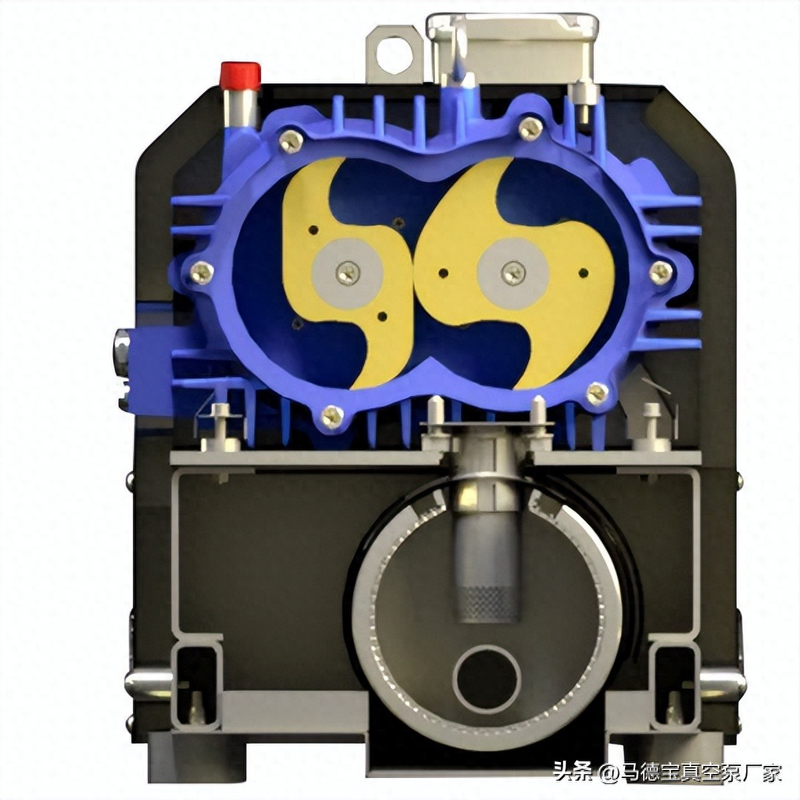
(caw dry pump, map source network)
2. Turbo dry pump (scroll dry pump)
Through the rotation of two vortex disks, the new moon-shaped cavity that constantly changes between the two vortexes achieves the effect of compressed gases. Turbo dry pumps are more energy efficient than some screw dry pumps。
Turbo dry pump does not apply to gases containing dust or droplets. In the semiconductor area, vortex dry pumps can be applied in such areas as carving, front-stage pumps (with molecular pumps) of the cvd/pvd process, and vacuum transmission systems。
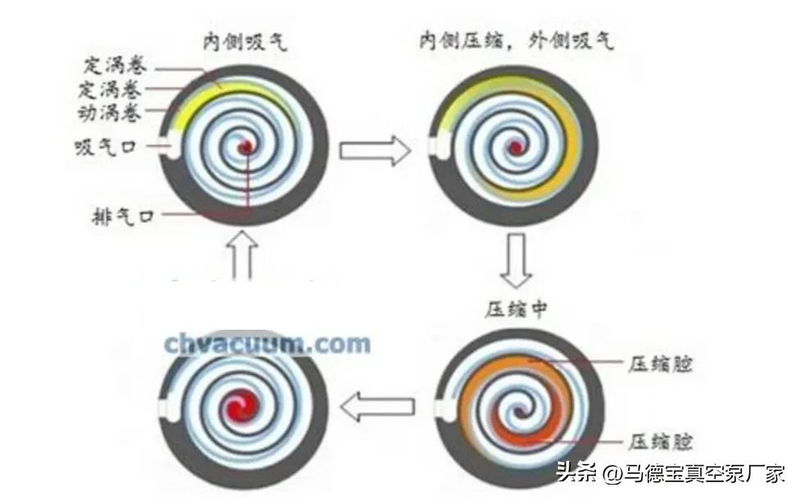
(vortex dry pump, map source network)
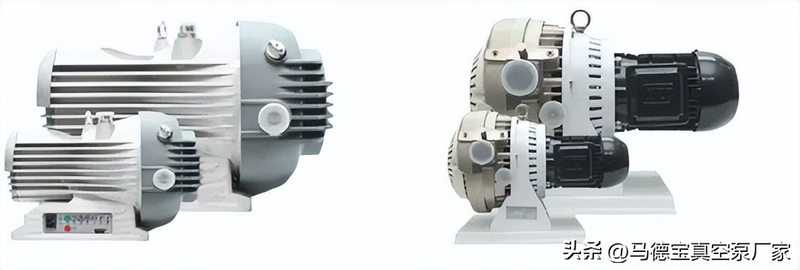
(turbo dry pump product map, source network)
3. Screw dry pump
It is a gas pump that uses a pair of screws, which act as a synchronized high-speed reverse rotation in a pump shell, with a finely finely balanced calibration, supported by an axle, and which has a certain gap between the screw and the screw, so that when the pump works, there is no friction, smooth operation, low noise, and the work cavity does not need lubricants。
In cases where a screwdriver dry pump is capable of removing gases containing large amounts of water vapour and small amounts of dust, the limit vacuum is higher, the power consumption is lower, and there are advantages such as energy saving, and exemption from maintenance。
The screwdriver dry pump has a continuous compression, no pulse flow, and is suitable for treating high humidity or liquid droplets. In the semiconductor area, screwdriver dry pumps can be used for dry etching, chemical phase deposition (cvd) front-stage exhaust; they can treat corrosive process gases (e. G. Cf4, cl2)。
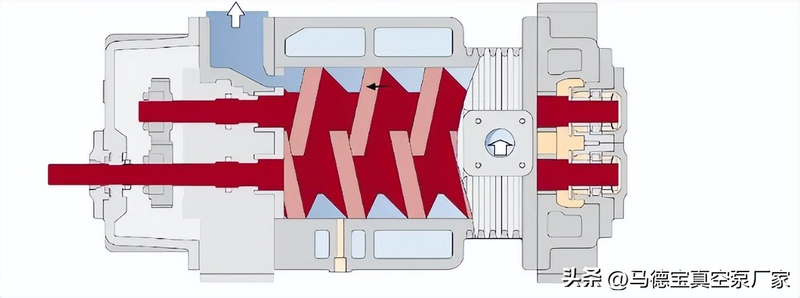
(snail dry pump, map source network)
Roots dry pump
The pump contains two synchronous revolving leaves in the opposite direction, a disfigured vacuum pump with a small gap between the rotor, the rotor and the inner wall of the pump shell without contact. The rotz dry pump can reach a higher vacuum by matching the front-stage pump (snail dry pump, etc.)。
At the same time, the high flow advantage of the roz dry pump is clear and suitable for a fast-espiration scenario. In the semiconductor area, rotz dry pumps can be used for high-density plasma carving (hdp etching) front-stage exhausts to treat large-volume reaction gases (e. G. Sf6, o2); and the crude-spill phase of chemical gas deposition (cvd) equipment。
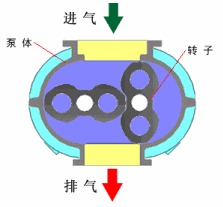
The roz dry pump works
The range of vacuums generated varies from one structure to another, as shown in the figure below。
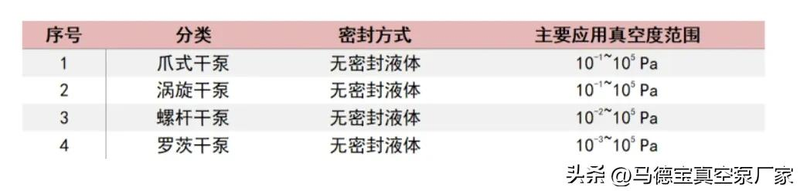
Figure source: description of the central and secondary science unit
Application vacuum range for different types of dry pumps
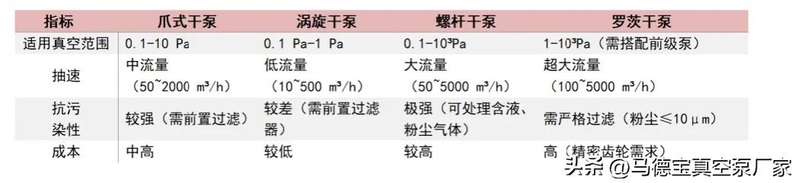
(performance of different types of dry pumps, map source network)
Classification and operation of molecular pumps
Molecular pumps pass the momentum through high-speed rotors to gas molecules, which gain directional speed and are pressured down to vents, mainly the turbine molecule pump and the magnetic suspended molecule pump, which is widely used in the semiconductor field。
Molecular pumps account for about 20-30 per cent of the semiconductor vacuum pump market and are suitable for high vacuum (10-3-10-10-10 pa) environments, such as optical carving machines (euv ultraviolet uv-dependent superhigh vacuums), ion injection machines, high precision membrane plating equipment, etc. Molecular pumps are complex and expensive and vibrate during high-speed rotation work。
Molecular pumps vary according to structure and working principles, and are divided into turbine molecule pumps (main industrial domain) and magnetic suspended molecule pumps (higher percentages of semiconductors, photovolts, panels)。
Turbo molecule pump
Its active or pump parts consist of rotors and stubbles. Turbo blades are located on the outer side of the beams and rotors and may be damaged if the pressure suddenly deteriorates during the work of the molecular pump。
The gas is pumped through a high vacuum into the boreholes of the franc to the gas area of the rotor and the cape, and the gas is compressed to the upper pressure or the pressure of the gross vacuum. Performance has improved in recent years and is widely used。
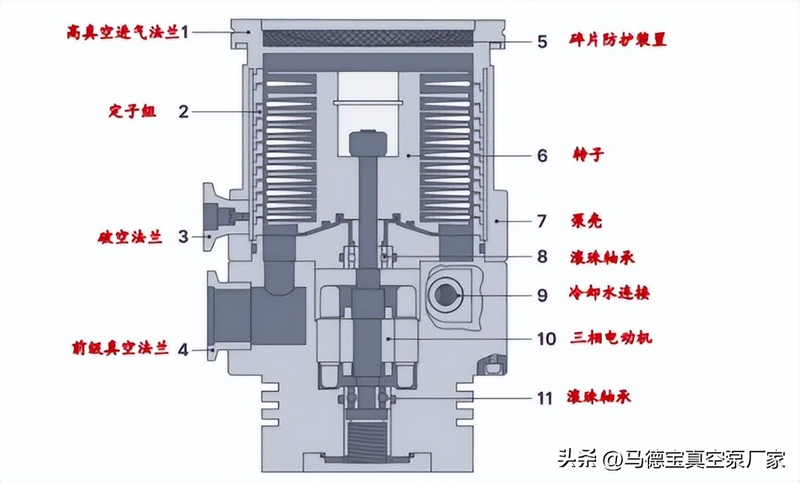
(turbot molecular pumping foundation map, source wafu securities institute)
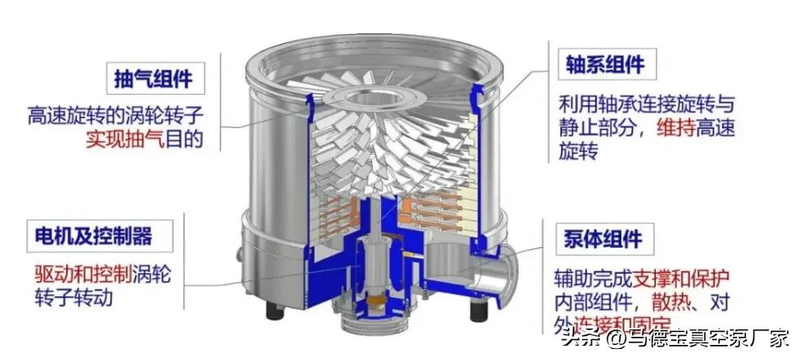
(turkile molecular pumps, map source public number: vacuum focus)
Turbo molecular pump application area:
Semiconductor manufacturing equipment, evaporation equipment, spattering equipment, analytical equipment, etching equipment, accelerators, fpd manufacturing equipment, etc。
2. Magnetic levitation molecule pump
The magnetic suspended molecule pump is a molecular pump using the magnetic suspended technique that combines both the magnetic suspension and the molecular pump techniques。
Molecular pumps are a device used to create a high vacuum environment to reduce gas pressure by removing gas molecules. Magnetic suspension technology, on the other hand, is a technique for suspension through a magnetic field and for controlling the movement of objects。
In the magnetic suspended molecular pump, the magnetic suspended technology is applied to the rotating components within the support and drive pumps, usually a leaf wheel. This is quite different from the way in which traditional molecular pumps use mechanical bearings or other support structures. Through the magnetic field, the wheel can rotate without physical contact, thus reducing friction and wear。
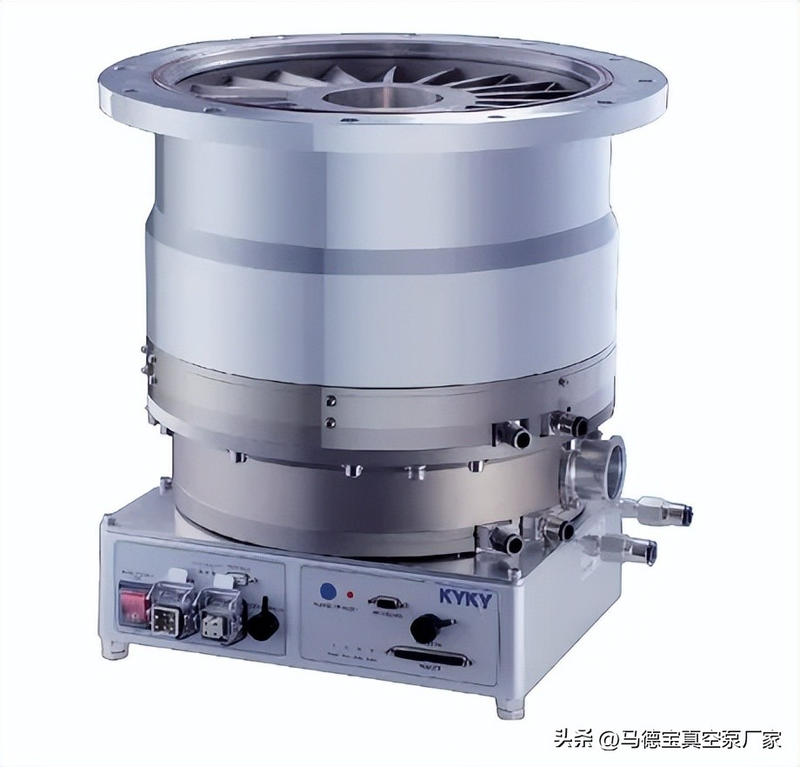
(magnetic suspension molecule pump, map source public: monowood capital)
Magnetic suspended molecule pumps use magnetic suspension technology, which leaves the wheel without physical contact with supporting structures during rotation. This no-contact design eliminated friction and wear and raised the lifetime of the pumps。
As there was no mechanical contact, the magnetic suspended molecule pump was oil-free and no lubricants were required. This is important for applications requiring an oil-free environment, such as in some laboratory and semiconductor manufacturing industries。
Iii. Rationale for cold pumps
Cold pumps, which use low-temperature surface condensation and adsorbing gases to pump gas, can reach a high vacuum of 10-10 pa, but because of their regular release and regeneration, the market is relatively small, at about 10 per cent。
It is widely applied in processes such as evaporation, spattering, ion injection, molecular beaming, etc., in semiconductor integrated circuit manufacturing, and in the lead cities such as vacuum plating equipment, electro-vacuary units, high-energy particle accelerators, controlled thermal nuclear reaction, surface analysis instruments and materials science。
Structure of cold pumps
The cold pump system consists essentially of cryogenic pump units (including chiller units), compressor units and hoses. The operation of cold pumps (low-temperature pumps cannot be activated under atmospheric pressure) and regeneration require a thick pump。
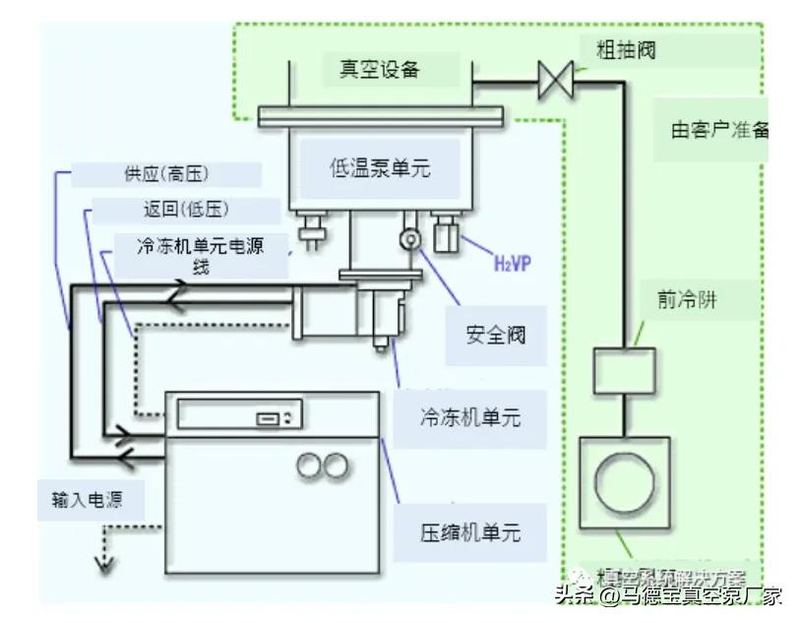
(construction of cryogenic pumps, map source public: vacuum system solution)
2. The operation of cold pumps
The cold pump is a storage vacuum pump with a very low-temperature layer within which gases can be captured by condensing and adsorption to achieve an ultra-high vacuum。
In addition, the availability of a clean vacuum free of oil pollution and with a higher rate of exhaust than other vacuum pumps was noted. The cold pump is a pump that absorbs gas molecules by condensing them at very low temperatures and storing all gas molecules in the pump。
The main characteristic of the pump is that there is no movement in the vacuum container, that there is no oil, that there is a clean vacuum, and that although it is adsorption, there is a high rate of exhaust。
A high vacuum is achieved through a 2-part formula。
Coldheads with two and one coldheads have greater refrigeration capacity and can cool down to below 80 k (calvin)。
So far, mainly the discharge of water, the next two colds cooled further and the molecules n2, o2, ar, h2 and so forth, to achieve a higher vacuum。
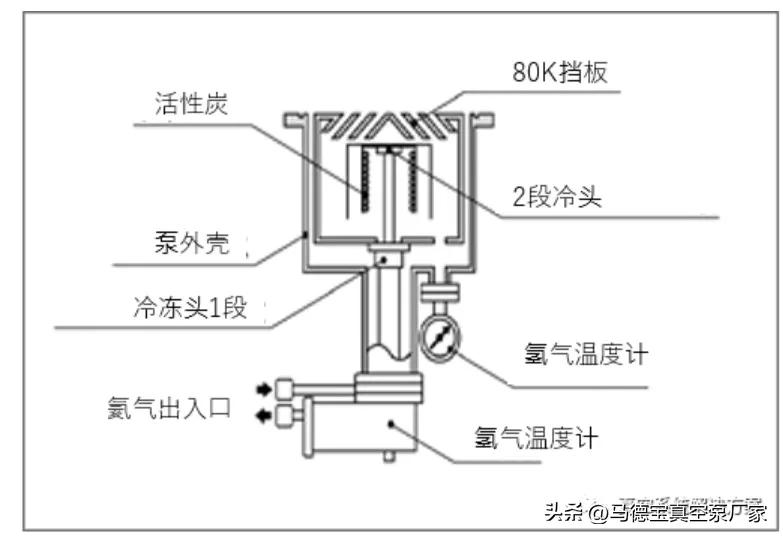
The real packaging contains very low-temperature surfaces, which capture the gas in the container with exhaust pumps by condensing and adsorption. A high clean vacuum can be achieved because of the small and non-oil use of mechanical motor components. In order for a cryogenic pump to be effective for venting, the vapour pressure when condensed must be less than 10-8pa when adsorbed。
The figure below shows the vapour pressure of each gas, which is lower than the vapour pressure of the nitrogen gas and below 10-8pa when it cools to below 20k at very low temperatures (low temperatures or low temperatures)。
Gases with high vapour pressure, such as hydrogen, helium and americium, cannot be vented through condensation at 20k, so they are vented through adsorbents up to 20k. In this way, cryogenic pumps can drain all gases to achieve an ultra-high vacuum。
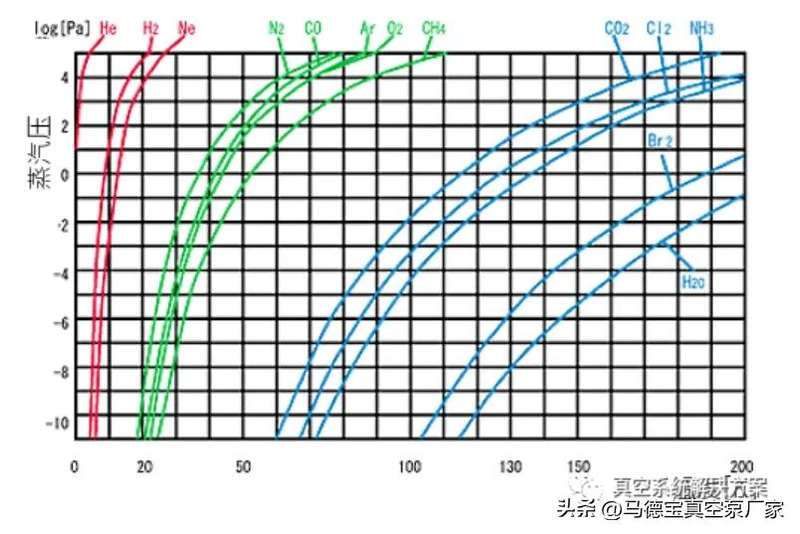
The form of formation of frozen surfaces is usually a small helium freezer with closed circulation. Low-temperature pumps use small helium chillers and do not require regular resupply of refrigerants like liquid-type cryogenic pumps, with clean super-high vacuums that can be operated over a long, stable period of time。
3. Advantages and disadvantages of cold pumps
Advantages: all gases can be excreted to achieve super-high vacuums。
Shortcomings: regular releases and regeneration are necessary because of storage pumps。
Iv. Size of the semiconductor vacuum pump market
The size of the semiconductor vacuum pump market has continued to grow, and according to the data provided by the cen, the total size of the vacuum pump market was rmb 11. 78 billion in 2020, rmb 13. 48 billion in 2021 and rmb 14. 73 billion in 2022, with an overall upward trend。
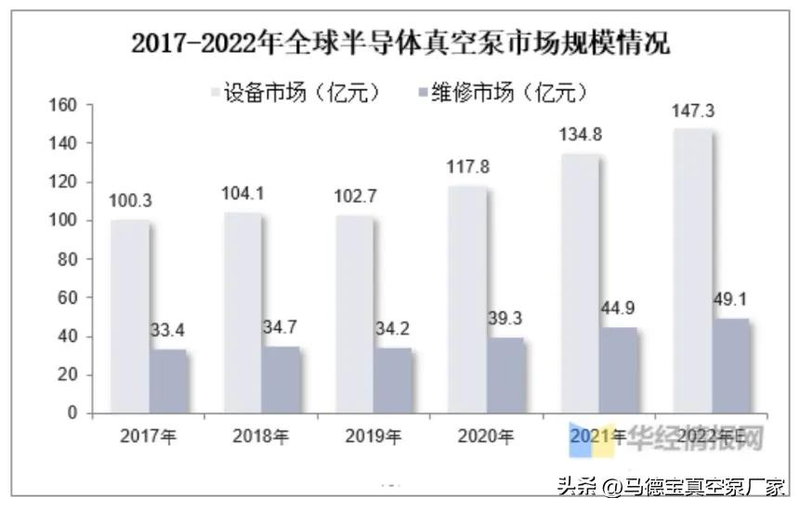
(global market size for semiconductor vacuum pumps, phin)