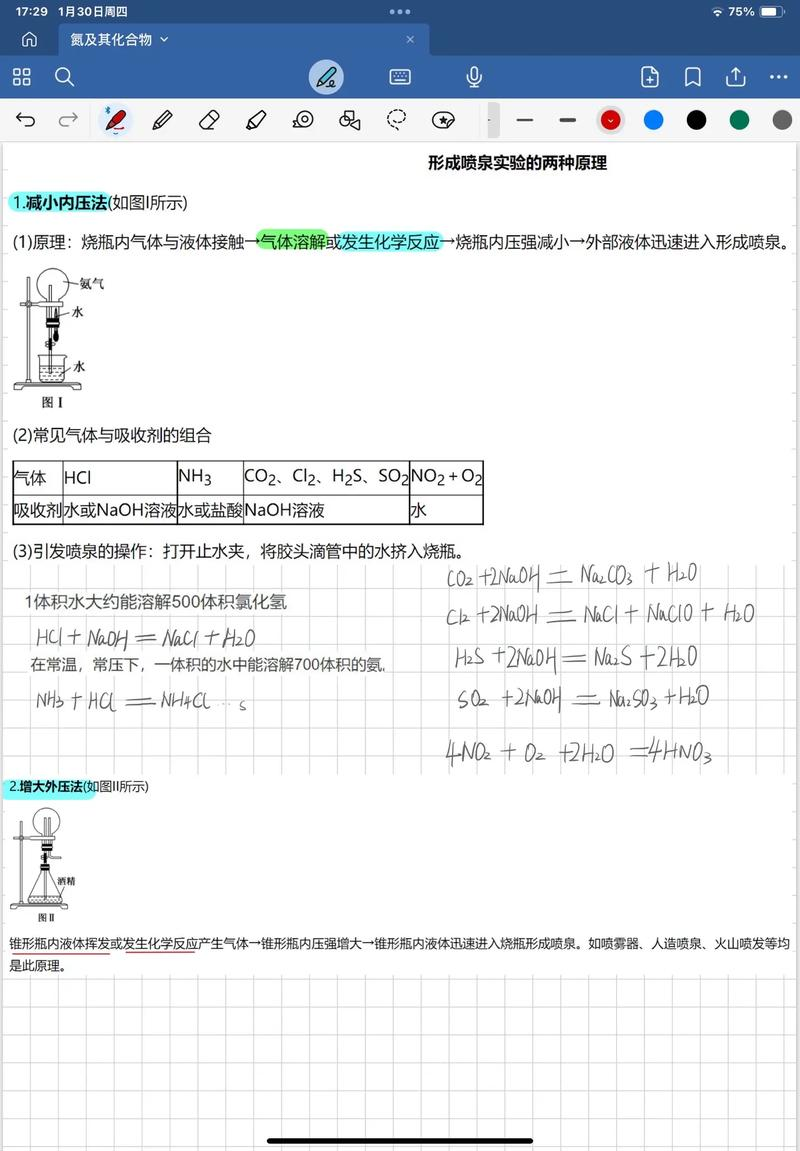
The operational principles of the national volcano micro-screen (7) experiment and the extension of the 1. Fountain experiments have resulted in large pressure differentials within and outside the flask in a short period of time, using atmospheric pressure to pressure liquids from the cups under the flask into the flask and to form a fountain at the tip of the mouth. 2. The gas types forming the fountain hclnh3co2, cl2, so2, h2sn2no2, o2(4∶1) absorbent water, dispersive devices from the naoh solution water naoh solution water 3. The test of the fountain and the operation methods in teaching materials (dispersion sources) may design different devices and use different operations (e. G. Solution of gases in water, heat or cooling, gas generation, etc.) to form the fountain as shown in the figure. Design description: (1) device (i) changes the position of the duct drip tube, which squeezes into the reagent bottle a small amount of water, allowing a small amount of solution to enter the cylinder along the catheter, resulting in a large number of nh3 dissolved, creating a fountain with negative pressure in the bottle. (2) the device (ii) removes the glue drip tube, covers the heat vials with hands (or hot towels, etc.), the ammonia is heated, ejected from the air in the glass catheter, the ammonia is in contact with the water, i. E. A fountain occurs (or “cooled” bottles with ice-impregnated towels, so that the water enters the bottle and the ammonia in the bottle dissolves into the water). (3) device (iii) adds to the sink substances that increase the temperature of the water, resulting in the volatilization of alcohol in a cone bottle as a result of an increase in the temperature and increased pressure of gases in a cone bottle to produce a fountain. (4) a certain amount of h2s and so2 is inserted into the tube of the device (iv) and is produced by light yellow powdered material, with beads attached to the inner wall of the bottle and sprayed into a fountain of naoh solution. (5) the device (v) opens one stopper and slows into the flask an equal volume of hcl gas, then closes the stopper, until it is fully reacted, before opening two stopper traps, where white smoke is observed before creating a fountain. (6) in a device (vi), squeeze the glue drip tube and then open two pistons on the upper part of the catheter, smoke is sprayed on the right side of the flask and then open the lower piston of the catheter, which can produce double fountains. The determination of the quantity and volume of the substances soluble in the resulting solution is key to the calculation of the concentration in the test product of the fountain. The concentration of the substance after the test in the fountain is determined by the gas in the standard condition: (1) hcl, nh3, no2 gas or when they are intermingled with other insoluble gases: the mass concentration of the substance is eq\f (1,22. 4) mol l-1. (2) c (hno3) = eq\f (1,28) mol l-1 when the volume ratio of the mixture of no2 and o2 is 4:1. As shown in the graph, the flask is filled with dry gasa, and the liquidb in the drip tube is squeezed into the flask, softly vibrating the flask, and the liquidc in the cup is sprayed with a fountain and eventually almost full of flask, a and c are () option a (dry gas)c (liquid) and (a) the ano2 water bco24mol l-1cl2 saturated with nacl acid dnh31mol l-1 hydrochloric acid solution: 3no2+h2o=2hno3+no can form a fountain, but the water cannot be filled with a flask, error a; co2 is not soluble in hydrochloric acid, error b; cl2 is not saturated and nacl solution, cannot form a fountain, error c. Answer: d1. The following figure is a laboratory test device for ammonia soluble in water. The experiment showed that ammonia is a highly soluble gas b. The liquid color of entering the flask is changed from non-colour to red, and explained that the amino-alkaline c. Formation of the fountain is due to its solubility in water and its gas pressure in the flask is less than that of atmospheric pressure d. The chlorine gas is used to replace the ammonia gas, which can also be used for experimental analysis: cl2 is less soluble in water and cannot form a fountain. Answer: d2. The four tubes are filled with one of no, so2, no2 and cl2, respectively, and they are placed in a water-rich sink, and are fully placed as shown in the figure below. Of these, the original test tube is filled with no2 is () decomposition: according to 3no2+h2o=2hno3+no, the remaining gas is eq\f(1,3) before reaction, so item b is correct. Answer: b3. As in graphic devices, there is a gas in dry bottles and a solution in cups and drip pipes. C. H2s (cuso4)/black fountain d. Hcl (agno3 solution)/white fountain resolution: co2 is insoluble in sodium carbonate solution, cannot cause pressure differentials, cannot form a fountain, and item a does not correspond to the experimental reality. Answer: a4. The following is a sample of four fountain experiments designed by students of the extracurricular activities team: the following operations are unlikely to trigger the fountain: (a) the glitter tube of the squeeze unit 1 makes ccl4 fully enter the flask; (b) the glush tube of the stopper kit b. Squeeze device 2 is opened after a moment, the solution of naoh is entered into the flask; (c) the stopper is opened after a moment, and (c) the drum gas is used to keep the air in the air from a point of installation 3 and to open the stoper kit d. Slowly insert a sufficient amount of sulphuric acid in the water tank of the installation 4 and open the slurry of the water: h2 is insoluble in naoh solution, and cannot cause large pressure differentials inside and outside the flask bottle, so that the fountain cannot be triggered. Answer: b5. As the figure shows, the cone bottles contain gas x, the drip tube contains liquid y, and if pressure is pressed on the drip tube glue, the liquid y drops into the bottle, convulsions, and a small balloon a is visible. Gas x and liquid y cannot be () a. X is hcl, y is saturated salt water b. X is co2, y is rare sulphate c. X is so2, y is naoh solution d. X is nh3 and y is nano3 solution: when the liquid y drops into the cone cylinders and dissolves or reacts with the gas x, the pressure in the cone bottle is reduced, and the atmospheric pressure pushes the air into the small balloon a into the drum. Co2 is not soluble in and does not react to rare sulfuric acid, so it cannot be b, and other options allow small balloonsa to mobilize. Answer: b6. As graphed as a fountain test device used in chemistry teaching. A fellow student uses different components of the bottle for a fountain experiment. Please help analyse the concentration of the solution obtained in the bottle after the experiment. Assuming that the experiment is completed under standard conditions and the solution is non-proliferation). (1) for hcl gas, c(hcl)= . (2) for no2 gas, c(hno3)= . (3) c (hno3)= if a mixture of n (no2)∶n (o2)=4∶1. (4) c (hno3) = if a mixture of n (no2)∶ (o2)=2∶1. The volume of the gas is eq\f (v, 22. 4). (1) in the case of hcl gas, after the fountain, the solution is filled with a flask, the size of the solution is vl, c(hcl)=eq\f (\f(v, 22. 4)mol, vl)=eq\f (1,22. 4)mol l-1. (2) if no2, after a fountain, the solubility is hno3, 3no2+h2o=2hno3+noeq\f (v, 22. 4) xeq\f (v, 22. 4) x eq\f (v, 22. 4) vl, c(hno3)=eq\f(2(,3), x \f(v, 22. 4)mol)=eq\f (1,22. 4) (3) if n(no2)∶n(o2)=4∶1 mixture gas, n(no2)=eq\f(4,5)xeq\f(v,22. 4)mol, 4no2+o2+2h2o=4hno3eq\f(4,5)xeq\f(v,22. 4)mol (4,5)xeq\f(v,22. 4)mol, the solution is hno3 and the solution is full of flask, c(hno3)=eq\f(\f(4,5)x\f(v,22. 4)mol,vl)=eq\f(4,5)xeq\f (1,22. 4)mol/l-1=eq\f (1,28)mol l-1). (4) if n (no2)∶n (o2)=2∶1, reflect the remaining eq\f (1,6), the solution is filled with eq\f (5,6), the solution is hno3, calculated as (3), c(hno3)=eq\f (1,28) mol l-1. Answer: (1) eq\f (1,22. 4) l-1(2)eq\f (1,22. 4) mol l-1(3)eq\f (1,28) mol l-1(4)eq\f (1,28) mol l-17. The fountain is a common natural phenomenon, which is the result of pressure differentials. (1) production of ammonia gas and completion of the fountain experiment (the holding devices have been omitted)。1 a fountain experiment with a chart 1 device, with the upper flask filled with dry ammonia gas, which triggers a water spray, is . The rationale for the experiment is . If only the device as shown in figure 2 is provided, please describe the method of triggering the fountain: . (2) using the device of figure 3, each of the following substances is added to the conical cylinders in sufficient quantities, and the potential for a fountain to react is . A. Cu and rare hydrochloric acid b. Nshaco3 and naoh solutions c. Caco3 and d. Nh4hco3 and rare sulphuric acid (3) add alcohol to the conic bottles in figure 3, with a sink outside, and with cold water in the tanks, the following substances are added in sufficient quantities to produce a fountain. The substance added to the sink may be . Figure 1 and 2 shows the pressure in the top flask and figure 3 shows the pressure of the gas in the lower cone of (all filled with "enrichment" or "reduce"). The principles of artificial fountains and volcanic eruptions are similar to those of the above-mentioned device . Parsing: this is a major examination of the underlying principle of the formation of a fountain, i. E. The difference in pressure from the external surface of the cup (or conical bottle) inside the cylindrical bottle. (1) figure 1 triggers a fountain, with the sole requirement to open a stopper and squeeze a glue drip. Figure 2 requires first to open a water stopper, to put a hot towel over a rounded bottle, and then to remove the hot towel when a bubble emerges. (2) if the gas is capable of reaction within a conical bottle, so that the pressure is stronger than the pressure in a round bottom flask, the nh4hco3 and hydrochloric acid shall be chosen, and the others either do not react, or the reaction does not generate gas or very little gas, so the fountain cannot be formed. (3) enriched sulphate solubles in the water to release large amounts of heat, so that the alcohol in the bottle can accompanie the fountain. (4) figure 1, 2 reduces the upper pressure, figure 3 increases the lower pressure, and both artificial fountains and volcanic eruptions are similar to the principles of figure 3. Answer: (1) unlock the stopper, squeeze the glue drip tube, so that a small amount of water is dissolved into the nh3 part of the flask, reduce the pressure in the cylindrical flask, release the water in the cup into the cylindrical flask 2 and open the stopper with a hot towel covering the cylindrical flask until the bubble comes out of the water, removes the warm towels (2) d(3)a (4) reduces by 3