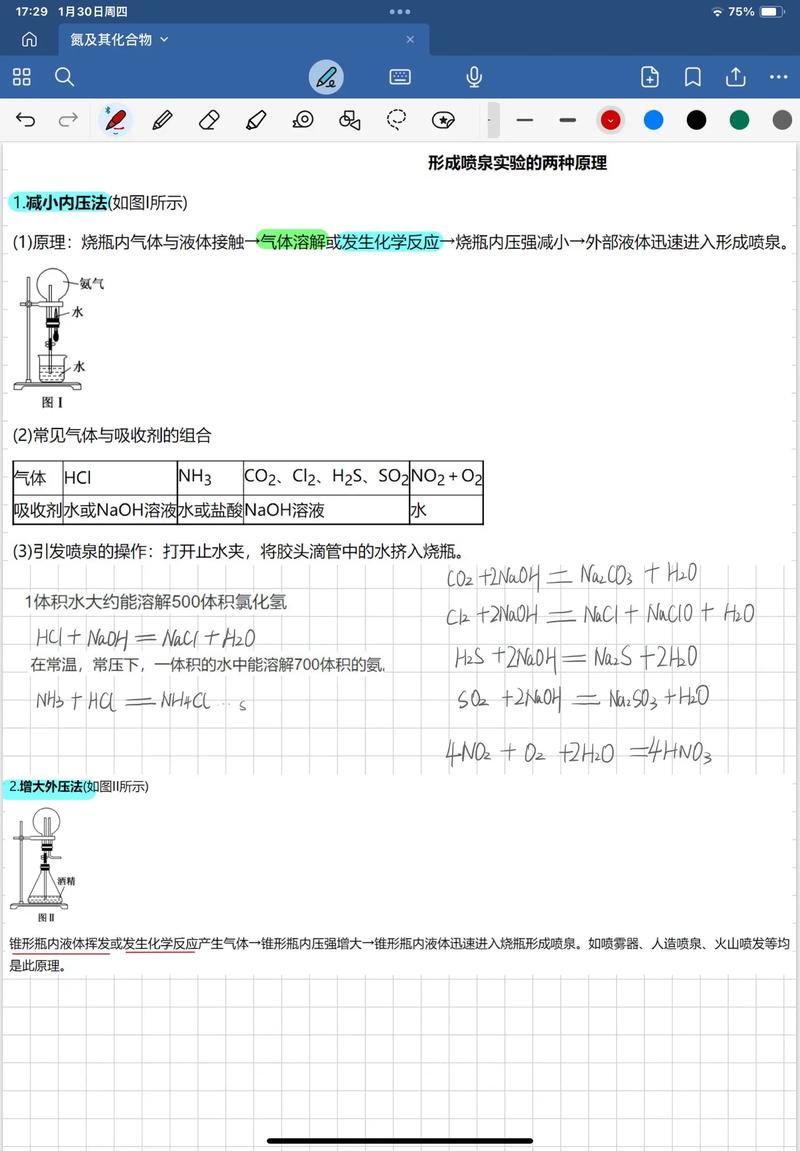
1. The essence of the test principle of the fountain (1) is that the internal and external pressure of the flask is low, and the liquid is pressured into the flask to form a fountain because the pressure of the gas in the flask is less than the pressure outside the flask. (2) operating method 1 which causes pressure differentials reduces the internal pressure of the cylinder, such as when the liquid absorbs or reacts to the gas. 2 increases the external pressure of the bottle. Common device (1), as in figure a (or b) flask, is highly soluble in water or chemically reacts with the soluble in solution, resulting in a rapid reduction of the internal pressure of the flask, opening of springs, and a rapid upward flow of liquids from the cups under atmospheric pressure, thus forming a fountain. Common substances are combined as follows: gases hcl nh3 co2, cl2, so2, h2s, no2 no2 or no2 and o2 absorbent water or naoh solution water or naoh solution naoh hydrochloride water (2) if a chemical reaction occurs within a figure c cone bottle, produces gas, so that the inner pressure of the cone bottle is increased rapidly and when the spring is opened, prompts the liquids in the cone bottle to move up quickly, thus forming a fountain. The critical (1) device for the success of the ammonia fountain experiment is of good air security. (2) round bottom bottles shall be kept dry. (3) the cylinder shall be filled with gas. (4) fill the cup with sufficient quantities of water to prevent the fountain from stopping or not occurring due to the lack of sufficient water. 4. The relevant calculations of the fountain experiment (1) were completed, and the solution was filled with flask and the amount of the dissolved substance was the same as that of the gaseous substance (as determined by volume conversion). Under standard conditions, if the flask volume is v l, there is v(aq)=v l, nb=, cb==mol l-1. (2) if the solvent is converted from a portion of the gas, it is judged by the circumstances. Under standard conditions, v l no2 and o2 are tested in fountains of 4:1 volume ratio, with a reaction of 4 no2+o2+2h2o===4hno3, with v(aq)=v l, nb=x, cb=mol l-1. [breakout] 1. A fountain experiment can be performed using a device as shown in the right map. The following is incorrect to say that () a. Cylinders are dry and ammonia in the cylinder is filled with b. If the water in the cylinder is replaced with hydrochloric acid, c. Drops 2 drops of phenolium solution in a cup, see the red foundation d. Replaces the nh3 in the cylinder with co2, replaces the water in the cylinder with 4 mol/l naoh solution, and also demonstrates the experimental resolution of the fray: b. A. Ammonium is highly soluble in water, so the cylindrical flask is dry and full of ammonia in the flask is correct; item a is correct; b. Replaces water in the glacial drip tube with hydrochloric acid, hydrochloric acid can react with ammonia, with reduced pressure in the flask, with a fountain phenomenon observed and b error observed; c. Ammonia and water reacts with a hydrocolymination, with a perusal alkalisity, so that a drop of 2 drops of phenolazine solution in the cup is seen in the red fountain, c is correct; d. Replaces the nh3 in the flask with co2 and the water in the flask with 4 mol/l naoh solution, co2 reacts with naoh, with a reduced pressure in the fray bottle, and can see a drop in the fountain, d is correct. 2. The devices shown below are four fountain experiments designed by students of the extracurricular activity group known to be ccl4 soluble. The following operation is not likely to trigger a fountain: (...) a. Thrust tube 1 makes ccl4 fully enter the flask, after a moment the glush drip tube of the b. Squeezing device 2 opens the saturated nshamco3 solution into the flask, and then the water stopper c. Uses a drum gas device to keep the air flowing from unit 3a and to open the stopper d. Add appropriate mass of lime in the tank of installation 4 and open the stopper clamp decomposition: option b. Cl2 is soluble in ccl4 and has easy and naoh soluble reaction, with reduced pressure in the flask, which can form a fountain, division a is not selected; co2 has a very small solubility in saturated nhco3 solution, which cannot form a fountain, division b is selected; from a place where the air is drawn, the water stopper is opened, hcl and nacl are exposed to the solution because hcl is highly soluble in water, resulting in a reduced internal pressure in the flask, which can form a fountain and c is not selected; joining the raw lime, lime and water reaction releases a large amount of heat, leading to a strong increase in the cone bottle, opening the water stopper, pressure on the flask and nh3, very soluble in water and reaction to salt acid, which can form a fountain and d does not select. 3. The following statement about the experiments shown in the figure below is correct: ( ) a. If the scalding bottle in a nail is ammonia and to produce a fountain, the solution in the cup must be acidic b. If the scalding bottle is co2 and the scalding solution is alkaline, the opening of the stop water kit and the heating of the scalding bottle in a hot towel can produce a swirl c. If the x in c is hcl, the scalding bottle can produce white fog d. If the x in c is cl2, there must be no flask in the scalding bottle: option b. A. Because ammonia is highly soluble in water, the cup may be water, water is neutral, item a error; b. Warmed the bottle for a moment with hot towels, increased internal pressure in the bottle, a reaction of co2, co2 and alkali solutions out of the bottle, reduced internal pressure in the bottle, external atmospheric pressure of alkali solutions in the cup into the bottle to produce a fountain, item b is correct; c. If x is hcl, reacts to nh3+hcl== nh4cl, resulting in white smoke and c error; and d. X for cl2, reacts 8nh3+3cl2 = = 6nh4cl+n2, producing solid nh4cl, reducing gas volume, producing a potential fountain and d error. The fountain is a common natural phenomenon, which is caused by pressure differentials. (1) gases aa in a device shall be 1 chlorine gas, 2 hydrogen gas, 3 ammonia, 4 hydrogen chloride, 5 carbon dioxide. A gas capable of producing a fountain phenomenon may be (serial number, same below); a gas capable of producing a fountain phenomenon may be if the liquid b is a sodium hydroxide solution. (2) if only the devices shown in figure b (a gas of ammonia and a liquid of water) are provided, describe the method by which the fountain is triggered: (3) a fellow student experimented with a fountain with different gases in a rounded bottle using the equipment shown in the diagram. Please analyse the concentration of the solution obtained in a round bottom bottle after the experiment (assuming that the experiment is completed under standard conditions and the solution is non-proliferation). For hcl gas, c(hcl)= . For no2 gases, c(hno3) = . The resolution: (1) ammonia and hydrogen chloride are highly soluble in water; chlorine, hydrogen chloride, and carbon dioxide all react to sodium hydroxide solutions, reducing the pressure in the cylindrical flask. (2) the flask b device is required to open the stopper and then cover the flask with a hot towel. A bubble is found to come out of the water, to move it away from the hot towel and to lower the temperature of the flask, which will cause a small amount of water to enter the flask, thereby triggering the fountain. (3) the volume of a rounded flask is v l and the quantity of the gas in a rounded flask is mol. When 1hcl gas forms a fountain, the solution is filled with flask, so the solution is vl, c(hcl)=mol l-1. When 2no2 gases form a fountain, the solution is hno3 and according to the chemical equation: 3no2+h2o===2hno3+no mol x mol form a reservoir of vl, so c(hno3)=mol l-1。answer: (1) 34,1345 (2) first open the water stopper, then put a hot towel over the bottom of the bottle until a bubble comes out of the water and removes the hot towel (3) 1 mol l-1 2 mol l-1 scientific network (beijing) ltd