Zheng lin
Last summer, when every undergraduate at west lake university opened the letter-of-take box, it came as a surprise to notice that this unique "scientific encounter" microfilm was embedded on the school board。
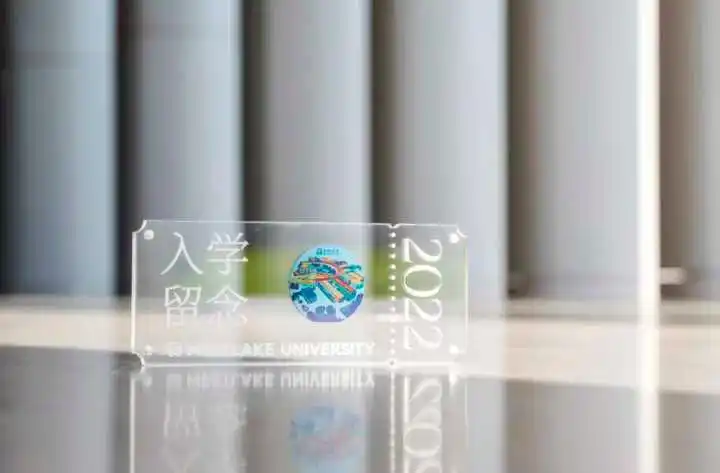
It looks like it's flat. It actually hides high technology。
Because of the color pattern on it, not a drop of ink
Six months ago, this launch was just a first test by scientists. In recent days, the complete technology, "the real face of xinsan", has been decrypted by the university of west lake's hate team in a recent issue of nature-speed league writing of technical colours for full-coloured inkries, using composite film consisting of two ultra-hard ceramic materials, titanium and alumina titanium nitro, as special “papers”, for micronarcing on their surfaces using super-fast lasers to achieve "fly-second laser-free ink-colour" to provide new ideas for the industrialization of laser-free ink colour printing techniques。
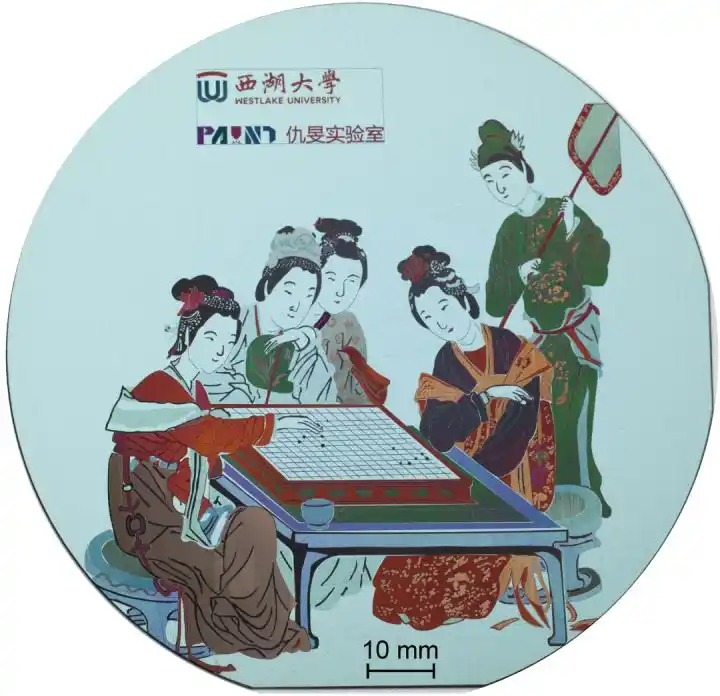
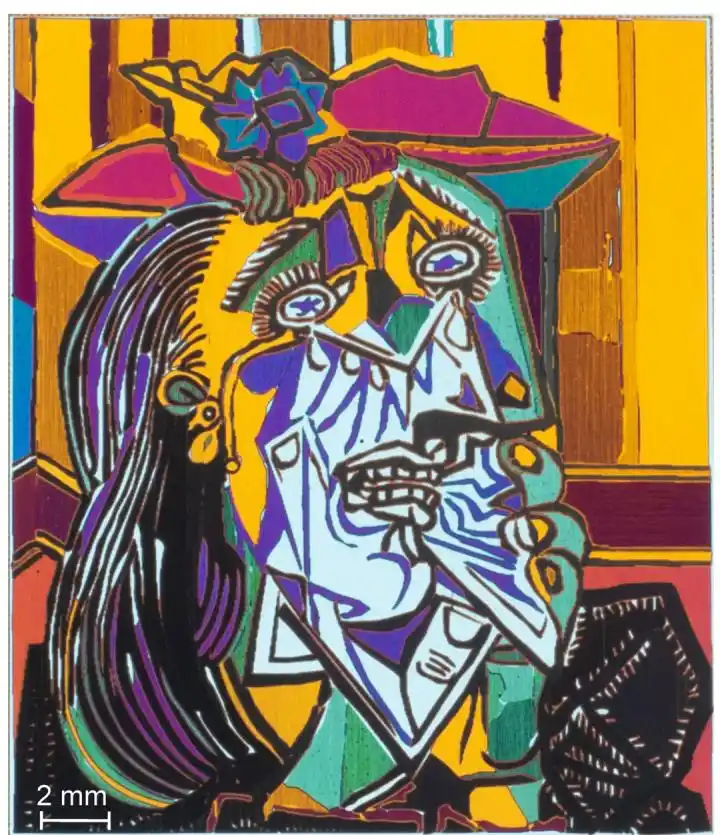
And with this technology, the west lake university engineering students have come up with these masterpieces
How did this happen
Ink printing high pollution
It's a common office or home scene: you click the "print" button on your computer lightly, the connected printer throws up high-speed paper, very easily, and you hold a coloured paper version of electronic content, whether it's a file, a chart or a photo。
It is clear that with the proliferation of colour printers, this becomes a daily routine for thousands of households。
Printers, however, are one of the important sources of environmental pollution, as currently widely used inkjet or laser colour printers require extensive use of ink or carbon powder, which can cause incognito pollution of the environment and harm to humans. Ink contains a certain concentration of volatile hazardous substances and elements such as lead, cadmium, mercury and pbbs; when printers work, carbon powder also releases large amounts of micro-particles that can be absorbed by humans. Studies have shown that the number of suspended particles in air is five times higher when printers work in a closed room。
How do colour printing get out of ink
Printers need ink to paint colour patterns, but the colour of nature's objects is not based on the chemical colours in their bodies。
In fact, it's a work of structural colour. When the light is exposed to a large number of sequenced structures at a fine point, there is a reaction of refraction, permeation, dissipation or interference, which produces colours, a process that is not actually used for “colour”. And the structural colour has the advantages of non-decoration, high resolution and environmental protection, as opposed to paint。
So can we follow the example of nature and apply the structure colour to inkless printing
Scientists have made bold attempts — the programme to produce structural colours by using super-fast lasers to create a micronarcing structure on the material surface, the super-fast laser colour printing technology. In this technique, light (laser) is a “pen” and a “caster” of a special structure “paint”. For example, the various forms of traditional anti-false-code paper around you are the use of lasers to lure themselves into the rainbow colours generated by the nano-ray, which have some application value in the area of fraud prevention, but do not produce patterns of specified colours. In canada, the technology is also used for printing coins and souvenir coins, but the print field is narrower, covering only 15 per cent of the standard rgb colour system; it can only be generated on the surface of precious metals, which means that material is severely restricted; and colour resistance to wear and tear is poor and prone to fade。
That is to say, despite various explorations and attempts by scientists, there is more or less a “lack”. The question of how to broaden the colour range of super-fast laser colour printing (i. E., to print more colours) and to achieve that colour does not change with the observed angle is a key issue for current laser colour research。
"purpose" with ceramics and "pen" with lasers
Nanophotology and instrumentation technical laboratory, which is the “big name” of the university of west lake vengeance laboratory. The head of the laboratory, who has spent the past 20 years “going to light”, has focused on research in the field of photonography。
Over the past year, researchers in the vengeance laboratory have innovatively proposed the use of super-fast lasers to process composite ceramic film to achieve a critical breakthrough in super-fast laser colour printing techniques。
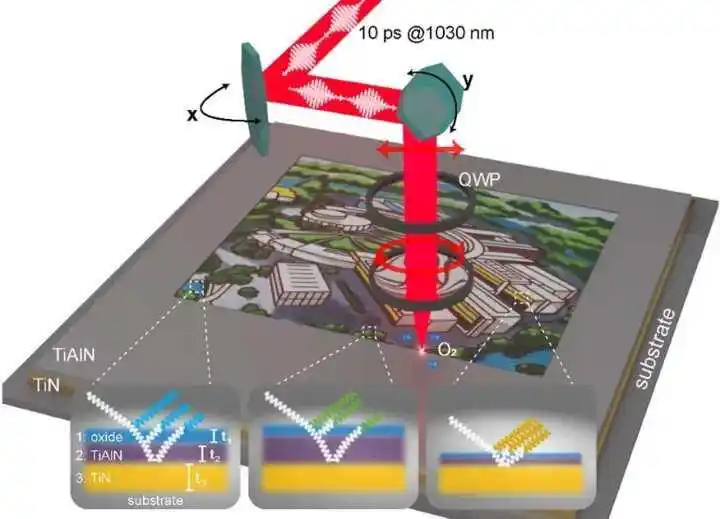
Figure 1. At the heart of the technique, the chromatography of super-fast lasers in composite ceramic film surfaces is, first and foremost, their invention of a novel “paper” - a thickness of only about 110 nm, which is only one tenth of hair. This “paper” is divided into three layers: as shown in figure 1, researchers plating 50 nanometers of titanium nitrogen and 60 nanometers of titanium nitrogen. The first layer, which is at the bottom of the top-down, is metallic titanium nitrogen, which acts as a reflection layer of light — acting as a barrier to light penetration and increasing brightness. The second layer, high-depletion aluminum titanium, will regulate the absorption of natural light-- as we know, the color of the objects is determined by the light they absorb. The third layer, the top layer of aluminum oxide - when super-fast lasers act on the surface of aluminium nitro, they form an additional layer of transparent film, dominated by aluminium oxide, which, together with aluminum oxide, regulates the natural light absorbed。
Because of the greater hardness of titanium and aluminum nitrogen, they are referred to as ceramic materials, and this layer of “porcelain” consists of light “papers” like feathers, which will become “extra-clothes” attached to objects that need to be printed。
At the same time, the enemy team developed another use of the pen — a pen that remains a laser — but in their technology, the pen no longer directly creates structures on the surface of the object, but will be “carved” on ceramic sheet paper. The laser will be placed on thin membrane, which, by controlling the energy or scanning speed of the imported laser, can change the thickness of both the oxidizing membranes (aluminium oxide) and the nitrogenized aluminium titanium membrane simultaneously; after the change in thickness, the natural light of the input will create a specific reflecting colour through complex interference effects between the three membrane structures. As a result, the colours are rich and colourful, as shown in figure 2a。
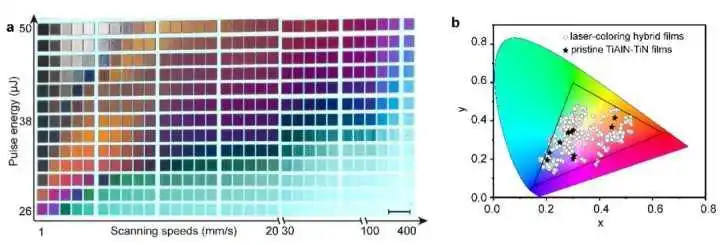
Figure 2. The typical colour panels (a) and the colour field range (b) for laser printing were then used by researchers to carry out material analysis of laser coloured areas using a variety of technical means, such as energy-scatter x rays, x-ray photoelectronic energy spectrum, x-ray distillation, and focus ion beams, confirming that the observed colours were indeed derived from laser-induced oxidation layers; in other words, the “paper” and “pen” they developed finally achieved the desired laser colour-free printing。
Colorful, efficient, and lastingly new to a beautiful world
Every step forward in scientific research cannot but be verified on the ground. After a brief festivities, the research team was put to the test round of new technologies。
They were surprised to find that “special paper” made of two superhard ceramic materials, titanium nitrogen and aluminum nitrogen, could well achieve high-speed, high-resolution, wide-coloured, large-scale, observationally insensitive, and anti-age colour-free laser printing。
Wide colour. At present, the "fly-second laser inkless" technique, invented by the vigilante laboratory, has achieved nearly 90 per cent of the rgb standard colour system (as shown in figure 2b), well above the current mainstream laser colour technology. The researchers explained that the former formed a single layer of oxidation film, with only one variable, compared to the previous conventional laser colour scheme of “laser-induced stainless steel surfaces to form a thin membrane oxidation”, while their laser-induced compound film oxidation would also alter the thickness of the oxidation membrane (aluminium oxide) and nitrogenized aluminium titanium membrane by an additional degree of freedom and thus gain a wider colour area。
High speed, high resolution. The technology allows for high speed and high resolution of all colour-free ink printing. In terms of printing speed, the technology reached a record 10 cm2/s, as shown in figure 3. This means that an a4 paper can be printed in full colour within one minute. In print resolution, researchers showed a colour print of 10,000 dpi, more than 10 times the maximum resolution of traditional ink printing。
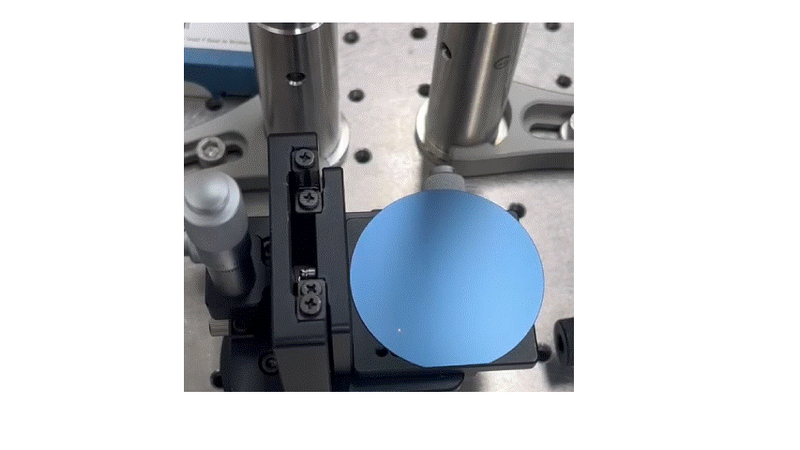
Figure 3. The dynamic chart shows that the process colour of super-fast lasers colours on the surface of the material does not change with the observation angle. The high absorption properties of aluminium nitro make it possible to generate significant additional phase differentials in its interface, which offsets the change in colour from the observational angle caused by differences in the thickness of the film; the simple understanding is that the colour is largely unchanged at 0-80 degrees in the context of this “fashion” (see figure 4)。
The color "over time." researchers carried out a series of destructive experiments, tested ageing in high-temperature, high-humid environments (two-85 experiments), tested corrosive resistance in salt fog environments, and carried out experiments such as light bleaching, incentivization, etc., but the work on "fly-second lasers without ink-colouring" was still “frequent”. This is because the formation of aluminum oxide membranes on the surface of aluminium nitro is a good shield. Following a series of national standard anti-aging tests, researchers further confirmed that the colour difference induced by lasers on aluminum nitro nitrogen is still <7 and is fully consistent with the needs of industrial applications。

Figure 4. Laser colour panels observed at different angles and final step experiments, most notably "coloured" and "sweet". Can you believe this is all an art work by a bunch of technologists
Picasso, "the crying woman,"
Ming dynasty's famous painter han ming chun xiaoming -
The book of the king, the book of lantin
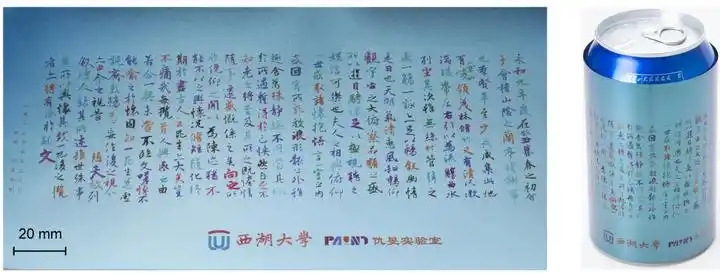
Of these, the han palace spring vision was printed on a rough unempted monolithic silicon surface, while the lantin sequence was printed on soft steel. This will also be a significant advantage of this laser printing technology, compared to the traditional micro-processing techniques (e. G. Electronic beam erosion and nanopressure) that also present structural colours。
In 2022, the first undergraduate students of the university of west lake, yang jin-ning, and more than 20 members of the university's advisory board became the first witnesses of this technology (figure 5-6)。
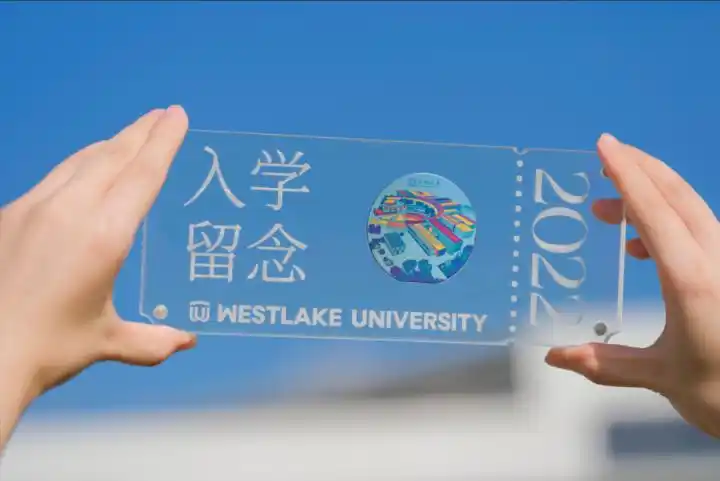
Figure 5. Enrollment of the first undergraduate students at the university of west lake by the jaeger laboratory products
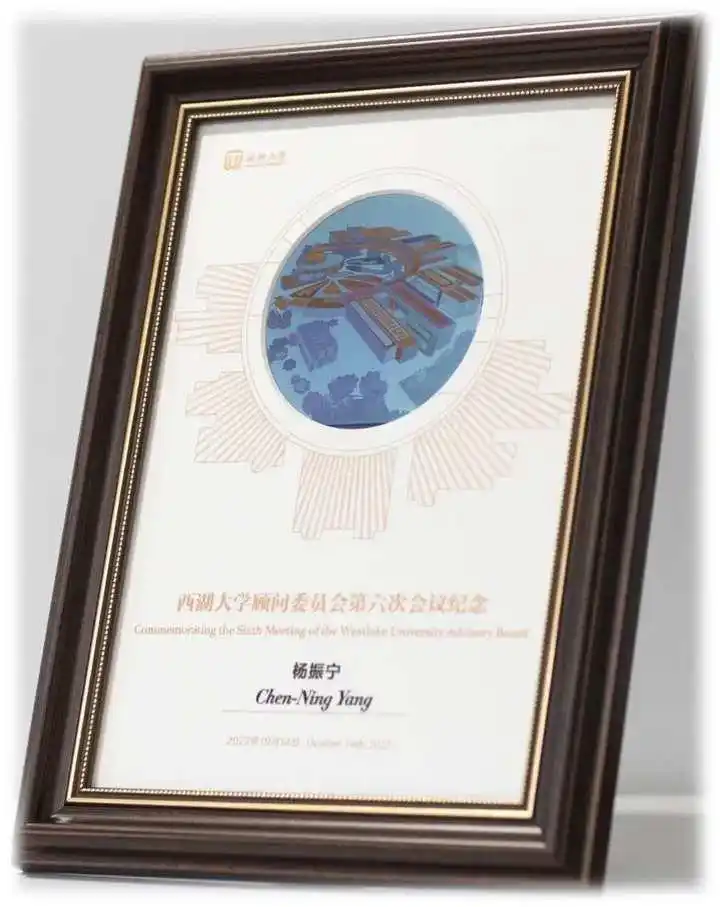
Figure 6. How will this technology change our lives in the future of a souvenir produced for mr. Yang jinning by a researcher at the vengeance laboratory? The team of researchers laughed that the open proposition was left to the public. “you may imagine that we are responsible for it” — the chinese space technology group, chinese petroleum, chinese petrochemicals, china food group, etc., responded to the spectacular fantasy of the film after its launch. And this is the voice of the enemy. It is the mission of scientists to explore the unfinished business of previous generations and to make it possible to move forward。