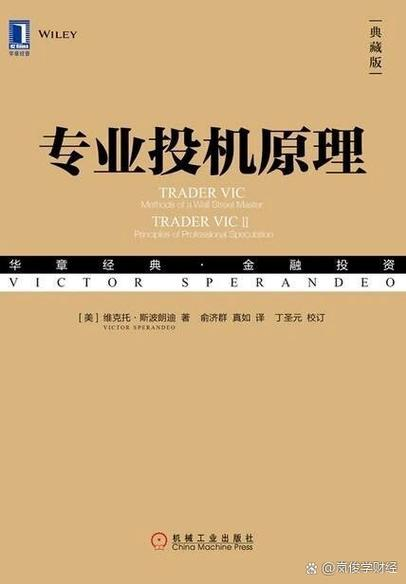
The author, victor sperandeo victor sporandi, professional securities operator, has been fund manager for 25 years. Rand management's investment manager is a financial focal point for the wall street journal and the baron book. Victor has been dubbed by wall street financiers as the “wilder vic” and the “wall street terminator” of the baron book. He had made 12 consecutive years of investment gains on wall street, from 1978 to 1989, without any one-year lost track record。
It is an investment book that appears to have a large amount of space on psychoanalytical and economics research, and in fact each page is full of the words “winner” and “self-regulation”. For the author, trading is poker gambling, and mastering a “winner” is the first element of success。
At the heart of victor's “winners” are three principles of victor's speculative philosophy:
1 capital security。
2 harmonious profitability。
3 seeking outstanding remuneration。
Its three main instruments for improving “winner” are: technical analysis, statistical methods and economic fundamentals noodles
In technical analysis, it is clear that the dow theory is its most important transaction analysis tool. For example, its main application is medium-term trends in transactions and the laws of 1-2-3 and 2b。
In statistical methods, the author summarizes the above-mentioned technical analysis through extensive statistics and tests
On the fundamentals of the economy, victor pursued the modern austrian economic theory of mices (the austrian school of thought) and looked to the market for speculative thinking。
“self-regulation” also occupies a large amount of penknob in this book, where the author analyses the psychology of traders and how to build the psychological fabric of successful transactions from a psychological subconscious perspective。
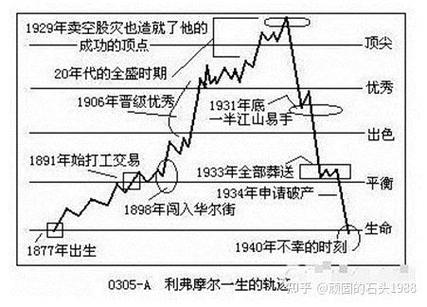
And here's my personal point: this book follows the murky american style of writing, describing my investment experience from childhood to old age. The book is accompanied by a great deal of knowledge, even about philosophy and life stances。
It is a more comprehensive investment book, in which investors can fully market-neutral and undefeated. In practical transactions, it is not uncommon for authors to analyse the fundamentals of the economy in such a way that they can simultaneously possess technical know-how。
But the author has no new contribution to the techniques and theories of market investment transactions, all of which have been summed up. For example, the 2 per cent principle of cessation of damage is discussed in greater detail in the sea turtles act, and the soros idea of the preconditions used in the technical law, such as four days in a row to verify that the situation has changed。
Victor's operational core is “winner”, and his tools to improve “winner” are not perfect even in his time。
From the point of view of technical analysis, for example, the book makes little reference to analysis of the psychological aspects of the market and the general public, while richard dvekov, who is older than him, is more clearly good at this. An analysis of the trading mentality of other people and groups in the market and an understanding of institutional dynamics can clearly increase the “winner” of transactions. As a result, traditional technology analysis is seen as mostly lacking an analysis and understanding of the human nature of the market。
Nor has the authors achieved the greatest success in adding “winners” to statistical methods. Real statistics are applied to transactions, where a large amount of data should be analysed using computer computing capabilities, from which multiple trading historical patterns should be identified and their probabilities judged. The authors in this regard, either in the application of their dow theory or in the assessment of their risk-benefit ratio, are largely engaged in qualitative analysis and lack quantitative studies based on large data. Maybe my demands were too high for his era, but at least it would have been better in math. It's like richard dennis, who's the same generation as him, took math into his trading system。
In this context, the question of “trading systems” has to be said. Victor's trading techniques are clearly a trading system in this book, but he does not propose the concept of systems. I think that if we move trading technology up to the system, the reader's learning and understanding will be clearly higher。
Finally, “self-regulation” shows, from the large number of texts involved, that only the masters can write about it. However, its claims use human psychology to understand and control “trading psychology”. I think this approach is difficult to do, and it is better to strengthen “self-regulation” with mechanical trading systems. Many of the transaction techniques and stoppages in this book can be incorporated into the mechanical trading system, which will ease the psychological difficulties of the transaction. Of course, i think it might be the style victor didn't like. Victor looks at this book as a man of love。
In general, the book describes a mature and comprehensive trading system, which is only slightly old. Author's tweet mk12221063