


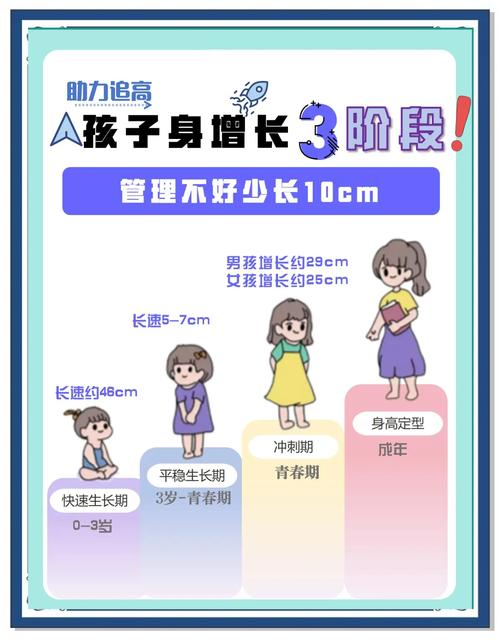
The general pattern of the growth and development of children and adolescents includes: stages and procedures, unevenness of speed, sequencing and harmonization. Growth and development is a continuous process consisting of different stages of development. Depending on the characteristics of these stages, together with the living and learning environment, the growth and development of children and adolescents can be divided into several ages; infant, early, childhood, adolescence and youth. 2. The process of growth and development: there is a certain process of growth and development, a sequence of stages. The development of the previous stage provides the necessary basis for the subsequent stage; any developmental impairment at any stage will have an adverse impact on the later stage. The fastest growing, most rapid growth of the baby's torso, with the lower limbs growing more than the head and torso during the period 2 to 6 years of age. As a result, the proportion of the child's body is constantly changing, growing from an extremely large head (4/8 of the whole body) for the foetus in two months, to a more symmetrical proportion (1/8 of the head, 4/8 of the body and 3/8) for the foetus in the second month. From the point of view of mobility development, children must walk at a stage of development, such as head, turn, flip, sit, climb, stand, etc. The pattern of hand movement is more pronounced, with the newborn being able to move his upper limbs unconsciously; the extraction of objects begins in 4 to 5 months, but only with a single hand; the finger is held in 10 months; the movement of the hands around 2 years of age is more accurate and eating with spoons; the fine movement of the hand (e. G. Writing, drawing, etc.) is about 6 to 7 years of age before the basic development is completed. The morphological sequence of the parts of the body is: lower limbs before upper limbs, four limbs before the torso, showing a pattern change from lower to lower, from the limbs far to the core. The growth of the adolescent foot began at the earliest and stopped at the earliest; after the jump, the calves began to increase, followed by the thighs, the pelvis wide, the chest wide, the shoulder wide, the body high, and, finally, the chest wall thickness. The upper limbs increased in the order of hand, the forearm and the upper arm in the order of long distances and nearness. The bone is healed in the order of a near end of the end of the fingerbone, in the form of a bone in the upper end, in the form of a bone in the pericarb, in the near end of the skeletal. (ii) unevenness in the growth rate of the individual during the whole growth period, sometimes at a slow and sometimes uneven pace. There were two surges in growth from fetal to adult: e. E. G. For the first time in the first year of life, but for the second time in the first year of life, for the second time in the second year in the second year in the second year in the second year in the second year in the second year in the second year in the second year after birth, and for the second time in the second year in the second year after birth, and for the second time in the second year in the second year after birth, and for the second time in the second year in the second year after birth, and for the second time in the second year in the second year in the second year after birth, and for the second time in the second year after the second in the second in the second in the second in the second in the second in the second in the second in the second in the second in the year in the second in the second in the second in the second in the second in the second in the second in the second in the year in the second in the second in the second in the second in the second in the second in the second in the second in the second in the year, and for the second in the second in the second in the second in the second in the second in this is an adaptive expression of the environment for human survival and development in the long term. No system is developed in isolation, and any factor that acts on the organism can affect multiple systems. For example, proper physical exercise promotes not only muscle and bone development, but also the performance of the respiratory, cardiovascular, nervous system ... (iv) growth trajectories and critical periods of growth, in which individual children develop in a stable and trajectorized manner without special changes in the external environment. The trajectory has a dynamic and complex regulatory system, in which genetics play a key role.... It does its best to keep growing individuals within a limited range of groups with limited up-to-down fluctuations. In the event of adverse phenomena such as disease, endocrinic disorders and malnutrition, there will be significant growth and development retardation; once these impediments are overcome, children will immediately show a strong tendency to approach and develop in their original growth trajectory. This acceleration of growth and recovery to normal trajectories after the factors impeding growth have been overcome, calling it "catch-upgrowth". Not all disease recovery processes are bound to catch up with growth. ... Whether a sick child catch up with growth and restore growth to normal trajectories depends on the cause, duration and severity of the disease. Normal development is disrupted at this time, often becoming permanent defects or functional impairments. In other words, when treatment is not readily available, these organs, tissues, even if they catch up, are often incomplete. For example, from the late foetal stages to the six months following birth, they are critical to the growth of brain tissues with a significant increase in the number of brain cells. Early youth is the key long-term in long-lived long-term long-term long-term long-term long-term long-term long-term long-term long-term long-term long-term long-term long-term long-term long-term long-term long-term long-term long-term long-term long-term long-term long-term long-term long-term long-term life.



