Overview
Laser is the abbreviation for “light amplification by stimulated radiation of radiation”。
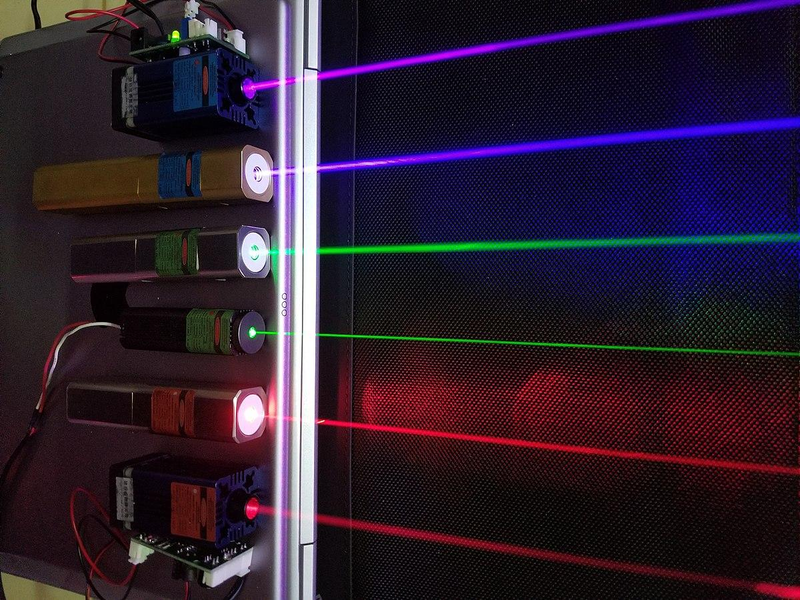
Red (660 & 635 nm), green (532 & 520 nm), blue purple (450 & 405 nm) visible lasers
It refers to the same-modularly enhanced photon beams resulting from electron leaps to release radiation energy by stimulating atoms. Characteristics include extremely small dispersiveness, high brightness (power), good monochrome, good correlation, etc. Laser generation requires the three elements of “stimulating source”, “benefit media”, and “resonance structure”。
Laser applications are extensive and include, inter alia, laser marking, laser welding, laser cutting, fibre-optic communication, laser spectrum, laser ranging, laser radar, laser weapons, laser records, laser indicator, laser revision, laser beauty, laser scanning, laser mosquito repellent, etc。
Historical background
Einstein began in 1916 with a description of the relationship between the atom's exposure and spontaneous radiation. There has been a long period of speculation since then as to whether this phenomenon could be used to enhance the light field, as it is assumed that the medium must have a mass inversion (or reverse translation). In a purely secondary system, distribution functions based on thermodynamics are impossible to achieve. The first thought was to use a three-tier system, and calculations confirmed radiation stability。
In 1958, american scientists charles towns and arthur shawlow discovered a magical phenomenon: when they shine the light from the light bulbs on a rare earth crystal, the molecules of the crystals send out strong light, always gathering together. On the basis of this phenomenon, they propose the "laser principle" that the substance produces this undissolved strong light - laser - when it is motivated by the same energy as its moleculeic vibration frequency. They published important papers for this purpose and received nobel prizes in physics in 1964 and 1981 respectively。
Following the publication of the shawlo and towns studies, various experimental programmes have been proposed by scientists from various countries, but none has been successful. On 16 may 1960, mehman, a scientist at hughes laboratories in california, united states of america, announced the acquisition of lasers with a wavelength of 0. 6943 micrometres, the first type of laser ever acquired by humans, making mehman the world's first scientist to introduce lasers into practical fields. His programme was to use a high-powered flashlight tube to stimulate rubies. The rubies are physically a jade with chromium atoms, and when they are irritated they send a red light. The surface of the ruby plating on a surface drills a hole, which allows the red light to spill through the hole, thereby producing a fairly concentrated thin red column, known as the ruby laser. It can reach a temperature higher than the surface of the sun when it reaches a point。
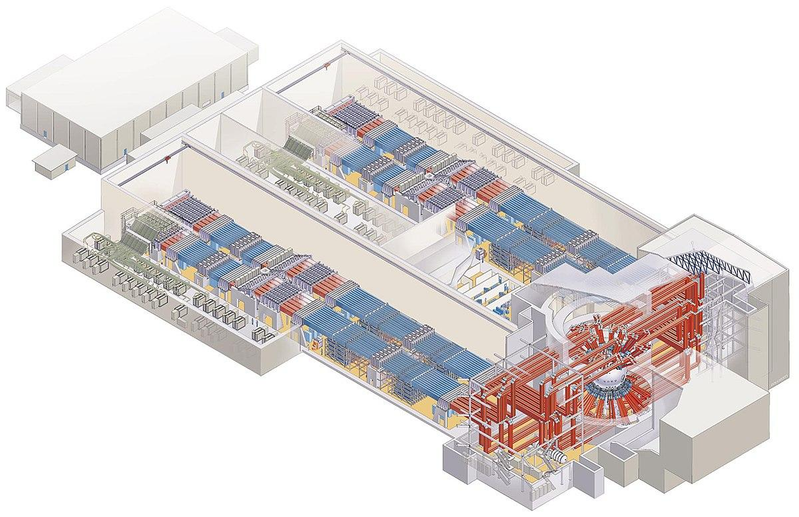
The nif national fire-blowing facility in the united states, which produces controlled fusions with a combination of lasers concentrated at high temperatures
The discovery of semiconductor lasers: the former soviet scientist nicola bassov invented semiconductor lasers in 1960. The structure of the semiconductor lasers is typically composed of the p layer, the n layer and the source layer that forms the double-heavy knot. It is characterized by small size, p-efficiency, rapid response speed, wavelength and size appropriate for fibre-optic size, direct modulation and relevance。
In the late 1980s, semiconductor technology made it possible to use more efficient and durable semiconductor laser diodes, which were used in small power cds and dvd optic data lines。
In the 1990s, the principle of high-power laser stimulation was realized, such as in the case of sheet lasers and fibre-optic lasers. The latter were partially replaced by co2 lasers and nd:yag lasers because of new processing techniques and the high power of 20kw, which were continuously applied to material processing。
In the 2000s, the non-linear nature of lasers was used to create x-ray pulses (to track processes within the atoms); on the other hand, blue light and ultraviolet laser diodes had begun to enter the market. In 2009, china developed a crystal known as potassium fluoridate (kbbf), which can be used to stimulate deep ultraviolet lasers, which, once successfully applied, can lead to a volume of more than 1 tb per disc and to a significant increase in stored circuit density on semiconductors。
Lasers have now become important equipment in industry, communications, science and electronic entertainment。
Fundamental stress radiation
The motion of electronics can be divided into different levels of energy, and the electromagnetic waves (so-called spontaneous radiation) of corresponding energy can be released when electronics leap from high to low energy levels. In general luminescence, these electrons release the photons randomly, and the released photons do not have the same properties, such as tungsten light。
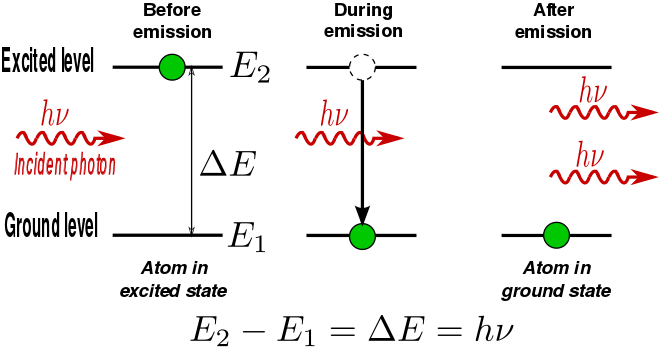
Irradiated radiation
When additional energy is injected into and absorbed into an energy-grade system such as electric fields, photons, chemistry, etc., will result in electrons leaping from the low to the high-energy level, and when the photons of spontaneous radiation touch these high-energy electrons, which are driven by additional energy, these high-energy electrons will move to the low-energy level and release the photons (so-called irradiated radiation), all of the optical properties of the irritated radiation will be the same as those of the original spontaneous radiation: frequency, phase, direction, etc., and these photons of the irritated radiation will produce more of the same light when other electrons leap up the high-energy level by adding energy, and the last light becomes more intense (i. E., light energy is amplified) and, unlike the general light, all light will have the same frequency, phase, direction。
In order to magnify light, it is necessary to create an environment in which high-energy electrons are larger than low-energy electrons, i. E., inverted in protomas, so that high-energy electrons can be exposed to photons to release new photons rather than random releases。
The general laser generator has three basic elements:
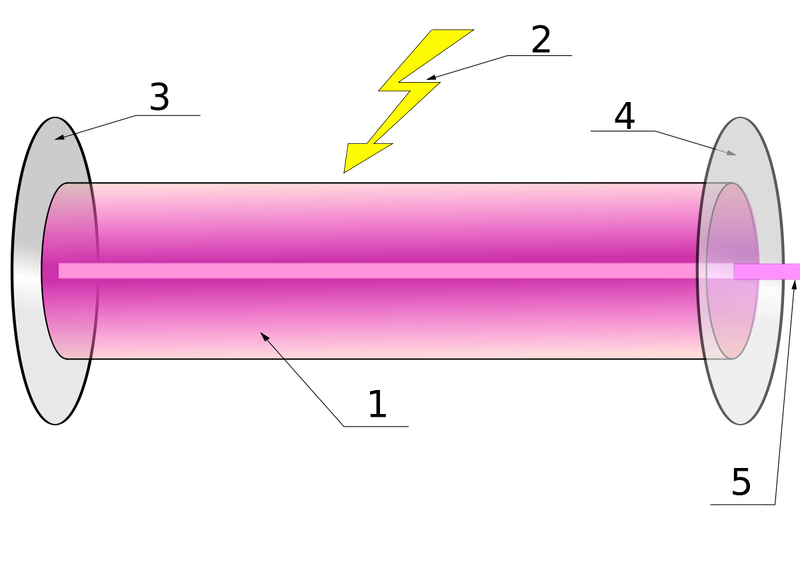
Main component 1. Active laser medium 2. Light pump energy 3. High reflectivity mirror 4. Output power coupling 5. Laser beam particle numbers inverted (population conversion)
In a secondary system, the probability of an electronic leap from low to high energy level and from high to low energy level is the same. In order to achieve light magnification, more electrons must be available at the high-energy level, which increases the probability of exposure. This state is called a residential reversal. For this reason, lasers cannot be achieved for photons-enabled secondary systems, so lasers are generally achieved through level iii and level iv systems. In level 3 systems, electrons are quickly converted to sub-stable once they are pumped to a high energy level. As a result, the laser medium is activated into a high-energy state, and the stock reverse is realized。
Types and working methods
There are many ways in which lasers can be classified, e. G. By characteristics such as working status, type of work material, frequency of output wavelength, ability of output laser wavelengths to regulate, use of lasers
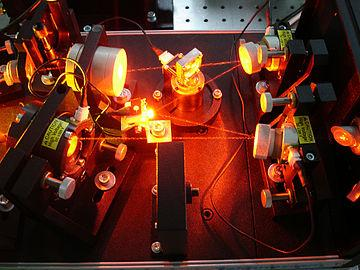
Continuous lasers classified by working state
Depending on the medium that produces the laser, lasers can be divided into liquid lasers, gas lasers and solid lasers. And now the most common semiconductor laser is a solid laser。
Practical application
Laser applications are extensive and consist mainly of fibre-optic communications, laser spectroscopy, laser ranging, laser radar, laser cutting, laser records, laser scanning, laser mosquito control, etc。
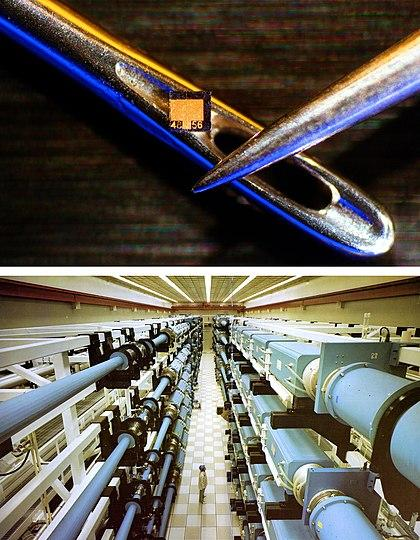
Lasers have a wide range of applications, ranging in size from a binode laser under a microscope (top graph) to a beryllium glass laser of the size of a football field (low graph) for inertial coNuclear weapons research and other high-energy density physical tests。
The first use of lasers in the daily lives of the general population was a supermarket bar-code scanner, which was introduced in 1974. The cd-rom was launched in 1978 as the first successful consumer product to include lasers, but the cd-rom player was the first common device equipped with lasers. Next, laser printers began to appear in 1982。
Some other uses are: