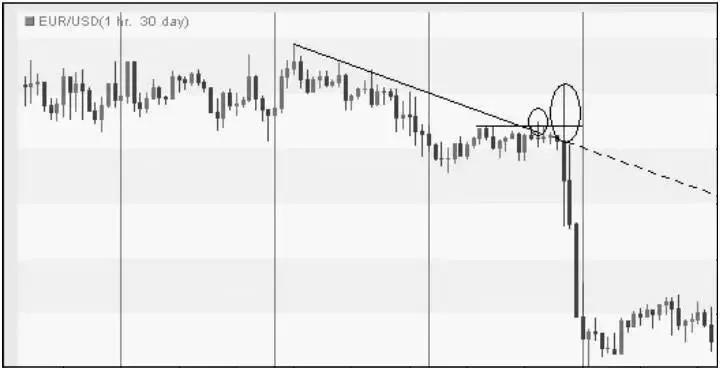
Method 123 is a method of trading in combination with techniques such as trend lines, high and low points, etc。

The 123rd code consists of three elements, consisting of trend lines, high and low points, and price breakthroughs to high and low points, which are very demanding. Although the trend line represents only the direction in which the price is going, even though only two points are going through the trend line in the course of the overall trend in prices (the two points are drawing the trend line), it is because the dow theory principle is included in the 123 code. Thus, once the price fulfils the three conditions of the 123rd code, it is certain that the opposite direction of the trend line will run, so that the 123rd code will be more certain in transaction practice。
Access to the 123rd code
Once the code of 123 is in place, it is sufficient to trade in the direction of a breakthrough and, of course, to guard against a false breakthrough. This is an immediate entry opportunity, a second best entry opportunity and a common approach for investors。
Similar to the morphological approach to entry, there are two other opportunities available, namely, pre-break access, which has a gambling character, but is better located, and post-break retrenchment, which is the best access, confirming both the formation of the breakthrough and the better timing。

However, the question is how much price can go in the direction of counter-trend lines。
Many investors use the code 123 to conduct transactions, but they find that there is sometimes a slight imprudent risk of falling into a trap, as shown in the figure. The exchange rate reached all the conditions of the code 123 at a, and investors could enter the premises empty, but if they did not settle at an early stage, the price could rise to a new high if they did not do so at a later stage。
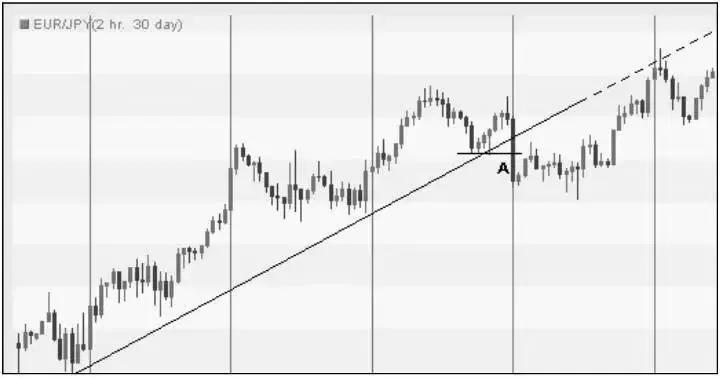
As can be seen from this example, law 123 is, in fact, a double-edged sword that is not well used and is likely to hurt itself. Thus, the technique of using the 123 code is an important way of avoiding losses and increasing the success of transactions。
Skills i: focus on the direction of larger timescale charts
Investors often use multiple graphs for foreign exchange analysis, transactions, combined graphs and hour charts, etc. When using the rule 123, every effort is made to follow the direction of the larger time scale chart and to avoid entering and entering transactions contrary to the direction of the larger time chart。
The two-hour map of the euro/japanese yen in the figure was then in an upward direction, so the use of law 123 in the two-hour chart was empty and could only be a short-term strategy, and the market had to leave early。
The focus on the direction of larger timescales is derived from the understanding of “trend continuity”. The shift in trends, which is rarely reversible in the short term at the general rate, often takes longer to accumulate. As a result, there is a high risk of falling into a trap when the main trend direction continues, with the use of the 123 rule for short-term trade movements。
Thus, the main orientation of the focus on small timescales is to use the first priority of the code 123。
Skills ii: reversing short-term direction and responding to key directions
Since the risk of using the code of 123 in the main direction is so high, investors may wish to think differently that, if they are able to respond to the main direction, the risk of using the code of 123 for dealing would be significantly reduced. At this time, when the three conditions of the 123rd code are completed, it will be short-term, secondary directions that will be reversed. As shown in the figure。
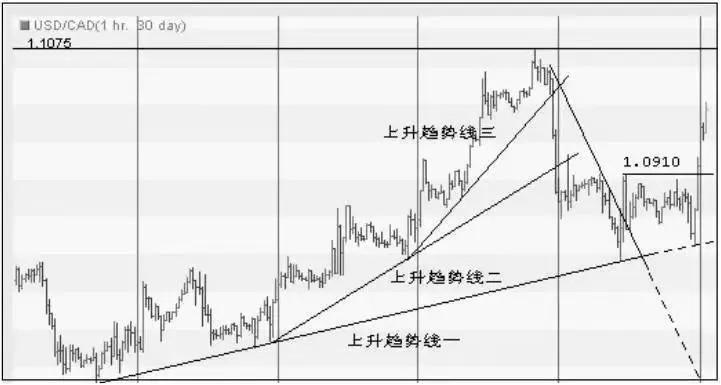
The figure is a one-hour united states dollar/can$ figure, which, following a upward trend, went down from 1. 1075, breaking the upward trend line 3 and upward trend line 2, but was supported by upward trend line 1. (at this point, the exchange rate is glued and the further direction is not clear) soon it will break the short-term downward trend line, rebounding to 1. 0910 and then retreating again to the upper trend line, the lower point being the lower point since the 1. 1075 retreat, the second condition of the 123rd rule. When the exchange rate has exceeded the high point of 1. 0910, the three conditions of the code 123 have all been established, and we have chosen to do more。
The risk of doing more after crossing the high point of 1. 0910 in this case is smaller, as the upward trend line has not been broken and the exchange rate has been supported twice since the retreat of 1. 1075, indicating that the trend line has a decisive impact on whether the exchange rate is going further (down)。
Following a upward trend, the exchange rate went down from 1. 1075, breaking upwards of three and two, but was supported by upwards of one. (at this point, the exchange rate is glued and the further direction is not clear) soon it will break the short-term downward trend line, rebounding to 1. 0910 and then retreating again to the upper trend line, the lower point being the lower point since the 1. 1075 retreat, the second condition of the 123rd rule. When the exchange rate has exceeded the high point of 1. 0910, the three conditions of the code 123 have all been established, and we have chosen to do more。
The risk of doing more after crossing the high point of 1. 0910 in this case is smaller, as the upward trend line has not been broken and the exchange rate has been supported twice since the retreat of 1. 1075, indicating that the trend line has a decisive impact on whether the exchange rate is going further (down). The exchange rate then reversed the downward direction, indicating that the main direction (uptance) was maintained, with only secondary withdrawals starting with 1. 1075. It was in this direction that the use of the 123 code was used. The choice of orientation would significantly reduce the probability of failure。
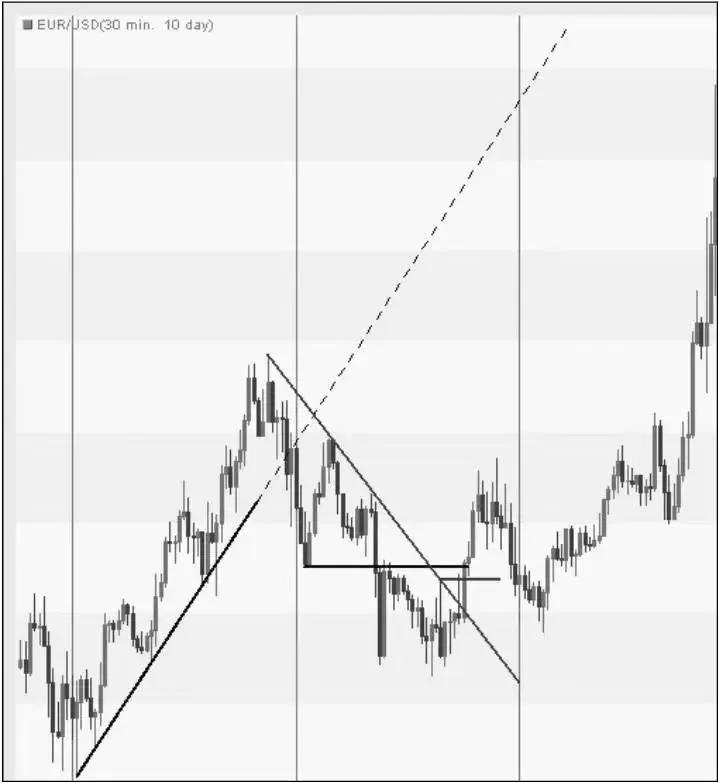
Euro/us$ 30 minutes figure
The exchange rate fell through an effective upward trend line, which then broke the low point between the highest and the second highest point, and law 123 was established. Despite the decline, the decline was limited. Foreign exchange prices then reversed the decline through law 123, and then went up even further. This is due to the upward trend of the larger time scale。
Impact of the trend line angle
Although the perspective of the trend line is not emphasized in the use of the 123 law, long-term transaction practice shows that the trend line perspective has a significant impact on the 123 law. We find that if the angle of trend lines and horizontal straight lines is closer or smaller than 45 degrees, the longer and the greater the price can run when the conditions are complete。
The influence of the trend perspective on the overall trend performance is generally expressed by the closer the angle is 45 degrees, the more stable the trend is. The high angle suggests that trends in the short term have been rapid and under pressure to reverse, but long-term, major operating directions are expected to be maintained, which means that prices may reverse once they have been reversed in order to continue the direction leading to the reversal; the low angle suggests that the dynamic forces driving trends are limited and the risk of reversal increases。
This phenomenon is reflected in the application of the 123 code: when the angle is too large and the three conditions required by the 123 code are present, and despite the fact that the price is more likely to be reversed, such reversals may be only short-term resting periods, often difficult to change direction over the long term, when the 123 code is used and it is likely to enter the trap, which may be long-term if it is not released early. When the angles are smaller, the trend itself carries the risk of reversals, and when there are three conditions for reversals required by the 123 law, the reverse signals will be shown with greater certainty。
Therefore, in the face of a large trend-line trend and when the 123rd rule is met, care is taken to trade in order to guard against short-term disruptions or adjustments. There are, of course, a few cases in which a large trend of angles can also be reversed in the short term through law 123, although this generally appears in a chart of lesser duration。
Be patient and wait to break the recent low/high
Article 3 of the 123rd code, which requires prices to exceed the recent low/high point, is in fact a breakthrough. And as long as there is a breakthrough, there is a real/false breakthrough。
However, for the 123 law, the issue of breakthrough is not difficult to grasp and, generally speaking, as long as the price can be collected on the day above or below the high point where the breakthrough is needed, the third rule of the 123 law on the map is basically valid. On the hour chart, a third article would be established in the short term if the higher/low point were to be exceeded at a larger k-line price. As illustrated
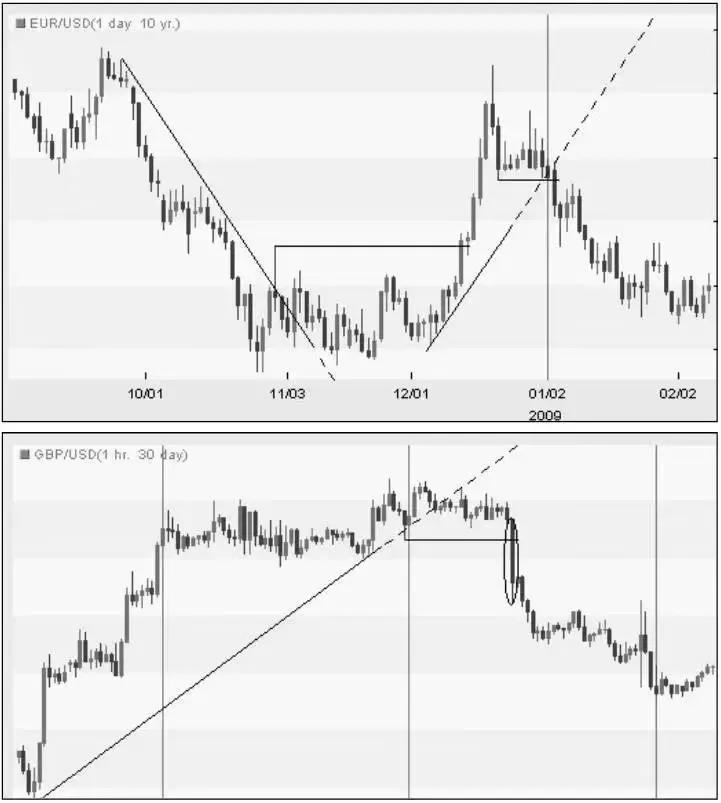
If the recent high/low point is breached in the twilight, but the failure to close the book on that day is in the direction of a breakthrough, the risk of a false breakthrough is high, and law 123 may not be fully established. As illustrated
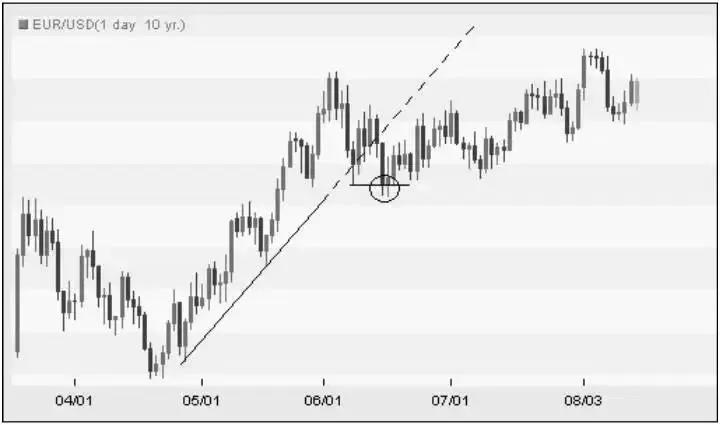
Euro/us dollar
For the hour chart, the requirements are similar and the investor will have to wait until k-line is closed before deciding whether to enter. The following movement, despite a one-time breakthrough, resulted in the recording of a large black candle. If you wait for the k-line to be closed before you decide whether to enter, there will be no loss (for multiples); if you see a price break before the k-line is formed without waiting for the closing to confirm the break, there will be a loss and a trap. As illustrated