They all followed ufc
01
Foreword
After many years of computerization, domestic advanced manufacturing enterprises have achieved a certain level of success and scale in information development, digitizing enterprise resources and business processes, greatly improving the efficiency of their work and the regularization and visualization of business operations. However, due to the difficulty of developing long-term, reliable top-level planning in the early stages of construction, combined with the rapid development of information technology and ideas, the current stage of enterprise information development is marked by a number of salient issues, in which the integration of resources with business and mutual reinforcement are central information challenges。
In general industrial development enterprises, resource systems are either centred on various content management platforms, such as knowledge-base systems, archives management systems, engineering document management systems, or relying on the business systems ' own data management modules, which result in informational isolation of the level of the enterprise's internal system, which can easily lead to segregation of data at the operational level. This dilemma is rooted in the failure of enterprises to synchronize resource and business planning when they are building information. A rational operating model of business and knowledge (the most representative intellectual resource) should be symbiotic and synergetic。
Symbiotic relationship between resources and operations
02
Relationship between resources and operations in information development
It is argued that the enterprise framework based on information-based construction includes the resource, application, business and value levels, and that there is a dependency and supporting relationship between each level. In the information-building process, enterprises use both technology and systems in combination to advance business. The question of how to match the corresponding resources with operations is also reflected at the following levels。
From resource level to application level, the process of digitizing basic resources
The process is aimed at the digital management and presentation of all types of enterprise resources, including human resources systems (hr), customer management systems (crm), office automation systems (oa), resource management systems, product life cycle management systems (plm), manufacturing implementation systems (mes) and various software tools, based on organizational personnel, financial information, customer information, product information and enterprise production equipment, in particular business processes and business practices accumulated by the enterprise. This process is mainly the digitization of enterprise resources and processes through information technologies such as virtualization and digitization. This is not only the focus of past information platforms, but also the essential foundation and content of the development of enterprise information physics systems (cps)。
On this basis, through a rational functional layout and process combing, the enterprise's resource and business implementation environment is migrated to a virtual digital environment built through information technology, focusing on the core business scene and creating digital twin, thereby breaking time and space constraints and ensuring rapid access to resources and efficient flow of processes。
From the application level to the business level, it is the concrete realization of an enterprise's activities in an information technology vehicle
Past informatization applications have focused on operational data transfer and process flow in the information system, using cross-sectoral, synergistic and multi-system integration techniques. This strategy has to some extent built the enterprise's integrated application environment, but it does not take full advantage of the information-based operational data within the enterprise, nor does it translate business data into knowledge models, with a large number of static data and information using archival storage and log management models. This is due to several factors: on the one hand, the lack of clear business process knowledge strategies for enterprises in the face of complex business processes, resulting in a lack of formalization of business process processes, the inability to obtain effective static business data based on stable business models and the inability to construct multi-stakeholder business framework models based on processes, data and people; and, on the other hand, the lack of an effective knowledge-based task execution model for enterprises in the face of light quantitative business processes, the constraints of departmental walls and multi-practice approval mechanisms for functional organizations, the difficulty of quickly achieving virtual project team formation, and the difficulty of demanding knowledge-sharing and application resources based on core objectives. Therefore, in the business scene mirror environment based on information technology, different implementation strategies are required for business processes at different levels of complexity. The process of generating, settling and reuse of knowledge resources is not only a demand for enterprise capacity enhancement, but also an inherent mechanism for operational implementation。
From the business level to the value level, it is the value and service that an enterprise realizes through its operations
All business activities of an enterprise are intended to achieve business value, which may be the demand of its clients for products and services, innovation, change in products and services, or enhancement of staff capacity. Different business values require different delivery strategies. In a new manufacturing business environment, meeting changing market demands, relying more on rapid adjustment and response to intra-firm organizational and service models, poses new challenges to the capabilities of enterprise employees, the ability to innovate for their products, etc. Enterprises need to provide markets with appropriate products and services through flexible resource allocation and demand identification, so that they can achieve multiple values. This requires, on the one hand, the knowledge, virtualization of business processes and the full recording and tracking of business static data and user dynamics in a virtual mirror environment, based on a target- and content-based synergetic referral mechanism that provides real-time, accurate knowledge services to users; and, on the other hand, the construction of product and business upstream/downstream knowledge systems, such as value chains, supply chains, and multidisciplinary and thematic knowledge-sharing centres that support faster and better market judgement and business change at the enterprise decision-making level。
Together, the building modules and tiers above form the blueprint framework for information for modern manufacturing enterprises, while knowledge management systems that focus on resource values are at the core and play a key role as an inspiration。
Important value of knowledge management in the intellectual age
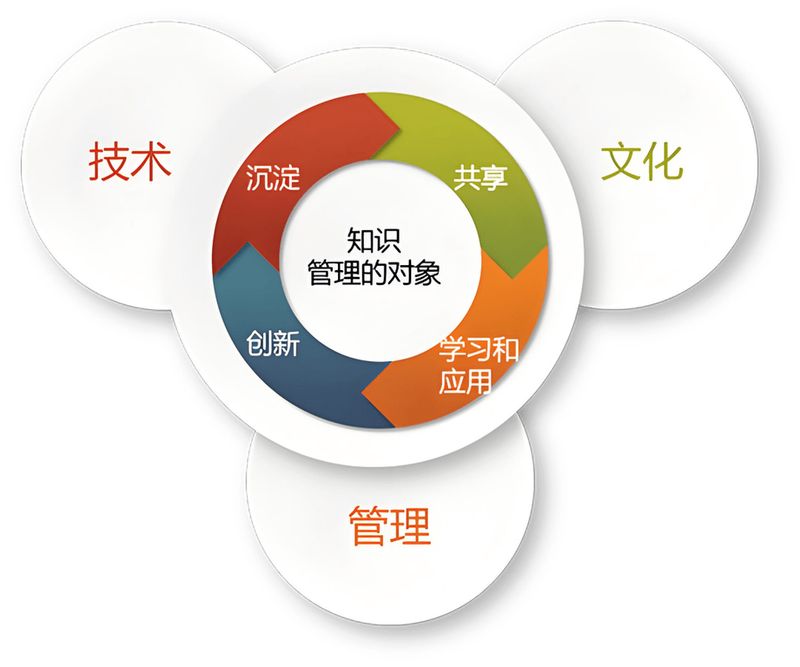
As can be seen from the figure above, knowledge management is at the heart of enterprise informatization, through the effective integration and management of intellectual resources through knowledge management, through the creation of a corporate collaborative environment through integrated technologies, and through the building of a knowledge collaborative community in the context of knowledge management systems, with knowledge-to-task linkages to provide knowledge support for a wide range of business activities, thereby achieving corporate value. At the same time, it is important to note that mission-based knowledge communities working together can not only achieve knowledge-supported support for mandates, but also the natural deposition of knowledge and the realization of the idea that “knowledge comes from business and serves business”, which solves the problem of resources and business. Further, based on a knowledge collaborative environment, comprehensive collection and tracking of user behaviour and business data, using large data technologies, mapping business landscape models and employee competencies, building a matching relationship based on synergetic filtering of recommended ideas, leading to smart distribution and referral of knowledge resources, enabling the right people to do the right things and delivering the right knowledge to different users。
03
Scenario-based knowledge management solutions
Based on these reflections and analyses, tonto ltd proposes an overall km solution based on the concept of “situated knowledge management”. Overall, the programme consists of two components: the km system solution, which is the information technology vehicle and process operating platform for achieving down-to-site km behaviour guided by the latter, and the km system programme, which is a strong safeguard for the development and application of the former and a guide for the latter. The two work together, relying on each other, and need to be built together on a continuous basis to create a synergetic application environment for knowledge management within the enterprise in order to achieve the business objective of knowledge management, which ultimately leads to a “task-driven, knowledge-accompanied” corporate knowledge collaborative environment。
Smart age knowledge management solutions
04
Concluding remarks
By describing the symbiotic synergy between resources and operations in the four layers of the information architecture, revealing the important value of building knowledge resources in the intellectual manufacturing age, and based on the informatization practices and research and development results of interpower ltd., this paper proposes scenario-based knowledge management solutions that seek to provide ideas and programmes for industrial development firms on how resource building and business optimization can develop together。