


In 2014, the state council issued a number of opinions on accelerating the development of the sports industry to promote sport consumption (hereinafter “no. 46”), which led to a rapid round of growth in the chinese sports industry. In the five weeks since the publication of article 46, the development of the sports industry in china has produced an interesting response. The value added of the sports industry has been growing at a high rate, the industrial structure has been optimized, and the level of participation and consumption of sports by the population has increased rapidly. At the same time, however, issues such as the landing of taxes and fees, the planning and use of sports land and the protection of intellectual property rights have become bottlenecks for many sports industry practitioners to further expand their operations。
Five years after its publication, the office of the state council issued its opinions on the promotion of physical health and sport consumption for the high quality development of the sports industry (hereinafter referred to as " the opinions " ). On this subject, xinhua journalists interviewed a number of sports industry experts, who considered that the opinions were a “timely rain” for the development of china's sports industry, but the issues raised in the opinions still needed to be implemented in detail in order to truly promote the health of the industry。
Objective: to address the plight of the sports industry
According to wang shelly, director of the research centre for sports industry development at the university of tsinghua, “the opinion has been more effective in addressing bottlenecks in the fallout of the old sports industry policy from the point of view of implementation, so in the course of the study, much effort was devoted to overcoming the difficulties of the fallout that already existed. Moreover, i think it is a particularly important expression of this document, which calls for the promotion of the sport industry as the mainstay of the national economy, meaning that after five years of development, the sports industry has a truly strategic orientation in the process of china's socio-economic development, transformation and high-quality development.”
According to wang yu hung, director of the centre for research in sports and economics of the central university of finance and economics, “the introduction of this document at this point in time has two key reasons for my personal understanding. First, after several years of reform and development, some of the key institutional and institutional factors have not yet been resolved. During the rapid growth of the sports industry, contradictions have become more pronounced, including difficulties in financing, use of sports facilities, excessive costs for institutional reasons, etc., which have severely constrained the development of the sports industry and, in a sense, have reached the point where it is necessary to change; it is also urgent to expand domestic demand, with the urgent task of expanding domestic demand and sustaining growth in a context of intense economic and commercial friction and downward pressure, and sport consumption as a new type of consumption, whether based on national experience or on our actual situation, has great potential to make a greater contribution to the expansion of domestic demand, but needs to be channelled through further supply-side reforms and demand-side reforms to unlock the potential of sport consumption.”
According to wang shelly, many of the measures mentioned in the views have dealt directly with some of the painful problems in the sports industry, such as the fact that water and electricity charges in the previous gymnasiums were based on entertainment industry standards and that the conversion of some factories to sports lands was inconsistent with previous land-use policies。
Bright spots: “practical” and “integration”
Wang shelly said, "i personally think the first bright spot is the problem of hitting the pain. The second is that the concept of `integration' is particularly reflected in the views, including medical and medical integration, physical integration, physical integration, etc., and that it specifies what `integration' should do. In response to the policy barriers that existed in the past in various sectors of sports industry development, specific sectors of responsibility have also been identified in the opinion, which is in fact a stronger policy voice. Thirdly, i feel that the opinion also contains a number of very clear objectives, such as the emphasis on services as a share of the added value of the sports industry, the overall size of the ice and snow industry, which also reflects a pragmatic aspect of policy. Finally, reference is made to the `across the road', i. E. How sport can help the `across the road' countries to connect people and cultural exchanges, which reflect very well the diplomatic function of sport and the cultural communication function of sport.”
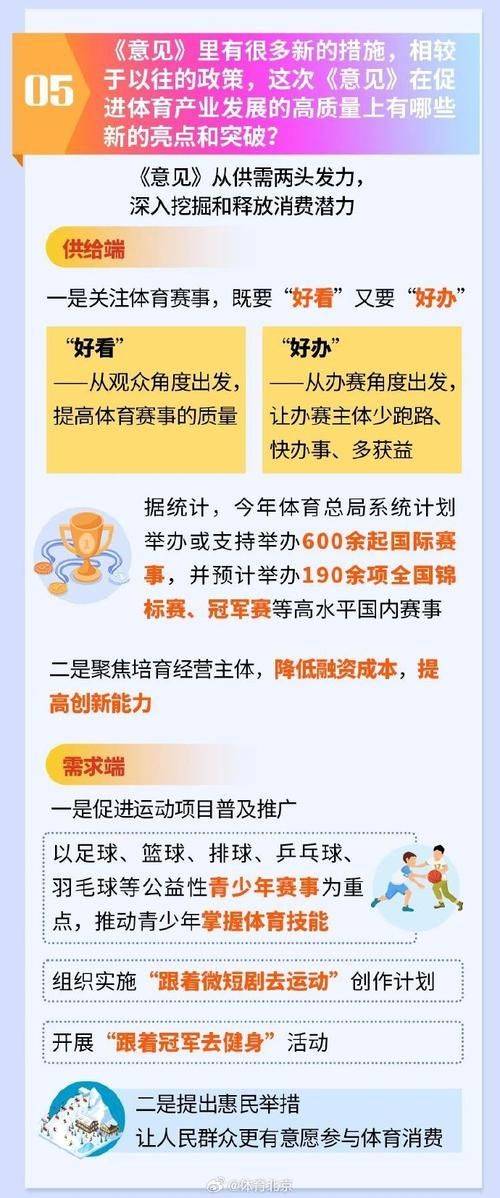
According to wang, the issues dealt with in the opinion are essentially the bottlenecks that currently constrain the development of the sports industry and, in addition to taxation issues, site issues, government and market relations, problems of financing, intellectual property protection, open competition resources, etc., have seriously affected the subsequent development of the sports industry。
In the sense that many of the initiatives in the opinion have been `timely rain' in the sense that, in recent years, a number of companies with which i have been in contact on various occasions have responded to these issues, it is believed that they can also bring confidence to businesses and markets and show the determination of the decision-making sector to promote the development of the sports industry. In addition to addressing the issue directly, the opinion is also positive in terms of the in-depth practicality of its measures to address it, such as the emphasis placed in previous policy documents, including 46, on the importance of intangible assets of sport for the protection of intellectual property rights, while the opinion, in addition to its continued emphasis on the protection of intellectual property rights, expressly sets out “the establishment of criteria for assessing intangible assets of sport, the improvement of the system for assessing them”, which provides the institutional basis for the formation of markets for the trading of intangible assets of sport, the way in which the value of the diversification of intangible assets of sport and the operation of capital, a measure which was also not mentioned in previous documents and which reflects the depth and practicality of the opinion.”
In the view of sports scholars and sports industry experts, the opinion reflects the initiative and motivation of the authorities to develop the sports industry, but in some more specific detail, it still requires a refinement of the theoretical and practical levels in order for policy to be truly laid down. “in the case of the marathon, which i am familiar with, there are now three main problems facing the marathon. The first question is how can urban governments be held accountable for the necessary elements of such events as security, transport, sanitation, medical care, etc.? There is a problem with this section, which includes cost-sharing and cost accounting. The second is that there are still imperfections in the market bidding chain. The third is the fact that there are companies, the media and business establishments in the market, which do not have a basic norm. Many departments were now responsible, but the challenge was whether rules could be made. For example, security, a football game, how much security do you need, 1,500 or 2,000, or 200 or 100? What about the specialization and marketing of security? How many guards should a marathon have? There are many unnecessary security costs, which would be more disciplined if a rule were to be adopted that would allow for discipline.”
Looking forward to the future of the "main industries"
Wang yu hung said: “with regard to the national economy's main sex industry, there is in fact a criterion for such sectors as cdrc, for example, that the value added of industry to GDP should be 4 per cent. Personally, i believe that the reference to `promoting the sport industry to become the backbone of the national economy' should be to emphasize that the value added of the sport industry is to reach a certain volume in the future, and that it is to be a percentage of the national economy. The value added of the sports industry to GDP is probably around this level in most pre-existing economies. If these objective criteria are set aside, i believe that the sports industry should also play a significant role in absorbing employment, linking other industries and promoting economic transformation. This can and should be done in the light of its own characteristics and advantages, which require that the sports industry continue to improve its structure and increase the proportion of sports services in the context of its growth in size, while enhancing integration with other industries.”
The deputy director of the national sports industry research base at beijing university, hoven, said: “to promote fitness and sport consumption for all, the aim is to promote the high quality of the sport industry, which is in fact a means for the physical and mental well-being of the human being. It is possible for the sports industry to become the backbone industry. In terms of business development in terms of consumption, our traditional consumption, such as food, shelter and clothing, accounts for the bulk of consumption, which is now slowly taking place. For example, it may cost $1,000 a month to eat, but it may cost $23,000 to participate in sports and run marathons, so that the consumption of sports may be higher than that of household expenditure, which is a development direction. When productivity is sufficiently developed, human beings can be freed from labour, everyone has enough leisure time, and the best way of life to spend leisure time is sports, so that in the future, when people's lifestyles dominate consumption, it will necessarily lead to the sports industry becoming the backbone.”
According to wang sherry, “the improvement of the physical qualities of the population is behind the exercise of physical fitness for all, which is a catalyst for any work in this society. The sports industry, in turn, is a green economy that corresponds to the philosophy of economic and social development in our new era. Finally, the `pillarism' of the sport industry manifests itself in the high correlation between sport and livelihood. So participation in or observation of sport is in fact part of people's aspirations for a better life, and if, in the context of the broader theme of reform, the goal is to meet the growing needs of people for a better life, then naturally the sports industry will be the backbone in the process.”



