Introduction 1
This chapter corresponds to the introduction to the project management knowledge system (pmbok) guide, version 6, part i: project management knowledge system (pmbok guide). As part ii project management standards continue to be quoted. Therefore, the title of this chapter is “introduction 1”, distinguishing。
The reference point to the project management knowledge system guide (pmbok) is relatively fragmented, mainly describing the basic concepts involved in project management. Thus, learning requires “know”。
Below is a presentation on the structure of the catalogue in line with the sixth edition of the project management knowledge system (pmbok guide)。
Overview and purpose of the guidelines
This section begins with a description of the concept of “project results”. Project results were identified as the result of the application of project management practices, principles, processes, tools and techniques by leaders and project managers in their work. Project - matters corresponding to the language of daily life. The company's annual working session is a “matter”; the yangtze three gorges project is a “matter”; and the exploration of mars is a “matter”。
In short, a “matter” is an item. Candidates need not confuse the concept of “contracting” with that of “project”。
Pmbok then presents the history of the project management knowledge system (pmbok guide). Early human beings did not have the concept of “project management”. It used to be unplanned and unmonitored. Such an approach leads to a low success rate. The project management association (pmi) later defined the project management knowledge system (pmbok) as a term to describe knowledge within the project management profession. The project management knowledge system includes proven and widely applied traditional practices, as well as new and emerging innovations in the profession. This led to the creation of the pmbok guide。
The pmbok guide captures the part of the project management knowledge system that is generally recognized as “good practice”. This means that the knowledge system (bok) points out that “most of the time, it is appropriate for most of the projects” and that “the use of these knowledge, skills, tools and technologies makes it possible to achieve the expected commercial value and results, thereby increasing the likelihood that many projects will succeed”。
“pmbok” refers here to “the process of determining the appropriate combination of the process, input, tools, technology, output and life cycle stages to manage the project, i. E. The `croping' application of the knowledge described in this guide”. A description of “process”, “input”, “tools”, “technology”, “output” is provided. For example, dumplings are a matter and naturally a project. The dumplings are first and face, then the skin, then the actual dumplings. This series of actions is referred to as “process” — followed by “progress management” and “activity”。
Flour, water, pie, spices required for dumplings are called "inputs" and packaged dumplings are called "outputs". The planks, chopsticks, etc. Used by dumplings are referred to as “tools”; the quality of dumplings and whether they are “showed” depends on the method of wrapping dumplings, which is called “technology”。
“cutting” refers to a “standardized version” provided by the pmbok guide, which the project manager needs to customize to the actual project context. The standard version provided by the pmbok guide is “plus or minus” and is eventually “detailed”. This process of “additions and subtractions” is called “crop”。
Project management standards
“pmbok” has the following information points in this section. Message 1: for the first time, reference was made to “project set”, “project portfolio”. These concepts will be explained later, and now the candidates can understand that. - project clusters are managed together to maximize benefits; portfolio management is managed together to achieve the strategic objectives of the organization. Information point 2: “pmbok” refers to project management, not “project cluster management”, “project portfolio management”. “project portfolio management” and “project portfolio management” are other specific criteria。
By way of example, each company colleague had to go to the breakfast booth downstairs in the office building for breakfast in the morning. Everyone goes in line, it's a waste of resources. A colleague may be assigned to buy breakfast for all company owners at a time. It saves time and effort. The cost of buying breakfast for everyone together is lower than the cost of buying breakfast for everyone alone. Harmonization of procurement means “management together”. To buy one's own is to “manage alone”。
Common glossary
No special description, normal understanding。
Ethics and professional conduct norms
No special description, normal understanding。
Basic elements
The project is an ad hoc effort to create unique products, services or results — a concept that is important。
It explains that “products” — mouse, keyboard, tangible products; “services” — listening to a concert, listening to a sound, which is an invisible service; “outcomes” — scientists invent a chemical formula and research teams study a scientific product, which is an intangible result。
“pmbok” indicates that the project is “interim” — note that provisional does not mean a period of time, but that it actually refers to “a clear start, end time”. The construction of the yangtze three gorges continued for many years, but it was a project
The “pmbok” follow-up notes that the project is “unique” - each project is different from other projects and does not have the same projects。
Other characteristics of the project are understood. “project-driven change” - a project was undertaken, with companies learning lessons, organizational maturity and organizational restructuring. “creating business values” - completion of a project to earn money and achieve business value. “background of project start-up” — where the project came from, “letting business stop being difficult” and then there was treasure hunting。
Importance of project management
No special description, normal understanding。
The value that needs to be added is the criterion for determining successful projects. Successful projects are not “low-cost, high-quality”. Project management is intended to be a “realization plan”. All work is carried out according to plan and is in good condition. Even if the plan is already clearly “problemed” and pending the formal approval of the new plan, it will be implemented as originally planned. The plan may be modified, but the change plan must be implemented. Follow-up remains as planned。
Some of the a were proactive in settling project costs for b at the end of the year; new contracts were entered into unexpectedly. One reason for this is that costs are one of the indicators of consistent project progress. The non-payment of settlement costs by a to b means that the project is not closed, even if the work is not completed during the year. This is an impact on the performance of the party itself. A new contract was signed, an advance payment was made and an item was established. A side has one more achievement of its own。
As a result, it is not “only the horses, not the horses, to eat grass”. “many, fast, good, low” are not the values of project management。
Relationship between projects, portfolio, portfolio and operations management
This section needs to clarify the differences between several concepts, and these knowledge points need to be understood。
Elements of a guide
Development life cycle can be predictive, iterative, incremental, adaptive or hybrid models:
The life-cycle concept is unclear to many candidates and is again described。
Prediction, traditional waterfall. The ancient poem: flying down 3,000 feet, suspected to be nine days down. The project is like a waterfall, in order. Once a job is done, the next job begins. The previous work was not completed and the latter did not begin. Most of these life cycles are used only in academic research, and actual projects are rarely used because of changing demand。
It's an iterative, not easy to explain. For example, visitors visit the palace. The rule now is to buy tickets for a visit to the palace for two consecutive days. The first day of a tour of the palace, from the south gate to the north gate, along the middle axis, the house of the tsar, the house of the middle tsar, the house of protection. The next day, a tour of the palace, from the south gate to the north gate, focused on the “kunning palace” and the “shufang sai”. The focus of the two-day tour was different, but the larger tour was from the south to the north. Every tour of the palace is an iterative one. The same point is the order of the general direction, and the distinction is the focus of the iterative process。
Incremental, not easily explained. For example, chang needs a car. Due to time constraints. Automobile stores provide a scooter with basic transport only at the first opportunity and conceal only the most basic needs. After a little while, three pairs of these “low-format” minibuses were upgraded, adding a leather cushion, an incremental upgrade. After a little more time, zhang added the car-mounted acoustic system, another incremental upgrade. As a result of these incremental upgrades, zhang san eventually transformed the original “low-format” minibus into a “high-format” car。
Adaptation, targeting projects with variable factors, corresponds to agile projects. More emphasis on embrace change。
The project management process groups and knowledge areas are shown in table 2-1。
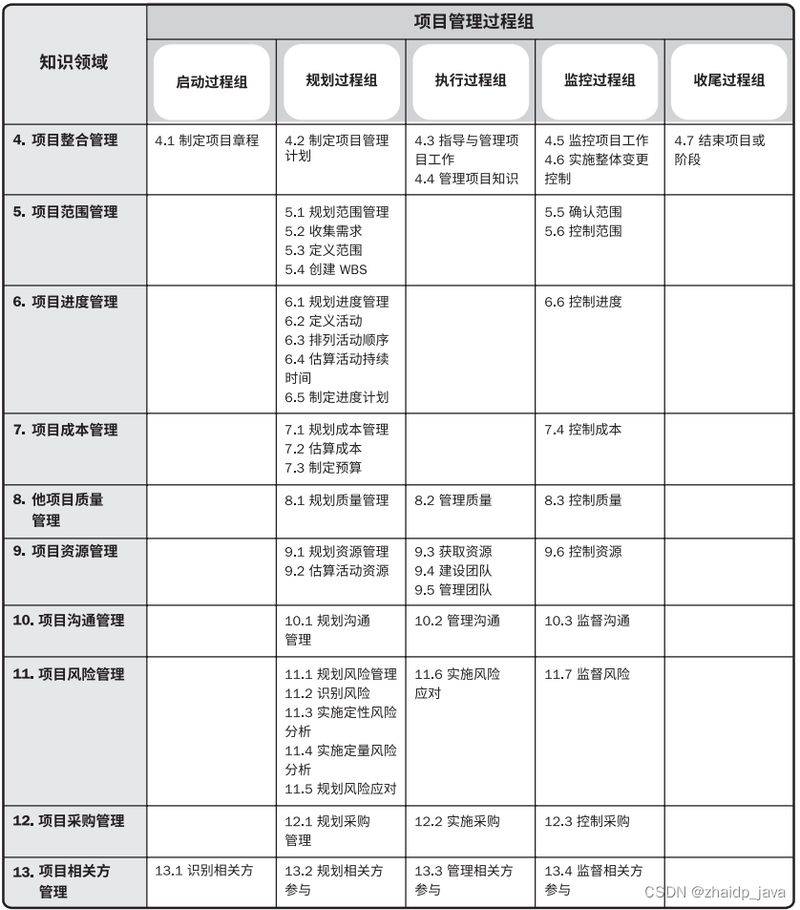
Table 2-1 project management process groups and knowledge areas
Crop
The term “pmbok” refers to tailoring to align the actual project requirements with the project management process groups and knowledge areas。
Project management business documents
The project business case, a documented economic feasibility study, is used to validate the benefits of options that are not yet fully defined and is the basis for initiating subsequent project management activities. In the later part, it was mentioned that an analysis of the feasibility of a project was needed before it could be formally started. The process of analysing the feasibility of the project is called “feasibility study”. The feasibility study of the project has various aspects, including (not limited to) economic, technical, social, etc. The clear explanation for economic viability is whether the project is profitable。
It is important to note that projects that are not not profitable are bound to end. Some projects are socially significant, as are some projects of public interest。
Project benefits management plan - a written document defining the process of creating, enhancing and sustaining project benefits. The project benefit management plan describes how and when the benefits will be realized by the project, as well as the benefit measurement mechanisms to be developed。