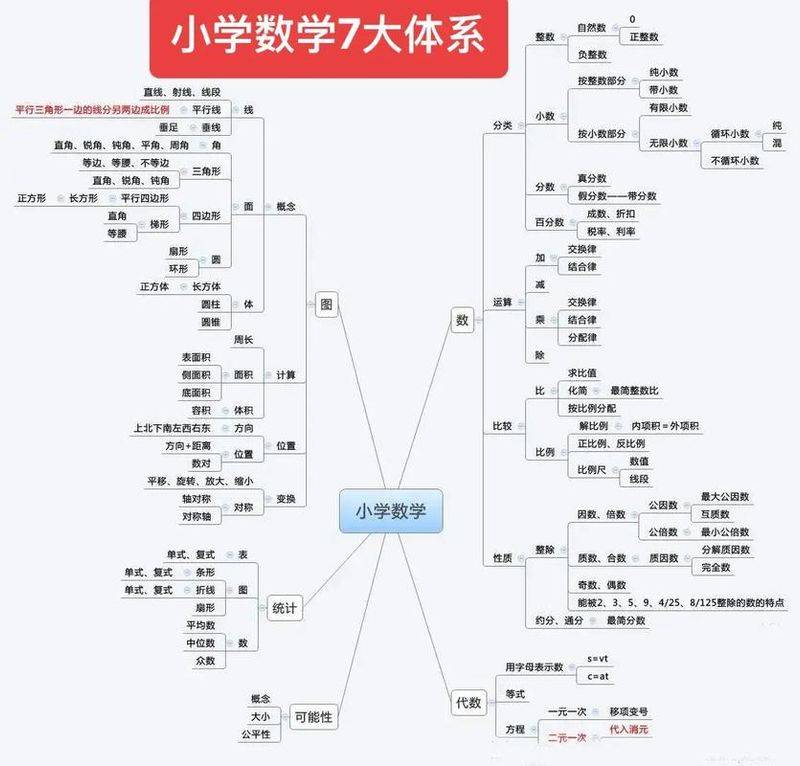
The mathematics knowledge system for grades 1-6 (where parents can refer to their tutored children), through which they can learn more clearly about the requirements to be met for each chapter of the study, helps children to detect gaps. Field classification (content) number and algebra number and graphics statistics and probabilities practice and integrated application one year level up book 1 number of numbers of points and numbers of objects. The second module compares object length (high and small) with weight. The third module consists of a simple classification, the method of classification. (i) awareness within (i) 10. The composition of unit 7 is divided into 10 or more units. Additions and subtractions within 10 or more of unit 8. Intuitive recognition of (ii) 11 to 20, meaning 11 to 20, plus 10 and corresponding reduction. Unit 10 is added by a single digit plus a single digit. The fourth element identifies its position by its front, top, bottom, right and left, and uses these azimuth terms to describe the relative position of the object. Module 6 recognizes objects intuitively, with respect to rectangles, squares, cylinders and balls. Interesting puzzle. The "rolling" "stacks" are the experiences of the plane and curve on the object, the "touching" is the initial appearance of feedback, the "touching" is a simple application of the shape characteristics of various stereos, and the "numbering" combines the recognition and identification of the object. The harvest orchard is a scenario-based practical exercise that brings together knowledge of recognition, computation and location to address practical problems with flexibility. Book i, next. Module iii recognizes numbers within 100 or more. Unit 4 plus and minus (i) double digit plus, minus deciles and single digits (no digits, no digits). The fifth module recognizes the renminbi and its units and rates of entry, simple shopping. Unit 6 plus and minus (ii) double plus and minus single digits (in progress, down). The second element recognizes graphic visual recognition of rectangular, square, round, triangle, parallel quadrilateral. The number of organizations we know that apply the number of “speaks” and guesses “counts”. The first part of the integrated practical activities of small shops is a situational problem, which exposes students to the situation they offer to solve problems of mathematics. The latter part is hands-on and organizes real or simulated shopping for students. A situational problem-oriented practice of the holiday team provides some known information and questions to be addressed, and requires students to look back at their own holiday activities and to raise and resolve some of the real problems. The additions and subtractions within unit 1 100 and within 100 correctly calculate the additions and decreases, plus or minus the commingling calculations, to give students an initial understanding of parallel quadrilaterals. The multiplication (i) in the third module allows students to appreciate the meaning of multiplication, on the basis of which 16 multiplications are written. The division (i) in module 4 is based on a multiplication machine of 1 to 6. Multipliers, one digit multiplied by one digit and the corresponding division for the multiplying and division (ii) 7-9 in the sixth module table. The recognition of parallel quadrilaterals in the second module gives students an initial understanding of parallel quadrilaterals. Unit 5 cm and rice recognize units of centimetre and rice. Unit 7 observation objects observe the same object at different positions, ex-post, rear, left and right, indicating the shape of the object as seen at each location. The interesting seven-board operation is to familiarize students with graphics and consolidate the knowledge they have learned. We have a ruler that further entrenches the concept of length and develops measurement skills. The first module has the meaning of the residual initial division, the initial recognition of the residual division, the vertical calculation of the residual division, and the answer to the remaining average fraction. The second module recognizes within a thousand. The third unit is divided into parts of rice and millimetres in length and millimetres. The addition of three digits to the fourth module includes the calculation of additions, calibration, estimation, validation and resolution of practical problems. The calculation and resolution of the three-digit reduction of unit vi. Unit 8, multiplication by two digits, practical problems related to multiple; two-step calculation of practical problems by multiplying and adding (decrease) methods. The orientation of module 5 has two elements, namely, north-east, north-west, south-east and south-west. The second is to look at the path in a simple plan. Module 7 understanding angles include the shapes of the angles and the names of the parts, the angles have sizes and methods of comparing them, and the direct, sharp and blunt angles. The ninth module of statistics collects and processes information using the methods already taught, choosing different classification criteria and counting methods based on the different problems that exist in the same event. Direction determination takes the form of group cooperation and direction determination on campus. How far you can jump is the first time that students are engaged in thematic practice, highlighting the application of statistical methods to thematic practice. The division of the first module by the double number divided by the single number (commercially double number) has a quantitative relationship in the actual problem to be resolved, the sum of which or what is left, and the actual problem of the average split. Unit 2 recognizes within 10,000. Unit 3 kg and g-understanding mass units kg and g. The fourth module, plus and minus two digits (and no more than 100), resolves the practical problem of two-step calculations relating to “multiple” or “discount”. Module v, 24-hour timekeeping, 24-hour timing and its connection to the ordinary timekeeping (12-hour timekeeping), is a practical issue of contact over time. The actual problem of multiplication of the seventh module by three times one and the actual problem of multiplication. Module 10 recognition scores, combined with a situation-specific initial understanding of the meaning of the scores, recognize, read and write simple scores. The characteristics of the rectangular and square rectangular, the meaning of the perimeter, the calculation of the rectangular and square lengths. The eighth unit of observation recognizes the front, side and above of the object; the objects that observe the rectangular or square shapes from the front, side and above; and the objects that are shaped from the front, side and above by the three same squares, making an initial conversion between the object and its positive view, side view and surface view. The possibility of events occurring in the ninth module of statistics and probability is sometimes the same and sometimes the same, and it is learned to describe the possibility of events occurring in life by the words “frequently” and “frequently” and “opportunities are equal”. The new rural landscape addresses practical problems in the reality scene, applying the two-digit digital divide and other mathematical knowledge just learned. The first paragraph refers to 1 kg of fruit or vegetables, the number of which is approximately how many; the second paragraph refers to weight. The arrangements for one day of weekends are understood, schedules are made, arrangements are shared and students are advised to rationalize their schedules. The length of the perimeter allows students to improve their understanding of the length of the surface graphics and their understanding of the method of calculating the length of the perimeter through activities such as rounding, tieing, spelling, measuring, calculating and estimating. Touch cards and chess continue to feel equal and less likely in the game. Next volume the first unit is divided by three digits divided by one number and two steps are used to calculate the actual problem. The second module relates to the year, month, year, month, day and neighbouring units, year and year. The fourth unit multiplication is double-digit, double-digit, multiplication is calculated. Units 6 and 6 are larger in length and larger in mass. (c) graphical symmetry and axial symmetry for the seventh unit axis. The recognition score for module 8 consists of two elements: an average split of one or more of the total, consisting of several objects, and a fraction of one or more of the total. The second is to apply the interpretation of fractions to solve the practical problem of one or more of the objects seeking a whole. Module 11 recognizes decimals, taking into account the circumstances, and initially understands the meaning of a decimal. It compares the size of two decimals with the addition and subtraction of one decimals. The third module smooths and rotates to recognize the smooth and rotating phenomena common in life; it allows simple graphics to move horizontally or vertically on square paper. Unit 5 observes objects from the front, side and above, with four identical squares, briefly describing the shapes they see。compare positive view of several objects (side view)