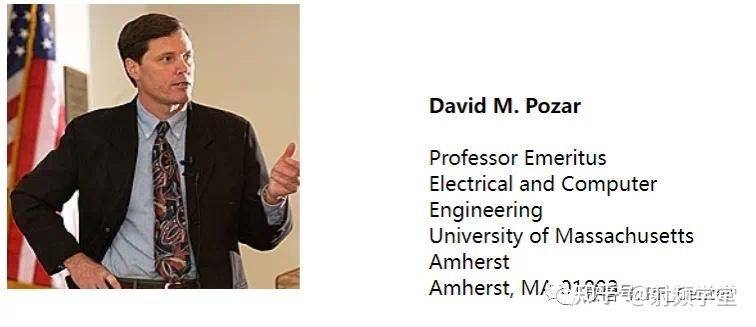
Professor pozar's microwave engineering is an essential reference for many and many radio-frequency people to study the design of microwave-frequency circuits. The book has been updated from its first edition, published in 1990, to its fourth edition. The impact of this microwave project among global radio frequency operators is evident。
Of course, in 2010, the chinese translation of this mega-microwave came before us, translated by professor zhang and others, and published the third edition of the book by the electronic industry press. In 2019, professor zhang and others translated the fourth edition of the great book。
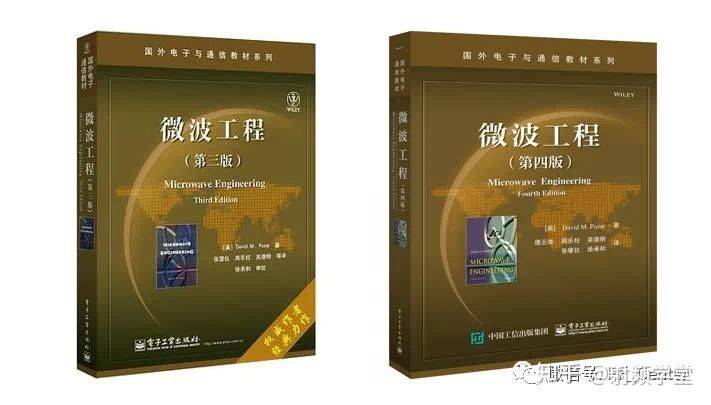
In the fourth edition, based on feedback from readers and the development of microwave technology, the author updates:
In chapter 10, the content on noise, altercation and related non-linear effects was expanded. In chapter 11 on activeware, the content of the bipolar crystal and field effects transistors was added, including data on many commercial components (shotki and pin diodes, silicon, arsenic, nitrogen oxides and silicone crystals), and the content of these subsections was reorganized and rewritten。
Chapters 12 and 13 provide information on the design of powered circuits, explore the electrical degradation of the differential amplifier, the nmos amplifier and expand the content on the differential fet and gilbert unit mixer. In chapter 14 on radio frequency and microwave systems, the content on wireless communication systems, including the budget for the link, the abundance of the link, the digital modem and the error rate, was updated and added. The section on radiation injuries was updated and rewritten. Other new elements include transient effects on transmission lines (which are in the first version but have been removed from the subsequent version and are now given again at the request of the reader), power wave theory, high-scale models and frequency effects of microband lines, and the method of measuring unloaded q. It also revises the subjects of practice and practice. The deletions in this version include quasi-static analysis of microbands and some elements related to microwave tubes。
Finally, hundreds of errors in the manuscript were corrected based on the original source document。
So, if the old version is on hand, the reference book at hand can be updated while it is still available in the country. Of course, if you haven't seen the third edition, then there's no need to rush to buy a new one。
In fact, books are cheaper in the country, which is the first reason why little carpenters keep books. The price of this book abroad is $266. 95, which corresponds to nearly 2000 yuan. Wouldn't it hurt if you spent $2,000 on a book
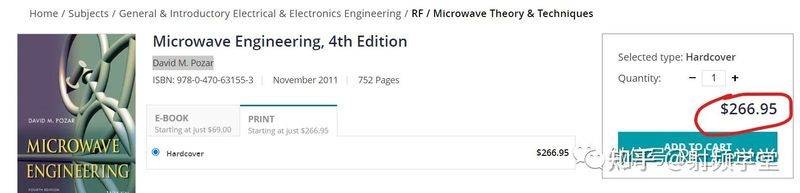
If you are willing to challenge the original version of the book and do not want to spend more, you can enter the keyword "microwave engineering 4" in the base public dialogue box of the radio frequency academy and get an electronic download address in english. (simple telling you, ctrl+c/ ctrl+v, which is faster)
Thanks to mr. Zhang zhang and others for their hard work, the chinese translation of this book has not only made it affordable for us, but has not been so hard to read it。
Of course, 2,000 dollars is cheaper for such a 700-page microwave bible study reference。
It depends on how you use it。
So how? It's important。
First, there's a certain microwave base
Over 600 pages of microwave engineering exceeded the thickness of many learning books. For a zero-basic student, the depth of seeing the book is about to recede, let alone read it. Therefore, it is suggested to study the microwave technology base before studying the book. There are a lot of university video courses on the beep, and mr. Liang changhong is more recommended for microwave technology。
Click on the picture below. Scan the two-dimensional code for study
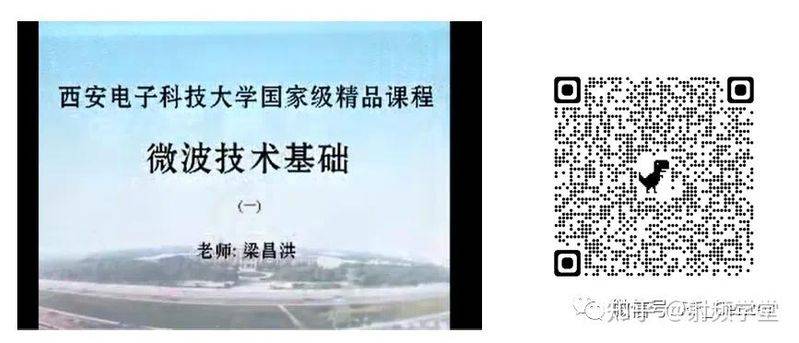
Of course, the site can also be reproduced at https://www. Bilibili. Com/video/bv1m7411l77f/? Spm id from=333. 337. Search-card. All. Nick&vd source=2b38fbd6800dc483c20c45279084eea
Some of the courses are included in the radio frequency school: teacher liang changhong on microwave-02
In conjunction with mr. Liang's concise microwave, learning is more efficient. I don't know where to sell it。
Of course, courses with microwave skills are offered in a number of university e-professionals, and if there are students interested in radio frequency, they must be studied carefully. At the same time, the teaching materials had to be kept, and it would be easier to replace them even if they were not listened carefully during the previous period。
In addition, there are better microwave books on the market, combined with theory and design, which make it easier to learn. For example, mr. Rai jinya's microwave engineering introduction and mr. Xiu su-jin's microwave technologies and microwave devices, both of which contain a wealth of microwave cases that can be deciphered in the course of learning, together with simulation designs, in order to deepen understanding。
Second, there's a certain base of electromagnetic fields
As our students in the electronics profession know, we study the theory of electromagnetic fields in the course of our studies before learning microwave technology. But it's a personal feeling that the electromagnetic field theory may be theoretical for many of our classmates, simply to stay out of school. As for what they learned, they probably gave it back to the teacher。
But electromagnetic field theory is also crucial to learning about microwave engineering, such as the decomposition of electromagnetic fields, boundary conditions and so forth, which are the theoretical foundations of microwave technology, especially for transmission line equations, which are the only way to deduce the transmission equation of electromagnetic waves in transmission lines and convert them into circuit models of distribution parameters that we can easily understand. For example, the various modes in microwave transmission lines are inseparable from the electromagnetic field base。
But it's difficult to understand the electromagnetic field as something you can't see or feel. There are a number of suggestions here. First, the maxwell equation needs to be understood. Recommended reading: unable to rip e=mc2, then try to rip maxwell's equation
Secondly, the concept of the boundary conditions of the electromagnetic field should be well understood. Of course, this border condition also focuses on learning in microwave engineering。
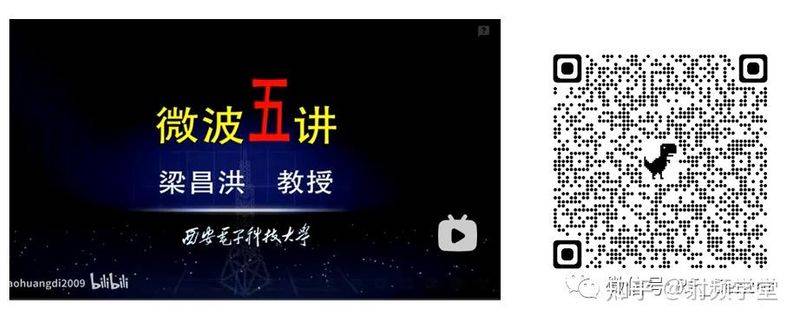
It is recommended here that mr. Liang changhong's microwave five speech, which also has a large number of miles, scans two-dimensional yards and can reach the course。
And third, there's a little math base。
Math is the foundation of everything, and of course microwave engineering is the basic tool of mathematics. Well, the math in this book is not so hard. At least it's much simpler than the electromagnetic field. But basic calculus, points and trigonometric functions need to be conceptualized. Mathematics classes in almost all of these universities, especially the higher mathematics for science and technology。
Besides, the matrix is a mathematical tool that's commonly used in microwave technology. For example, various matrix parameters in microwaves: s, y, z, t, and so on, we like to describe the calculations in a matrix. So there's a basic matrix. The subject of online algebra is focused。
Of course, if you're good at math, it's more useful not only to study microwave engineering, but also for electromagnetic computing. If mathematics is not good, and don't be discouraged, there is still less mathematics involved in microwave engineering. For the design of many microwaves, there are even fewer mathematical calculations involved。
With these foundations, it is easier to learn from the book microwave engineering. But it's not just done. Of course not. 700 pages of technical books. How long will it take
So there are a few suggestions for how to learn the book。
One, good to read, no to ask。
I think the ancient saying is particularly good, that it's "good" to read, that it likes to read, that it doesn't have to be understood in its entirety for the first time. When you first learn, you'll probably be able to master the basic concepts of the book. For example, understanding what is a transmission line equation, what is a microwave network, what is a transmission line, what is a convulsive cavity, what is resistance to matching, is basic concepts. When the latter microwave device is being studied, the other way around is to learn about the prior knowledge points and see how they are used in microwave design。
So for the first time in the book " microwave engineering " , it is suggested to start with a general reading, and probably know what it says. As for complete understanding, it could be left to the back。
Two, simulation test theory, theory guide simulation
The most difficult part of the book is the theoretical part, that is, the basic knowledge of microwave engineering, such as microwave networks and transmission line equations, presented in previous chapters. But this can be combined with the device design to understand the theory when it's being studied in later writing. The filter design, for example, uses the concept of a convulsive cavity, which is used in microwave transmission lines. Microwave engineering, on the other hand, is based on resistance to matching, and learning about the smith circle and how to use it to achieve resistance matching in the back when dealing with resistance matching。
At the same time, the design of microwaves can also be validated using simulation software. Validate the theory in simulations, using theoretical calculations to guide simulations。
Three, use this book as a tool
Students are advised to use the book as a tool book, similar to the dictionary that we used when we first went to school, as a dictionary for radio-frequency engineers. In the course of their work, answers can be found in this book if they encounter a place they do not understand。
For example, in the case of power-capacity-related designs, the book contains detailed descriptions and calculations in the section on the same axis。
For example, there are non-usual transmission lines, for example, some of the little-used coupons, the subdivisions, which are actually covered in this book。
Learning is a long-term process, and it's probably the charm of the book, as in the mega-write of microwave engineering, where there are different gains from each reading。
For learning, you can't eat fat, you can't keep going. The habit of lifelong learning is more critical for radio-frequency engineers in today's fast-modified technology than for them to stay behind and stay behind。
Good luck
Here's the radio frequency school, watch and add, and ensure that new knowledge is learned every day。