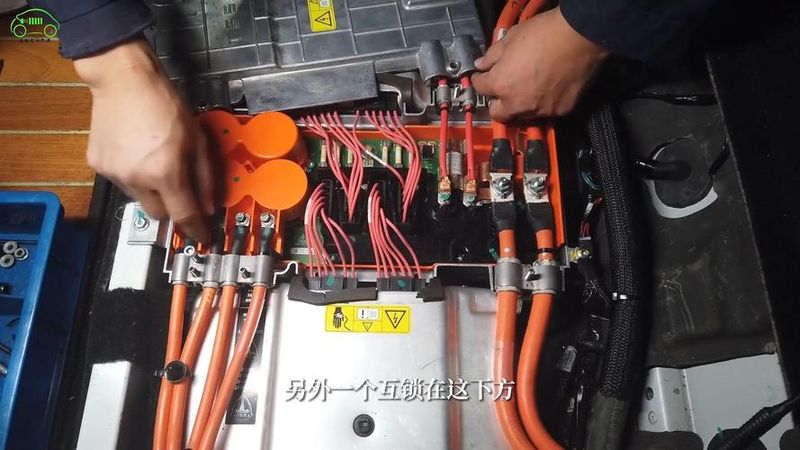
As of 21 march 2026, the first large-scale new energy passenger vehicles in the country had been concentrated in the 5-8-year life cycle, with battery decay, re-carrying and charging anomalies becoming high-frequency problems. Many car owners are in the same situation: the body, chassis, electrics, electrical controls are normal, power battery performance is down, and 4s generally recommends the replacement of the package at a cost of tens of thousands of dollars。
In response to this industry, order no. 73 of the ministry of industry and information technology, the national development reform commission, the ministry of ecology, the ministry of transport and communications, the ministry of commerce and the general directorate of market supervision, on the interim measures for the recycling and integrated use of used motor batteries in new energy vehicles, was published on 31 december 2025 and has been in force since 1 april 2026, simultaneously abolishing the 2018 version. This article is based strictly on the official language and authoritative interpretation of the real situation on the market in march 2026. All information is verifiable and landable。
I. Real context: why's the camera camera in 2026
The year 2018-2019 is the year in which new energy cars in the domestic private sector are released, and the year in which the minimum quality assurance requirement for the three-power system was generally implemented for 8/1020,000 km of vehicles sold. By 2026, the vehicles were in the final stage of quality assurance and in high condition of decay。
Decomposition of power cells to physical patterns, non-mass problem:
- normal annual decline of about 5 per cent to 8 per cent for household use
- full power storage, high speed charge, low-temperature large discharges will accelerate decay
- when the capacity is reduced to less than 80 per cent, there is a marked decline in the continuation, speed of recharge and low temperature performance
- the total mechanical and electrical core parts usually have a lifetime of more than 10 years, thus creating a widespread phenomenon of “car availability, battery drag”。
Industry empirical data from march 2026 show that approximately 75 per cent of battery failures were localized, including large core pressure differentials, bms sampling anomalies, cooling pipe blockages, bad beam contact, sensor failure, equilibrium failure, minor seal leakage, etc., and no need to replace the whole package. A large number of partial malfunctions were previously disposed of as a package and pushed to higher cost to the owner because of the lack of open technology and irregular testing。
Ii. New regulations of 1 april 2026: core provisions of the official original language
The following are directly derived from order no. 73 of the ministry of industry and communications and from the official interpretation of the chinese government's network
Maintenance and technology openness: explicit support for “capable repairs”, prohibition of technical barriers
- power battery enterprises should provide companies and repair companies with coded and necessary dismantling technology information
- automobile companies shall be required to make available technical information on vehicle maintenance and shall not place technical barriers on compliance third parties
- motor vehicle repair facilities should regulate the transfer of used power cells, which may not be disposed of at will。
True statement: the new regulation does not use the term “compulsory fixation” as an absolute term, but rather uses the whole life-cycle traceability, recovery liability, technology disclosure, failure diagnosis as a tool to promote maintenance priorities. The door shop may still make recommendations for replacement based on safety standards, supply of spare parts and repair capacity, but may not make a direct replacement without a diagnosis。
2. Disability diagnosis and reporting: must be retroactive and verifiable
- establishment of a single power cell traceability platform throughout the country, with code management** for “digital identity card”**
- maintenance, replacement, recycling and dismantling of the entire process, with the only code that cannot be altered
- the diagnostic response should be coded so as to create searchable records and avoid arbitrary decisions。
True statement: the new regulation does not oblige the “48-hour double programme report”, which is a proposal for local and media landings and is not a national uniform law. The central basis for the rights of the owner is tracer records, failure data, detection vouchers, rather than uniform format instruments。
3. Liability for recycling: motor and battery companies must establish a network and not refuse to accept
- installation of a recycling service network, public address and contact information at the municipal level by car and battery companies
- waste power batteries that should be recycled shall not be refused
- the new energy vehicles at the end of their life are managed as one vehicle and missing batteries are identified as missing vehicles。
4. Legal liability: clear penalties and clear subjects (executed as of 1 april 2026)
- failure to hand over used power batteries as required: a fine of $10,000 to $30,000 for rectification
- failure to transmit information or to send false information: a fine of up to $30,000 may be imposed on an order to correct it
- unpublicized technical information on maintenance: punishable by law in the transport sector
- infringement of movement to prohibited areas such as electric bicycles: penalties in accordance with the law。
Current market reality: march 2026
The difficulty of “capable” landing: objective existence
- part 4s still recommends full-pack replacement on the basis of safety regulations, original plant processes, missing parts and no maintenance space
- the number of third-party compliance maintenance enterprises remains limited and the coverage of cities on the 3rd and 4th line is inadequate
- maintenance requires high-pressure qualifications, detection equipment and traceability, not all of which can be carried out。
True conclusion: the new regulations provide a basis for defending rights, but do not allow for “immediate enforcement of one sentence”, and the owner of the vehicle is required to provide test data, communication records, trace documentation and, if necessary, complaints through the competent authorities of the industry。
Battery decay risk: there is no universal stand-alone product for private cars
- there is currently no national independent commercial risk of battery decay for ordinary private cars
- most of the relevant safeguards are found in the programme for the operation of car and power separation, business continuity and battery leasing
- some insurance institutions are still being piloted and are not being extended to private users on a large scale。
True conclusion: don't believe in the “depreciation-to-compensation” campaign, private car batteries rely mainly on quality assurance, new maintenance, recovery discount guarantees。
3. Maintenance price: real area in march 2026 (no extreme cases)
- bms software repositioning, sampling anomalies, cord hardening: $300-1500
- cooling system clean-up, sealing, sensor replacement: $500-$3,000
- single core balance/replacement, module detection maintenance: $1,000 to $5,000
- whole package replacement (concentrated domestic vehicles): $16,000-$30,000; medium vehicles: $46,000-$70,000
True conclusion: while partial maintenance, usually 10-30 per cent of the total package cost, can significantly reduce expenditure, the vast majority of failures are not solved by hundreds of dollars and involve the cost of modelling and core operations in general of several thousand dollars。
4. Policy transition period: objective presence
- the new regulations came into force on 1 april 2026
- local by-laws, supervisory inspections, upgrading of the door shop system and training of personnel for one to three months
- national synchronization of the full-fledged process, with the owner waiting rationally and placing a witness in communication。
Iv. Insuring/insured owner: real landing in 2026
(i) still in the three-power guarantee period (based on the contract and national standard)
1. National compulsory bottom line: no less than 8 years/120,000 km of electricity
2. Declining is determined on the basis of the data of the car announcement + test, with some brands (e. G. Biadi, polar krypton, etc.) committed to national standards and based on written terms
3. Non-anthropogenic damage (no bubble water, no major accident, no self-retrofitting) may claim quality assurance services
4. Protection of rights: soh health screening, charge record, failure code, door shop communication record, test form。
(ii) owner insured: three secure paths
1. Conduct full core/total module testing to determine whether it is a partial failure or a whole package of ageing, without direct switchover
2. Prioritize compliance maintenance at a much lower cost than the full package replacement
3. The replacement is subject to an official recovery discount, which is set at soh health level to reduce expenditure。
V. The owner of the car must do it: 3 chains of true evidence (core of rights)
1. The whole process leaves a mark: testing, quotations, communication requires written or systematic recording, and oral conclusions are not accepted
2. Coding verification: confirm that battery codes are consistent with trace sources to prevent sub-filling
3. Channels of compliance: select institutions with high-pressure maintenance qualifications with access to traceability platforms to reduce risk。
Summary and reflection
“cars are good and batteries are bad”, which is the real pain of a new energy car entering the market from the popular phase. The new six-sector regulation, which was introduced on 1 april 2026, establishes the institutional framework for a full life cycle of traceability, technology disclosure, recovery liability and legal penalties, at the root of which it regulates “no change” and protects the legitimate rights and interests of the owner。
We must return to reality: policies are institutional guarantees, not instantaneous elimination of all differences; decay is a physical pattern that cannot be avoided completely; maintenance is cost-effective, threshold-based, process-oriented and there is no ideal “zero-cost easy fix”。
For every owner, the real sense of security comes from three points: detectable failures, traceable records, rules on which to rely. For industry, competition for new energy vehicles will eventually shift from renewal and acceleration to life-cycle use costs, maintenance convenience, residual value and recycling systems。
The year 2026 is the year of standardization of the post-dynamic battery market. As rules land, third parties expand and prices are transparent, the “failure of good batteries” situation will gradually ease. We should focus more on how maintenance standards are harmonized. How's the fitting going? How can the old battery recover more for the owner? These issues will determine whether the new energy owners can really use the car for the next five years。