1. The principle of electromagnetic heating
The electromagnetic furnace, also known as the electromagnetic stove, is, by definition, a stove for food heating by the electromagnetic field. So, what's electromagnetic heating? Before answering that question, let us look at the following phenomenon: the metal core heats when the worker frequency transformers in domestic appliances work. How does a steel core heat up when it is neither connected to a primary rounding group nor to a secondary rounding group
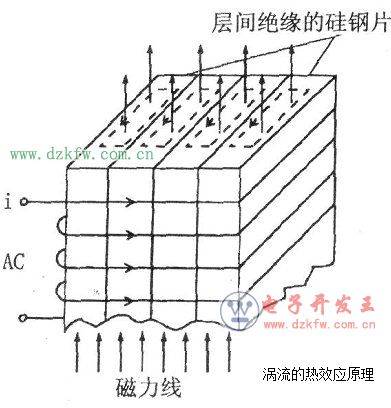
The structure of common power transformers is summarized in the following figure. When electricity is exchanged in the ring, the magnetic field is created in the circle. Every piece of silicon steel in the transformer is crossed by a magnetic line, which, as a result of changes in magnetic field strength, i. E. The number of magnetic lines (magnetic fluxes) that pass through each piece of silicon steel, is known by the law of twirl and produces a closed vortex-like sensory current (in the direction of the current at a given time) within each piece of silicon steel in order to prevent changes in the magnetic flux, which is called the vortex current, a short vortex flow. The vortex flows in every piece of silicon steel, and as the current has thermal effects, the silicone is hotter and warmer. The phenomenon of vortex conversion of electricity from metal to heat is called the heat effect of vortex。
Although thermal effects of the vortex can have adverse effects on electrical equipment, it can be applied to heating technology, known as electromagnetic heating。
(1) knowledge link: thermal effects of vortex response
Thermal effects of vortex flow are very harmful in electrical and electronic equipment。
When the transformer's wiring communicates electricity, large vortex is generated in the steel core, releasing large amounts of heat, not only to consume electricity in white, but also to the detriment of normal operation of electrical equipment. In order to reduce the impact of vortex and vortex, the steel cores of common industrial frequency transformers are more likely to be formed by stacking of thin silicon steel with insulation paints or surface insulation membranes, and by paralleling the tablet of silicon steel with magnetic lines. As a result, the vortex of each piece of silicon steel is reduced by reducing the cross-section area through which the vortex passes, together with the greater resistance of the silicon steel piece itself, and thus the vortex is reduced, thereby reducing the energy loss. In order to minimize the vortex, the iron cores in the hf components are suppressed by insulated magnetic material particles。
(2) background knowledge: electromagnetic furnaces
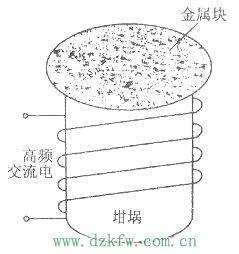
Electromagnetic heating is not a technique that has emerged in recent years. In the 1950s, in the metallurgical industry, high-frequency sensors (also known as electromagnetic furnaces) for metal smelters were produced using thermal effects of vortex flows. The high-frequency induction furnaces are entangled in the outer circle of the plume and are brought to the high-frequency turnover power source, as shown in the figure below. A magnetic field producing high-frequency-transformation within the hf turnover online loop. The smelted metals in the furnace produce strong vortex due to electromagnetic induction, releasing large amounts of heat and melting the metals。
Shortly after the emergence of the above-mentioned high-frequency sensors, many high-frequency sensors for civilian heating food, now commonly known as electromagnetic furnaces or electromagnetic stoves, have been designed. Due to the complexity of the circuits designed at the time, together with the low level of manufacturing and poor performance of the power-based devices at the time, the reliability of the performance and use of the electromagnetic furnaces has remained low, together with their affordability, and the electromagnetic furnaces have not been widespread for a considerable period of time。
In the late 1990s, large numbers of high-capacity semiconductor power units were available, single-piece control technologies were being improved, resulting in a significant increase in the reliability of electromagnetic furnaces, and the emergence of cheap and beautiful electromagnetic furnace products, springing out of the rain, was popular among consumers。
Theoretically and experimentally, vortex power is not only proportional to magnetic induction strength (b), but also to the level of the exchange frequency. Thus, in order for the electromagnetic furnace to achieve a certain heat exchange power (greater than 1200 w) to meet cooking requirements such as frying, frying, steaming, cooking, etc., the most effective way to do this is to increase the frequency of the exchange of electrical power to increase the vortex power, in addition to the installation of a transmagnetic field coil capable of producing high magnetic sensitivity. At present, the communication frequency via electromagnetic furnaces and hotlines is 15-30 khz. When power is exchanged with high frequency (hf) in the coil, an intersection magnetic field is generated around the coil, a powerful vortex is generated in the iron pan base, which quickly releases a large amount of heat, as illustrated in the figure below。
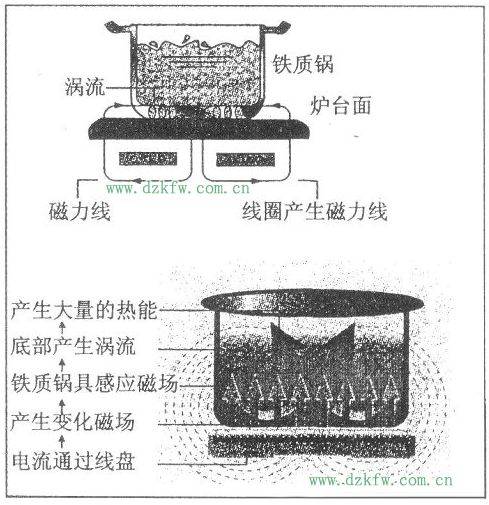
Tips: the electro-magnetic furnaces do not heat the food in their own turn (also referred to as the hairline rings or the hotbeds). This means that the electro-magnetic furnaces do not heat the food using heat transfer, but rather use electromagnetic sensors to heat the pot itself at high speed, thus heating the food and increasing the heat efficiency。
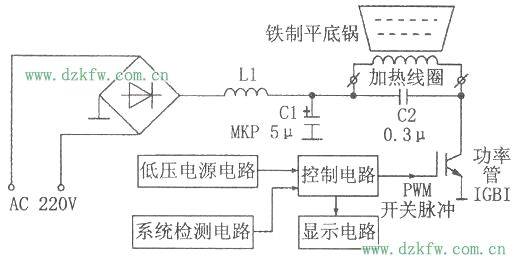
In order to form 15-30 khz of high frequency (hf) communication power in the hairline ring, there are frequency conversion circuits in the electromagnetic furnaces, which convert currents, filters and direct currents into high frequency (hf) fluxes; power detection and control of circuits are also provided in the electromagnetic furnaces in order to achieve power adjustments in different cooking processes, such as cooking, frying and steam. A summary of the circuit principles of the common electromagnetic furnace is shown in the figure below。