Explore cost management systems for manufacturing enterprises. Using the example of a fictional, representative car spare parts manufacturing company, we will analyse the whole process from target cost setting to standard cost implementation to actual cost analysis and improvement, in the hope of providing you with a clear cost management closed perspective。
Before formally starting the case analysis, we will first clarify three core concepts. The target cost, the maximum cost that we set at the outset of product design, is “how much must be” at the strategic level. Standard costs, which are the cost poles we implement in the production process, are “what should be” at the operational level. The actual cost is the true cost that is accounted for at the end of production and the “actual amount” at the outcome level. These three constitute a complete closure to cost management。

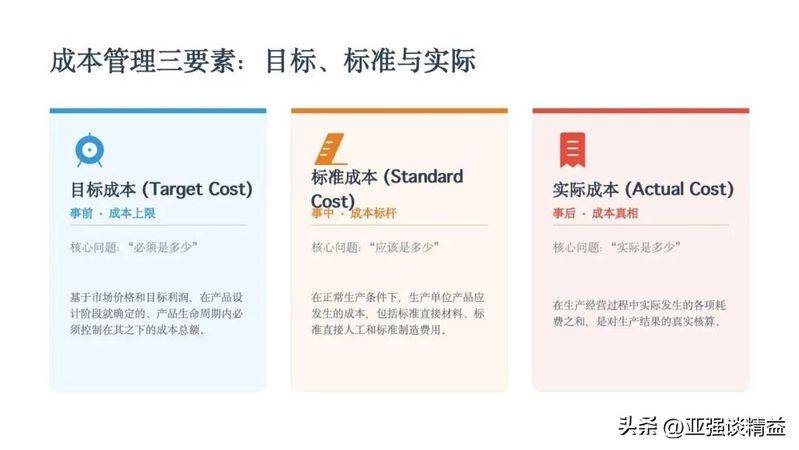
Now, let's look at a specific case. It is assumed that company xx will produce a car engine pole. During the product design phase, the company learned from market research that the market value of the pole was around $200. In order to guarantee a 20 per cent profit margin, the company calculated that the target cost of the pole would have to be kept within $160 per package. This is the “cost cap” we set in advance。
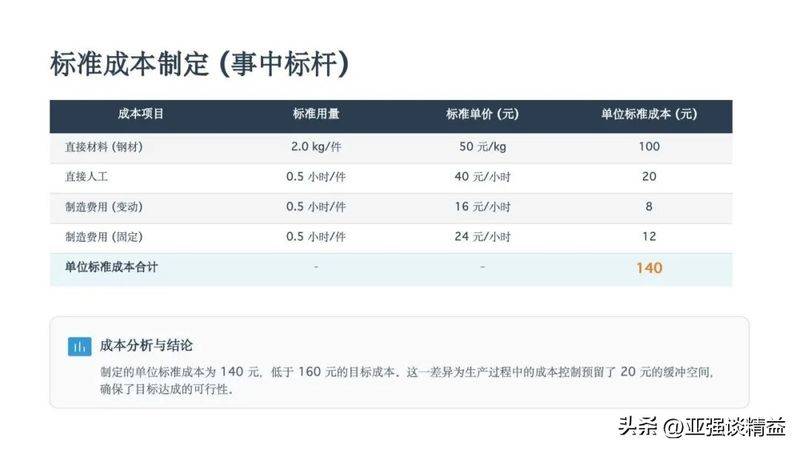
With a target cost of $160, companies started to develop “cost poles” - standard costs - in the production process. They split costs into direct materials, direct labour and manufacturing costs. For example, the standard for the production of a pole requires 2 kg of steel at a unit cost of $50, so the material cost is $100; the standard requires 0. 5 hours of labour at $40 per hour, and the labour cost is $20. By such extrapolation, the standard unit cost was eventually calculated at $140, which is lower than the target cost and provides a buffer and target for subsequent cost control。
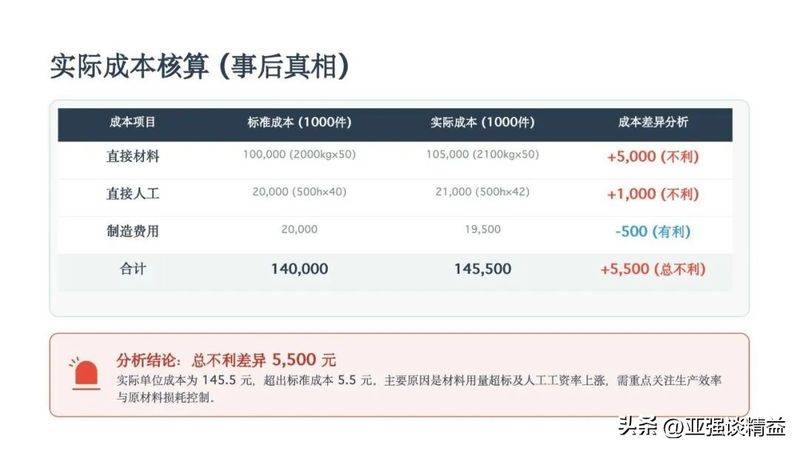
When production is completed, we look at “cost truth” — the real cost. By way of accounting, we found that 1,000 products were produced at a total cost of $145,500, or $5,500 more than the standard cost of $140,000。
Specifically, the cost of materials increased by $5,000 because of excess usage, the cost of labour increased by $1,000 because of higher wage rates, with only modest savings in manufacturing costs. That is the cost difference that we need to analyse and improve。




For the reasons analysed, we have developed specific improvement plans. First, with regard to waste of material, we will immediately provide intensive training for new staff. Secondly, we will optimize production plans and avoid emergency orders in response to the increased labour costs resulting from overtime. Finally, we want to turn the analysis of cost differentials into a routine exercise to continuously monitor and improve our cost management levels。
Finally, let us summarize. This case analysis tells us that effective cost management is a closed loop from setting targets, implementing standards to analysing results and continuously improving. Discrepancies analysis is key to our finding of problems, and continuous improvement is central to cost management. At the same time, cost control requires joint corporate efforts. It is hoped that this case will help to better understand and apply cost management methods。
Basic knowledge:
The price acceptable in the target cost market - the target profit = the maximum cost that must be achieved. It's a "cost line to do." standard costs are based on normal processes, normal efficiency, normal wear and tear. It's the "base cost of testing." the actual cost of producing the real material, work and costs. It's "real money spent." 1. What is the target cost? Freeze
Formula: target cost = target price - target profit
Steps:
Purpose:
2. What are the standard costs? Freeze
It consists of three parts:
Standard cost = standard material + standard worker + standard cost
Characteristics: annual or quarterly
3. What are the actual costs
Reassembly by reality:
Actual cost = actual material + actual work + actual cost