


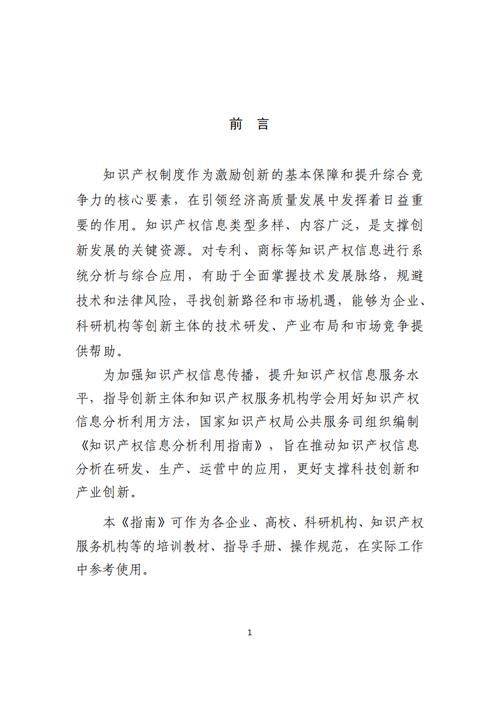
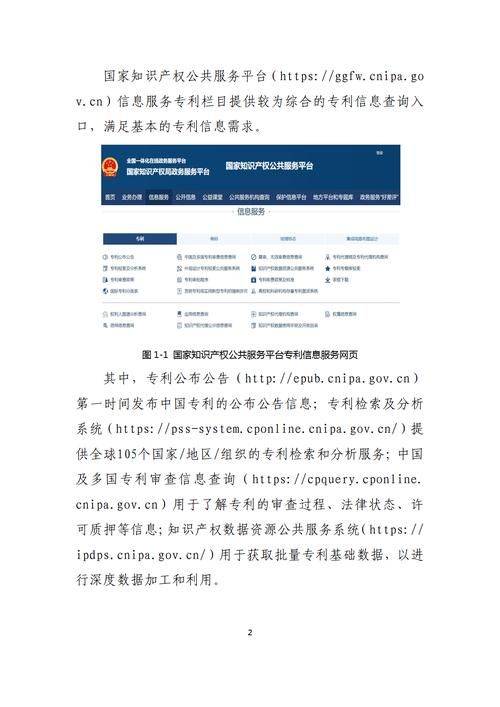
Intellectual property information is diverse and inclusive as a key resource underpinning innovative development. How precisely to access and effectively analyse this information and ultimately turn it into a “meanor” for commercial decision-making is a common theme for innovation actors. Recently, the guide on the use of intellectual property information analysis (hereinafter referred to as the guide), organized by the public service division of the national intellectual property agency, was officially published with the aim of better harnessing the role of intellectual property information in r & d, production and operation and of better supporting sti and industrial innovation。
“the guide provides a comprehensive overview of access to intellectual property information, analytical methods, process norms, analytical tools, etc., and it is hoped that a practical manual on intellectual property information analysis will be made available to enterprises, universities, scientific institutions, service providers, etc., from `introductive' to `exact'. “the relevant head of the public service division of the national intellectual property agency states。
Patents and standards synergies, technology and brand integration are current trends in innovation development. Based on the actual needs of the innovation subjects, the guide draws out the limitations of a single information analysis, constructs a system of analysis of patents, trademarks and 3d connections of integrated information, deciphering the pains of the fragmentation of past information, analysis of shallow layers and applications。
In the context of the patent information dimension, the guide consolidates 14 core analytical methods, covering both basic tools such as statistical analysis, monitoring of early warning and front-line applications such as technology life-cycles, technology road maps, standard relevance analysis, strengthening risk-control tools such as free implementation (fto) analysis, patent stability assessment, precision technology development, patent layout and standard integration into the whole process. In particular, with regard to the synergy of patents and standards, the guide refines standard relevance analysis methods, helps innovation subjects to develop project orientations, circumvents the necessary patent barriers to standards, promotes the embedding of their own patent standards and allows technological innovation to resonate with rule-making. These methods of analysis constitute a complete system of patent intelligence analysis that serves both “micro” decision-making in technology development and “macro” layouts that underpin enterprise strategies, helping innovation agents to locate, avoid risks and take advantage of technological evolution。
In the age of the brand economy, the value of trademarks has become increasingly prominent. The guide proposes seven specialized analytical methods for the full life cycle management of trademarks, covering key elements such as statistical analysis of trademark information, monitoring early warning, profiling of trademark visibility and layout optimization, registration risk assessment, stability assessment, profiling comparison analysis, and valuation and management analysis of trademark assets. Users monitor early warning through the dynamic of trademark information, which is precise against risks such as betting, near-conflicting, and through trademark value assessment and management analysis, can provide a scientific basis for the financing of brand pledges, licensing transactions, transforming trademarks from “marks” to quantifiable, operational core assets, and building the intellectual property base of brand development。
In practice, an innovation often involves multiple intellectual property rights, such as patents, trademarks and copyrights, and a single dimension analysis makes it difficult to comprehensively assess its risks and value. To this end, the guide is innovative in creating a comprehensive information analysis matrix on intellectual property, combining patent and scientific and technological information, patent and trademark, trademark and copyright and domain names, and providing users with a multidimensional integration of analytical thinking. For example, by linking “patents + science papers” data, decision-making can underpin technological innovation and market competition; by integrating “patents + trademarks” assets, compound values can be tapped, brand technology integration strategies supported and competitive power enhanced; and by connecting “marks + copyrights/domain names” information, the risk of infringement can be effectively avoided and the legal security and market integrity of brand assets guaranteed. “the introduction of these cross-cutting analytical approaches provides users with a more comprehensive and holistic analytical perspective and echoes the trend of the era of intellectual property integration and protection. “the relevant head of the public service division of the national intellectual property agency states。
In addition, the guide regulates the whole chain of operations of information gathering, processing, analysis, report writing and feedback warning from a full process perspective, with particular emphasis on data security and ethical risk prevention, ensuring that information analysis is legally compliant and accurate and efficient. At the same time, the guide follows the wave of artificial intelligence (ai) technology development, systematically combing 14 types of ai tools, such as translation of text, automatic classification labels, automatic analysis and report generation, forward-looking mapping of the evolution of intelligent analytical tools, facilitating the transition of intellectual property information analysis from “manual” to “smart enabling”, significantly reducing the cost of analysis of information on innovation subjects, increasing the efficiency and accuracy of analysis and making smart technology a “new engine” for intellectual property information use。
“the guide places the analytical use of intellectual property information in the real context of market competition, brand operations, risk prevention, etc., and provides a clear path of capability for innovation agents to move from `data availability' to `analysis' to `decision-making', so that intellectual property information can be truly transformed from `technical language' to `commercial language'.” the associate professor at the institute of intellectual property of nanjing university of technology and director of the jiangsu brands research centre considered that the guide fully demonstrated the factor properties of intellectual property information in resource allocation, value assessment, strategic decision-making and provided methodological support to move innovation agents from “know-how” to “assets”。
“currently, our country is accelerating the process of building a strong intellectual property power, and the need for sti and industrial upgrading to underpin intellectual property information is becoming increasingly urgent. The publication of the guide has helped innovative subjects and service providers to raise awareness and use information on intellectual property data, master information analysis methods, and efficiently regulate the use of intellectual property information analysis.” the relevant head of the public service division of the national intellectual property authority (naip) indicated that the next step would be to guide the promotion of the guide, to deepen the use of intellectual property data resources, to deepen the use of information analysis and use of practical results, to summarize typical cases and practice experiences and to better support scientific, technological and industrial innovations。



