



“innovation and development of the fundamentals of marxism in the digital age”, “the theory of global development that shapes chinese styles”, “synergy and unification of large markets” . . . . . . . . . . . . . . . . . . . . . . . . . . . . . . . . . . . . . . . . . . . . . . . . . . . . . . . . . . . . . . . . . . . . . . . . . . . . . . . . . . . . . . . . . . . . . . . . . . . . . . . . . . 。
China's forty-four forum on political economics was established in 2018 and has so far held seven successful sessions. The forum was co-sponsored by the institute of economics of the shanghai academy of social sciences and the annual conference on political economics of china and hosted by the office of political economics studies of the shanghai institute of economics。
In his opening address, the deputy minister for public information of the shanghai city council of the communist party of china and the secretary of the shanghai academy of social sciences stated that the study of political economics should be conducted in a way that is simple and simple, and that the strategic direction and practical interpretation should be continuously enhanced. It is necessary to build on the new chinese-style modernization process, the new requirements, and the real development of the services needed. It is also necessary to build on the chinese story, explain china’s path and continuously improve the country’s distinctive academic, academic and linguistic systems. In the light of the latest developments in the country's two chambers and the tasks of the 15th and 55th periods, major realities and theoretical issues, such as the optimization of the macro-policy system, the synergy between science, technology and innovation and industrial innovation, the continued expansion of domestic demand, and the new shape of the intelligent economy, have been addressed. The shanghai academy of social sciences, which is a major town for economic research in shanghai and beyond, has consistently maintained academic positions and has been active in the service of the great era and has accumulated deep roots in the construction of political economics disciplines。
According to the vice-president of the shanghai academy of social sciences, han chun-chun, the twenty-fourth session of the congress of the party devoted a series of strategic deployments to the “fifty-fifty-fifty” period, which introduced a new era into the development of the marxist political economy and opened up a broader space for research on the specialist socialist economics of china. As a series of academic events marking the 70th anniversary of the establishment of the shanghai academy of social sciences institute of economic studies, the forum hopes to be able to create a high-quality platform for academic exchange and further promote the exchange of ideas among expert scholars。
Innovation-driven growth
In 2025, the nobel prize for economics was awarded “an interpretation of innovation-driven economic growth”, and this brought renewed attention to the “creative destruction” proposed by economist schumpeter. Hong xin xing, a professor at the university of nanjing business school, shared his thoughts under the theme “creative damage under new qualitative productivity in a wealth analysis paradigm”. In his view, the study of new qualitative productivity must move from a value-analysis paradigm to a wealth-analysis paradigm, since its core effect is first and foremost the growth of wealth, i. E. The use of value. He introduced “creative destruction” into a systematic updating study of productivity factors, emphasizing that workers, labour information and target audiences were being reconstructed and that entrepreneurs and capital remained important conditions for innovation. Therefore, research on new qualitative productivity should be harmonized in the context of wealth analysis, building on factor restructuring, capital promotion and new production relationships, and providing institutional support through sound full factor participation in income distribution mechanisms。
According to professor gyan at the university of nanjing school of business, investing in goods and people is the path to reshaping new production relationships. The two combine to promote new qualitative productivity development through the empowerment of workers, the upgrading of labour information, the expansion of the workforce and the optimization of the role of “people” and “goods”, and to promote a shift in the form of ownership and property rights from “unilateral control of capital” to “multicultural shared governance”, from “equity-based” to “contribution-based distribution”, from “capital-led” to “people-data-critical nodes”, from enterprise-industrial organization to “plant-employees” to “eco-creatives-plus”。
According to huang kainan, a member of the chinese communist party's party school in shandong province, economic growth in the country during the “155” period requires a technological revolution on the supply side to drive forward technological border movement and expansion of the production possibilities boundary, increasing the contribution of full factor productivity to economic growth through innovative deployment of factors of production, including knowledge, data, talent and finance, as well as structural transformation and upgrading within and between industries; intensifying consumption-investment interaction on the demand side; and integrating supply and demand through a unified national market。
From division of labour to synergy reform
“shenzhen boan to shanghai rainbow bridge is likely to be the busiest route this year.” based on a case study of industrial cooperation between the long triangle and the great bay region, professor tang jie of the chinese university of hong kong (shenzhen) found that cross-regional industry logic has shifted from “end product marketing” to “intermediate division of labour” to an “r & d-manufacturing” network. By way of example, he cited biadi, a car company established in shenzhen, which took full advantage of the pearl triangle and the long triangle's industrial chain advantages, linking industrial chains and innovation chains in many cities and businesses, accelerating more specialized production and research and development in shenzhen, while promoting new energy vehicle manufacturing capabilities in the long triangle, and leading the world in the development and application of the core components represented by electric charge, batteries and electric controls, as well as smart driving technology. “the building of a single national market requires not only the opening of logistics, the removal of barriers and the reduction of trade costs, but also the upgrading of regional specialization efficiency to cross the division of labour threshold. The future should be based on the proliferation of standard-building and platform-building to promote a shift in industry from `sale to nation-wide' to `chain to nation-wide' and to achieve win-wins in a deep division of labour.” tang jie said。
The establishment of an efficient, competitive and fully open national unified market is an important deployment in the direction of reform of the socialist market economy。
According to wang tinghui, professor at the faculty of social sciences of guangdong province, the reform of the economic system should be seen as a “bottle nose” with a breakthrough deepening of other areas of concerted reform, i. E. “twirling and concerted reform”. She stated that the understanding of the reform paradigm had gone from “economic leadership” to “economic pull, regional synergy” and that “twirling and synergetic reform” reflected both china's reform experience and the governance thinking that could inform the process of integrated modernization in developing economies. The content and path of the university of jordan's school of economics has been illustrated by the teachings of the university of jordan's school of economics, which has pointed to the role that economic institutional reform can play in shaping, demonstrating and spreading economic development performance and other areas of institutional reform, while economic development performance and other areas of reform have led to deepening and sustaining the enabling functions of economic institutional reform through mechanisms and approaches such as behavioural change, institutional matching, demand generation, modelling, etc. Better use of the pull-on role of economic institutional reform is needed to reflect on the path to its implementation based on systemic combinations and the characteristics of the times。
Artificial intelligence development in the political economy perspective
What is the impact of the rapid development of artificial intelligence on the global division of labour? According to zhao chang wen, professor at the national development institute of the university of nakayama, artificial intelligence as a general technology is reshaping the global industrial division of labour by changing capital replacement labour. The ability of artificial intelligence to promote both capital accumulation at the enterprise and industry levels and changes in narrow capital-labour ratios (capital organic composition), the shift from labour-intensive industries to capital- and technology-intensive ones, and the shift in the traditional logic of industrial division of labour based on low-cost labour in the context of a country's slower labour growth, both offer greater possibilities for the re-industrialization of developed countries and pose new challenges and opportunities for developing countries, including china, to consolidate and upgrade comparative advantages and maintain a reasonable share of manufacturing. In the context of accelerated technological progress and employment priorities, reconciling the two has become an important issue of political economics. The institute of economics of the shanghai academy of social sciences, researcher jan woopo, believes that it is important to combine technological diffusion, labour protection and institutional constraints to avoid a continuing structural conflict between technological advances and employment objectives。
Researcher lu chow of the national institute of innovation, who analysed the systemic game of competition in the area of chinese-american artificial intelligence from digital ownership, distribution of digital residual values, digital resource allocation mechanisms and global space re-engineering in the context of digital economic development, suggested that artificial intelligence could be transformed from an instrument of capital value-added to a force for the benefit of all humanity only within the framework of a socialist system, through state-led socialization of multiple synergies and the socialization of productive resources, the distribution of digital residual values, and the tripartite governance of government enterprises。
Political economics for positive innovation
“since 2008, capitalism has entered a phase of `industrial capitalism 4. 0' characterized by the country's promotion of re-industrialization, external intensification of protectionism and structural contradictions such as physical and virtual disconnection and deepening of the divide between rich and poor, and western capitalism has been at a long standstill.” the faculty of economics of the university of nankai has taught self-reliance to reflect on the contemporary phase of capitalism and trends in development. In his view, understanding the new changes in contemporary capitalism required a return to marx's analytical tradition, which focused on industrial capitalism, and suggested that china should insist on developing the real economy and manufacturing, promoting the integration of digital intelligence technology with manufacturing, insisting on the real economy of financial services and responding to its new changes with chinese modernization. The chinese academy of social sciences, professor cheng eunfor, believes that contemporary research on the political economy of capitalism must regain the centrality of imperialism, particularly the issue of neo-imperialism, as a way of grasping the contrast between china’s road and the world landscape。
According to munger, professor at the faculty of economics of the university of jordan, marx's structural macroeconomic theory provides the theoretical basis for building an autonomous knowledge system for macroeconomic governance in the new era. Macroeconomic governance is the strength of china’s socialist system of characteristics and an important emblematic concept of the new era’s socialist political economics. Only on the basis of marxist political economics can supply and demand, structure and aggregate, and long-term and short-term relationships in macroeconomics be properly understood, and as a basis for promoting the scrutinisation of macroeconomic governance。
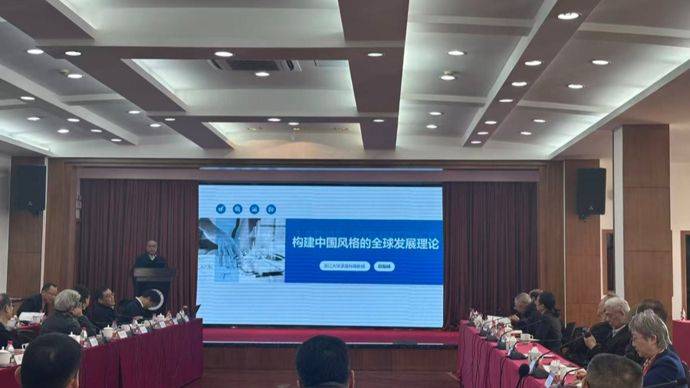
The zhejiang university school of economics has taught ouyang yi on “global development theory” and believes that the chinese-style global development theory should be based on the global development community theory and promote an autonomous knowledge system with chinese ideas, chinese experience and emblematic concepts. In his view, global development theory should be understood as a cross-cutting area between international political economics and international development law. At its core was an analysis of the relationship between global interests and national interests, open systems and closed regimes. The key to theoretical construction was the achievement of “three transcends”, i. E., transcending dualist thinking, transcending western centralism and moving beyond development goals with poverty eradication as the bottom line。
The faculty of economics of the shanghai university of finance and economics, professor masuket, explored the innovation and expansion of the fundamental theory of marxism in the digital age, such as the development of a new approach to digital thinking that intersects with the marxist methodological system in terms of methodological system innovation, the introduction of a new value theory that harmonizes the value of digital labour with the virtual value of digital data in terms of labour value innovation, the construction of a new theory of economic growth that integrates the digital economy with the real economy in terms of reproduction theory innovation, the creation of a new theory of digital spatial distribution in terms of distribution theory innovation based on elements, domain and three-dimensional framework, and the interpretation of a new theory of digital socialism in terms of innovation in scientific socialist theory。



