In recent years, our economy has shifted from high growth to high-quality development, and innovative entrepreneurship has become a top priority for the country's combined strength and core competitiveness. As part of the integrated development of science and technology in education, national competitions for innovative entrepreneurship among university students, such as the “call of challenges” (hereinafter referred to as the “breed competition”), have grown rapidly. However, along with the rapid expansion of the “breed competition” and the strengthening of the authority, use and influence of its results, the “breed competition” results have been over-approached, even with short-sightedness, impatience, quick gain and falsification。
The outcome and format of the student innovation entrepreneurship competition determine that the award is only a symbolic result of stimulating separation. From the standpoint of results, the award-winning projects are supposed to be excellent innovative start-ups, and the fact that these award-winning project teams are, objectively, mostly formed for the sake of competitions and that the competition is closed does not really translate into results. In the form of competitions, it is impossible for several expert assessors to distinguish the level of participation on the spot, whether in the pre-selection stage of tens of thousands of project declarations or works, or in the final stages of each team with minutes or minutes of project road runs at all levels。
Indeed, a number of stakeholders have a “prior to the award” attitude towards university students' innovative entrepreneurship competitions, all of which are based on the award's availability and evaluation criteria. This practice of replacing the term “educational purpose” with the term “virtual purpose” has led to the alienation of the term “dual-generation competition”. The “highest prize” has led to a serious departure from the original idea and even to the opposite。

First of all, various forms of academic misconduct have been condoned. In the context of “who wins and who wins” academic ethics and norms of conduct are often set in motion in the context of “twinning competitions”. And once this is done, the true results of the students are “dignified” in the face of “packaging”。
Secondly, the psychological burden of mentoring teachers has increased. The process itself is fraught with challenges and gains, as mentors lead students to prepare and participate in the competitions, which should be explored and discovered with students interested in related projects. Of course, if a prize were to be awarded, a positive incentive would be added. But if the mentors were to target only the prize, they lost both the pleasure of their work and the fear of uncontrollable results。
Thirdly, valuable national educational resources have been wasted. It should be said that most of the support given by institutions of higher education to students to participate in creative entrepreneurship competitions is very limited, but it is regrettable that some schools tend to focus only on the results of competitions and are reluctant to monitor and manage the process. For projects that have access to high-level awards, while all can invest at no cost, much of the money is not actually spent on substantive innovative entrepreneurial activities。
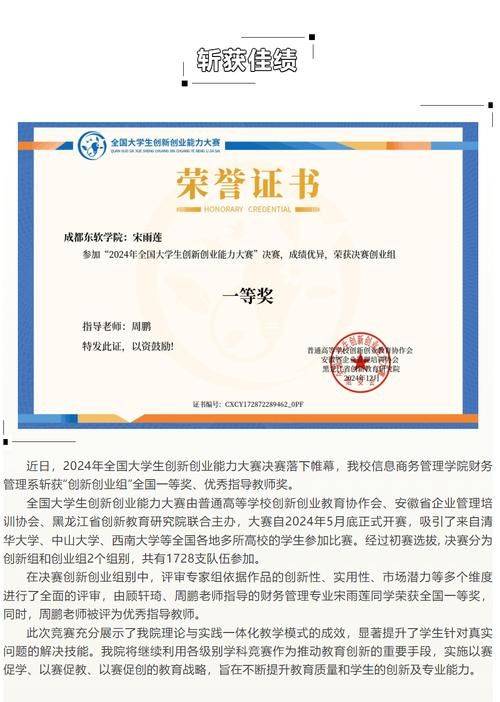
Finally, the fear of knowledge among university students is weakened. For students, high-level “twinning” awards are of great importance for their high-level ratings, awards and grades, and to be awarded these awards, it may be much more “effective” to ask mentors, seniors or agency agents for the project than to explore them. To some extent, it is difficult for a student to emerge from his or her own “realty of learning” in the “one hammer trade” on the ppt road for up to 10 minutes。
In general, it is necessary to reverse the trend towards “centres at the top” in innovative entrepreneurial competitions for university students and to bring the “breed competition” back to the educational practice itself. In essence, the “twinning competition” is an educational tool and a tool whose value lies mainly in the ability of students to advance theory and practice, rather than merely obtaining symbolic certificates. To this end, it is necessary for the main actors to follow the long-standing goal of innovative entrepreneurship education by integrating the “two-creet competition” into all aspects of student development, so that the “basket for learning” becomes a reality。
Personally, the current “two-in-one” ppt road competition and award of awards at the national level needs to be drastically reduced. This does not in any way mean that the “dual competition” does not require attention at the national level; rather, it is a reflection of the importance that the state attaches to this issue. The educational value and practical results of the “two-in-one competition” are reflected in the actual combat activities of the student's school or district, and not in the movement of the student to the first level. Moreover, the “breed competition” should have taken root, and this form of up-front competition can also lead to problems such as the fragmentation of students' learning efforts, the waste of education funds and the poor ecology of innovative entrepreneurship. At the same time, it is questionable whether a national prize is needed, given the short-term uncertainty about the effectiveness of the “twinning contest”。

To date, there has been an increase in the “centres at the top” in the competition for innovative entrepreneurship among university students, which is rooted in the dependence of the relevant sectors and social ranking institutions on the award indicators. In fact, the “two-in-one” award neither fully reflects the actual level of “two-in-one” in higher education nor the overall level of innovative entrepreneurship education in higher education. However, it has to be admitted that, as long as these awards exist, schools and students will at this stage be subject to these evaluational orientations and be held hostage to the “centre-first” competition. Therefore, a concerted effort on the part of the relevant sectors, universities and society at large is needed to move away from the “highest prize” and to effectively support university students in innovative entrepreneurship。
(director, centre for educational assessment and research, university of tuji, faculty of law)