Unlocking the pauline lantern maintenance password: scientific planting techniques and precision management guidelines
Rodamin
1 treasure lantern profile
The golden lantern, also known as the pink acid foot pole, is a foot pole of a wild policeman born in the philippine tropics, mostly adjunct to trees or stone walls, and can grow up to 1. 5 m high in the tropical rainforest area, with heavy stocks and rough and hard branches. The bouquets are beautiful, the elliptical leaves are green, and they hold each other in pairs; they have many sides. The most notable feature is the fall of large bouquets from the top of a branch, which is about 35 cm long, the formation of cone bouquets that form the downward large chandelier form, and the pink little bouquets. It usually lasts from february to august and lasts from three to four months on a single scale, and under suitable conditions, many flowers bloom in rotation, or even last year, with high value. There are 399 acid foot poles in the world, located in tropical africa, asia and the pacific islands, and eight acid foot poles in china, produced in mountain forests in yunnan, tibet, guangxi, guangdong and taiwan. As one of the most luxurious and beautiful flowers of the wild policeman danko, the bouquets are well suited to be set up in hotels, convention halls, villas and living halls, and are beautifully luxurious。
2. Frozen features and value of view
The flower of the bouquet is like a lamp, and its morphology is unique and remarkable. The flower blooms in a time layer of folded petals, like a lamp mask, with a small ball of pearls under it, known as the "boline lantern." sequencing structures usually have multi-layered features, with plants divided into one, two and three layers according to the number and level of buds, which must be more than 5 cm in order to be normally open。
In terms of colour expression, the flowers are mainly light pink and pink. The first to appear was pink twilight, and then a little pink bouquet of pearls, with a sharp one, like a shining palace lamp, appeared to be magnificent and ordinary. Green gray leaves are broad and coarse, with visible ivory dents in the main arteries, in stark contrast to pink bouquets, which enhances their visibility. Figure 1 is pauline。
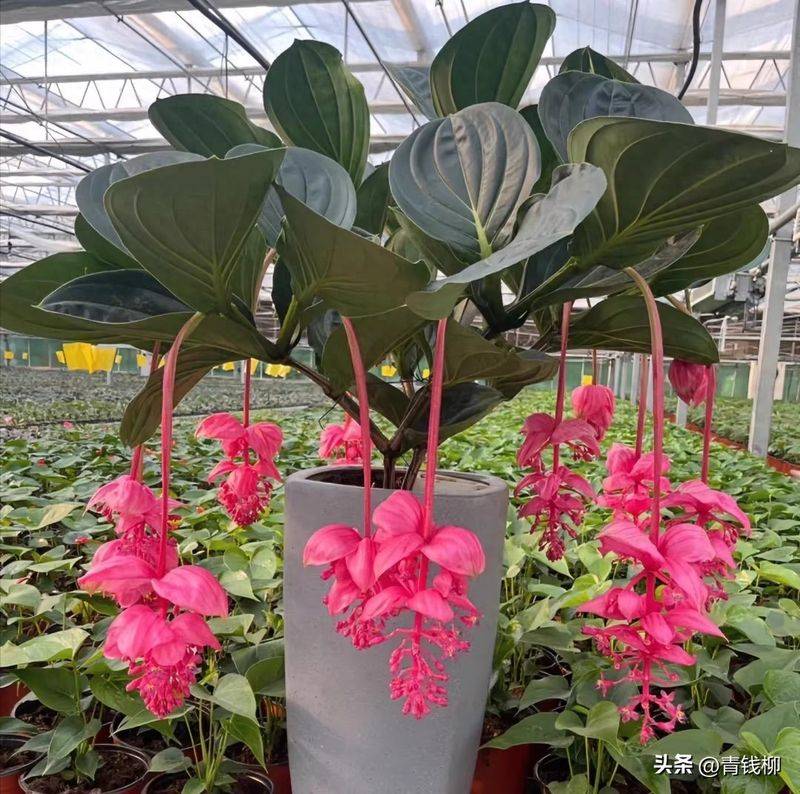
Figure 1
The value of appreciation is reflected mainly in the overall perception. The flowers are beautiful, the leaves are green and glamorous, the pink flowers fall down, and the flowers, the leaves and the fruit view work well. The flower tectonics, large tectonics and maturations span hundreds of days, with the tectonic layers folding and the meaning of “high steps”; the fragrance of flowers, with the meaning of “red fire”; and the small tectonics of flowers, with the meaning of “twilight and blessing”, making them the essence of indoor pots. The flower can be placed in isolation or combined with other leaf-watching plants, such as barbed wires and bamboo, and can be combined with red palms and butterflies, creating a “high-middle-low” stereotyre, creating fresh natural landscapes and upgrading the taste and stratification of interior decorations。
3 plantation management techniques
3. 1 substrate selection and preparation
The root of the poignant lanterns is thicker, and the planting base is better with grass and carbon, rather than clay or sand, and can be mixed with coarse peat or pearl rock at 5 °1. The matrix ph must be controlled at 4. 5 ~ 5. 0, which is essential for the growth and coloring of the bouquets, which can be combined with 100 g of iron sulphate per cubic metre, 50 g of lemon acid down ph and both can be placed separately. Every spring, new basins are needed to remove the land and to add fertile, well-drained foliage. The soil mixer is based on the ratio of two parts of the earth or under the tree to four parts of the leaf or peat, two pieces of sawdust or coconut or pine needle, and two parts of the sand or coal ball slag, preferably sterilised by a week of tan before use。
3. 2 light and temperature management
The bouquets of lanterns are half-dispersible in the light of the environment, and the summer light is too strong to be straight to cover 50 per cent of the sun. The light strength is controlled in the 3nd tranche of “10,000 seedlings, 18,000 seedlings and 22,000 flower seasons”. Families are placed on an east-to-east balcony, tan for 1h in the morning, and the rest of the time is clear; the sun is weak in the early winter and spring, so the net closes up, so that the plant will be as “sky as possible”, otherwise the leaves will be thinner and pale。
In terms of temperature management, pauline lamps are hot and wet, and they are not cold. 18-27°c is the cosmopolitan area, 21°c in the day and 19°c in the night. The summer is above 27°c, which is used to cover the sun, open windows and activate a water curtain winder, so that the shed is 3-5°c below the outdoors. Early winters are below 18°c, with windows closed and inner membranes added; when 10°c falls, the air must be lit, and 5°c is the line of death, and the black leaf can fall out of the bud overnight. In the north, heating occurs during the winter, with care to warm the bouquets 10 cm from the ground and spray twice a day, with a dry hot wind burning the head of the leaf。
3. 3 water management
The bouquet comes from the bottom of the rainforest and is born to love “wetted feet, mist on the face”. The base of the pelvis is filled with pine coils + peat + coarse coconut shells, which are then filled with deep white hairs and dryed with white hairs on the surface. Spring and autumn mornings, summers and evenings, winters are selected for noon, and water temperature rooms have a temperature difference of not more than three. Air moisture is the key to invisibility: more than 80 per cent of the seed age and not less than 70 per cent of the strain. The family balcony can be a pallet pyrotechnic with no water in the water, so that the water can evaporate from the bottom; the greenhouses will be sprayed with 70 beams, 30s per day in the morning, mid-night and 30s in the evening, and the foes will be covered with fog, and the night is strictly forbidden to “wet over the night”, otherwise asymptomatic seconds are on the line. The flowering period reduces the humidity to 60 per cent and stops the spraying of leaves before the lanterns are locked up. Be careful not to spray water on flowers。
3. 4 fertilizer technology
The bouquets are to be applied in such a way that they are produced in april-october and are fertilized with 20-2020 water, with 0. 8 grams per litre and two drops of citric acid to be sour, once a week and once a week; from november to march, they are to be lost so that the plant is “disturbed”. In mid-september, the formula was replaced with 10-30-20, which was equally thin, and could be used four times. Any granular fattening, organic fattening, fattening can make the roots black in a moment. Once a month, the water “basket” is cleared and the accumulated salt is removed so that the soil can “breath” smoothly. It is appropriate to maintain the ec50 value at 0. 6. It is also possible to apply phosphate and potassium fertilizer throughout the year. Nitrogen fertilizer can be applied in conjunction with phosphate fattening, such as the application of 0. 2% potassium + 0. 1% urea for a half-month period。
With the 12 words “wet, cold, sunless, fatty”, the bouquets will sneak out of the foliage of the pink lanterns, one by one, and display one of the most beautiful bouquets at the beginning of the winter spring。
4 year-round flower management and spring festivities technology
Ensuring that the bouquet is sequenced many times throughout the year requires sophisticated environmental control and planting management. Temperature is a key factor in the control of flowering, and bouquets can bloom throughout the year when the temperature is right, generally at 20-22. Experienced florists can judge the need to adjust temperature by observing changes in the color of buds, as long as the colour changes in place at higher temperatures。
Light regulation is equally important. In addition to the 50 per cent cover required for summer, other seasons, especially early spring and winter, require adequate light. The light strength should be maintained at 10,000 to 25,000 lux, with a higher level of light required for long-term reproductive life (fruiting and flowering period) with a light strength of 20,000 to 25,000 lux。
Water management requires special attention during flowering periods. During the january-march flowering period, the humidity should not be too large, otherwise it could cause falling flowers. When the buds start to change color, the temperature should be slightly raised to prevent falling buds. To match certain buds according to the size of the plant, the bouquet is 5 cm or more。
Precautions are key measures in shaping the strain, promoting branching and increasing flowering. The seedlings grow four leaves for the first time, and the side branches grow up to four leaves before they can be taken again to promote more branches. There is a long-term need to keep the new branches in mind and to replenish the thin fertilizers, and when the buds are divided, care should be taken to shun the branches and avoid over-heavy. The flowers are cut off in time, and in the autumn the heart is light enough for the flower to bloom. Sterilized scissors should be used to operate, ventilation should be maintained to prevent pests and diseases, and large gravitational sequences should be supported. Reasonable care can lead to a full and stratification of the stock and significantly increase its value。
Spring festival plumbing, 10d before new year's eve, in row 105d: silt sleep induction (down 105-90d), cessation of nitrogen-controlled water, control of relative humidity at 65%, reduction of night temperature to 16°c, light to 10-12h short day 2000lux, contributing to thawing. At low-temperature plants (down 90-30d), at 22-24°c during the day, at night (16°1) at 6-8°c at night and at night, it is critical to divide the buds. 50 mg l-1ga33 with 10-30-20 potassium phosphorus. The bouquets are long (30-10d) and the laces are 6-10 knots, increasing relative humidity to 75 per cent. The night temperature rises to 19°c and the relative humidity is controlled at 60% before the colour of the radon, which ensures flowers around the 20th month. Women's day 3-8, labour day 51, mother's day, mid-autumn festival, national day, etc. Can also be compared。
It is worth noting how many layers of flowers can be planted, depending on the time of entry and the size of the basin. Therefore, the acquisition of multilayered and expensive plants requires the selection of the appropriate size of the basin and the operation of the basin at the right time. It is generally recommended that a flower pot of 30 cm high calibre of 25 cm be used to make it easier for the bouquets to grow into finished products。
5. Pest and pest control methods
Precious lamps are more resistant to pests and insects, but poor management is still subject to some pests and diseases that require constant observation of plant growth and timely detection and treatment。
5. 1 disease control
The most common diseases are foliage, stasis and stasis. Most of these diseases occur during the spring and autumn seasons, with black or brown spots appearing on the leaves of the disease, which, if not treated in a timely manner, will gradually expand. Prevention and treatment methods include timely leaf cutting and weekly spraying of bacterial wettable powder。
Rodent stasis is the result of long periods of water accumulation, mostly on new branches, which gradually turn brown and decompose. The response must start with the number and quantity of water being poured in such a way that it is timely and appropriate, and that the decomposition part is trimmed until it is released to its health, where it is sprayed with polybacterial elixir。
The disease is mainly due to poor ventilation, which translates from green to brown and leaves fall. The method of prevention is to improve ventilation and to dilute the area of the disease with new wettable powder in a timely manner, with 800 times the amount of water sprayed every 10 d。
5. 2 pest control
The pests of the bellows include dead night moths, red spiders, parasites, assemblages and shellworms. Red spiders can be treated with 15% md, 1. 8% amphibrin, 75% khd, 10% dichloride, and 1,500-2,000 times-squad-squad sprays of cream, or 1,000 times less humid powder using dicoficides, or spray pests with soap。
The amphibians are subject to blue sticker baits, with 6 per cent of the equido fungus 1,500 times + 3,000 times the organic silicon display agent and spray at night. It can also release the stupor. The catapult period is designed to prevent red spiders and ostrich horses, which are sprayed once every 7d, three times in a row, otherwise it will be difficult to prevent them from falling。
For the aphids, 22% of sulflamine is sprayed 3,000 times. Other pests, such as dead leaf night moths, parasitics, can be treated with 1,500 times more efficient chlorocypermethrin cream, with a control effect of over 95%。
Preventive measures are essential to ventilating and humidizing and avoiding the growth of bacteria。
6 reproductive technology
The growth of the bouquets is mainly due to incubation, sowing, hydroponic reproduction, group breeding, and pressure. Among them, adhesion is most common. Cultivation can take place in the spring, summer and autumn three seasons, but at the beginning of the spring and autumn. Select the thick branches of the year to be inserted, cut the half-wood branches with two to three leaves from the top, flat the cut, cut them at two cm from the stem, and remove the extra leaves if they are large. 1 cm down of the branch is immersed in a growth regulator, e. G. 50 mg/l吲哚butyric acid (iba) + 50 mg/l吲哚acetic acid (iaa) before a pre-plug, and then dry-dry-plugging promotes root。
The platinum is coated with a wet coconut base, in order to hold tight the drop of water, and the plume is not able to accumulate water at the bottom of the platinum and some ceramics or stones. Slender beds are covered with sunnets and plastic sheeting, water is sprayed every 1-2d day, temperature is maintained at 23-27°c, light is lit at 6,000-9000 lux and relative humidity is 85%-95%. It takes root around 44d and can be transplanted for two months or so。
Cultivation is less frequent, as the bouquets do not easily obtain mature seeds. When seeding is used, seeds are collected when they are mature and are available for broadcast, they can be broadcast next spring, or they can be purchased for sowing. Seeds are immersed in clean water before seeding, prepared for seeding with loose, nutritious and fertile soil, and prepared the soil, watering it to keep it wet, sowing the seeds to cover a thin layer of ground. The seeding will keep the sun warm and the seedlings will grow with water and fertilize, and the weeds will be removed in a timely manner。
Hydroponic reproduction is a relatively new form of reproduction. A branch is inserted directly into a container containing water, but the bottom of the branch is not touched, otherwise it is difficult to root in the water. During hydroponics, timely water exchange is required to add nutrients to supplement the nutrients consumed by plants。
Group breeding is a high-tech tool, usually carried out in specialized laboratories. During the operation, the stem or armpit sprouts of a robust mother's strain are selected as an implant, which, after strict disinfection, is inoculated on a well-equipped induction culture base and stimulates the separation of the sprouts. It was then transferred to the root culture and produced a whole seedling. The greatest advantage of this approach is the high reproductive coefficient, the availability in the short term of large quantities of harmonized, virus-free quality seedlings, and the core method of commercialized large-scale production, with high requirements for equipment and specialized technology。
In contrast, the practice is more traditional and simple. A single year of healthy branches is selected for 2 mm wide stripping, with wet moss wrapped in the wound and plastic membrane fixed to wet. Once the roots have been laid around, they can be cut down into a new independent plant. The success rate is extremely high, it is simple to operate, it is suitable for a small number of family lovers to reproduce, and it preserves perfect maternal quality, but it is slow and limited in number. The grower may choose the most appropriate method according to the scale of production and the technical conditions。
Regardless of the method of reproduction, later management is important. The seedling period needs to be careful in a timely manner, to promote branching and to make the strain more abundant. At the same time, appropriate humidity and temperature are to be maintained to avoid direct light and regular application of thin liquid fertilizers to promote the healthy growth of young children。
7 concluding remarks
By virtue of its unique flower shape, luxurious period and high-grade symbols, the bouquet has become an important category in the market for flowers. In micro-acid environments, anniversary production can be achieved and marketed at the wrong peaks through scientific seedling techniques, fine crop management and effective pest control. The future should strengthen the selection of new varieties that are cold, multi-facility, with new hot spots, with wide industrial prospects as technology upgrades further reduce costs and provide a sustainable supply of markets for flowers and high-end rents。
The bouquet of flowers in the bouquets of the bouquets, the beauty of spring tropical plants