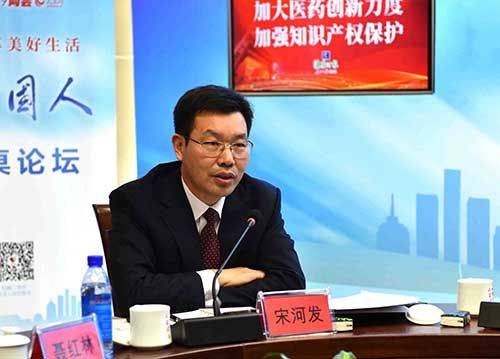
Deputy director, research and training centre on intellectual property of the chinese academy of sciences
On 11 march, a researcher at the institute of scientific and technological strategic advice of the chinese academy of sciences, professor song hafa, deputy director of the centre for research and training in intellectual property rights of the chinese academy of sciences, attended a round table series on “healthy chinese” in 2019, organized jointly by the health times and people's network people's health. At the special forum on “improving innovation in medicine and enhancing the protection of intellectual property rights”, professor song hafa proposed strengthening the management of intellectual property rights by mastering the methods and techniques of intellectual property management and making intellectual property an important weapon in the protection of enterprises。
For the first time, central 8 of 2014 introduced a strict intellectual property protection regime. The national framework for innovative-driven development strategies provides for intellectual property protection in order to be built as a world power for science, technology and innovation by 2050 and as a power for intellectual property around 2030. Turning to the pharmaceutical industry, professor song hao stated that the key problem facing the pharmaceutical industry today was that many enterprises were highly innovative, but the level of intellectual property management needed to be strengthened。
First, the quality of patents written needs to be improved. “how to improve the quality of patent writing is a compulsory subject for enterprises in innovation and intellectual property protection.” professor song pointed out that many enterprises do not refer to patents for practical and new types of patents and designs, nor do they have problems with the quality of invention patent writing. “maybe it's a big problem for you to protect one thing, to be surrounded by others, to spend millions of dollars, to work for more than a decade, to make an original drug that is easily bypassed.”
Second, intellectual property protection was inadequate. This layout consists of a combination of patents for products and an international layout。
Professor song explained that it was not enough that a drug might be patented, protecting one point. Our medicines need to be protected by a combination of patents. "if we don't have a combination, it's a one-size-fits-all patent, and it's hard to work. In short, like a cell phone, why the cow? China has tens of thousands of high-quality patents on mobile phones, a combination of patents and control over patent protection.”
In terms of international layout, our pharmaceutical companies have very few applications for patents abroad, and in 2018 we applied for 51,000 patents for pcts, and the proportion of patent applications for inventions by single-stop residents is still low. Professor song, for example, now that we have a “one-way” initiative, chinese companies are very few to patent in the “one-way” countries. “how can your intellectual property rights be protected if our business is to trade along the road in the future?” professor song reminded businesses that it was very difficult not to defend their intellectual property rights。
Finally, products and patents have two skin problems. Many enterprises are faced with the problem of a lack of close integration of original products and patents, looking at them as relevant and indicative, while in practice patents do not protect the dominant products of enterprises. Professor song, for example, does not have access to a standard for products and does not have access to a patent. There have been many cases in the past, such as iron and stork magnets, vcds, red-ray evds, artemisinin, etc. We chinese have acquired original inventions, but we have not earned major profits from the industry. Why? There is no close integration of intellectual property rights and standards