Foreword
Atmospheric pollution, the deterioration of the water environment and the depletion of fossil energy sources pose new challenges to human development, thus giving high priority to the use of renewable energy, which is currently the most commercially valuable form of renewable energy use。
Generators are an important part of the wind power generation system and are tasked with converting mechanical energy from the wind axis to the electrical output. The selected type of generator is directly related to the type of wind generator set and the control system. Wind generators are classified as follows:
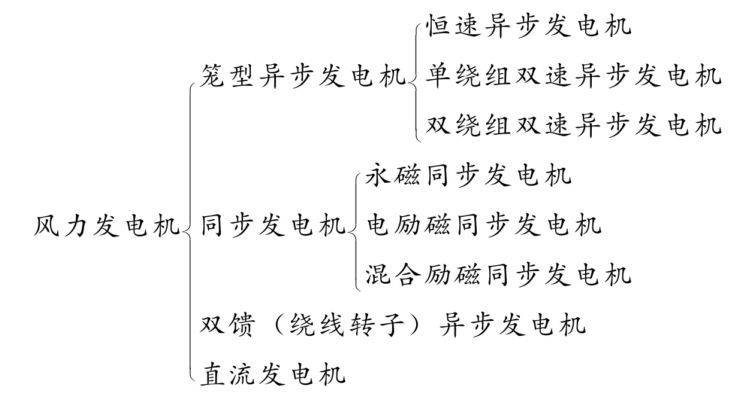
Currently, the use of cage-type walkers (cage sensor generators), double feed (wire rotors) walkers and synchronized generators for wind generators is widespread, and direct-flow generators are rarely applied. For stationary-range wind machines, the system uses constant-frequency control with the option of a walk-in generator, which often uses a double-speed model to increase the efficiency of wind conversion. In the case of transformers, double-regulating (wire-rotation) walkers or synchronized generators should be selected when the system is using the constant rate changer control. In the context of synchronous generators, constant-magnetic-synchronous generators are generally used to reduce control costs and improve system control performance. They can also be synchronized with electromagnetic or hybrid-magnetic (both electromagnetic and permanent). Low-speed (multipolar) long-magnetic-synchronous generators are generally used for the direct wind generator set。
Electrical science is a traditional discipline, but wind generators are special and fast-growing, often engineering before theory. Although there was a large number of wind generators in the project, there was a lack of theoretical support, a lack of core technology, and a state of border mapping, design and production. While there are some books associated with wind generators, most are systems or controls. So far, there has not been a book with a wide range of applications, specifically for the analysis of various wind generators, and the development of wind power is in urgent need of a special book for the analysis of wind generators, which has been published。
The book is divided into eight chapters. Chapter 1 provides a summary of wind power systems, various wind generators, etc.; chapter 2 exchanges basic theory, analyses some of the common knowledge of the power exchange generators, including, inter alia, the basic working principles of the synchronized electric generators and the insular electric generators, the circuits and power dynamics of the exchange generators, the magnetic dynamics of the exchange generators, etc.; chapter 3 provides, inter alia, the basic working principles, mathematical models, coordinates conversions, structures and designs of the two-wind power generators, concluding with details of two wind power generators; chapter 4 exchanges the operation and control of both wind power generators, beginning with the operation of two wind power generators, followed by a separate analysis of the main control modes of double wind-responding generators, as well as a presentation of the type and type of direct wind-resist generators, simultaneous wind-responding technology, simultaneous wind-resoring of the two wind generators, and a number of issues related to the continuous conduct of large generators, such as the structure of the non-brusher, the regional analysis and energy transfer, and the final control strategy; chapter 6 provides a detailed description of the main motion-res。
In writing, the book was written with the strong support of the deputy general manager of the yangtze three gorges group company of china, the deputy general manager of sun qiang, the new energy corporation of china three gorges, the deputy general engineer of wang yugyu, the professor of wu zhieng, professor of wu min jian, professor of yu haitao, and professor of wang xiaoping, the university of heihai, professor of chengping, professor of zheng zhengjun, professor of zhang xuan, professor of the chinese overseas university, senior engineer yang song, hua xiaoxiang electric science and technology co. Ltd., senior engineer of the deng construction army, xinjiang feng feng feng science and technology co. Ltd., and senior engineer of guo, nanjing stein tankers co. Ltd., to express their sincere thanks. The book was written with the assistance of a number of teachers and graduate students from the faculty of energy and electrical sciences of the university of the sea, mainly chen yi fai, zhao hong fei, xu gang, liu bao sheng, li koang, wang kim yong, zhang lin, xi xiaoqiao, cheng jun, zhang changdong, shishan, huang chun mei, choi yang yeo, zhou yu, ji wei, wang tao yun and sha dong-sung, among others, and without their help, it was difficult to produce it in time, so they were also, in a sense, authors of the book。
The book was written with the full support and assistance of director lee li, editor of the china water and power press, and thanks them for their contribution to the book。
In doing so, the book draws upon a great deal of literature, which, to the extent possible, has been included in the post-book references, but some omissions are inevitable. In particular, it is difficult to ascertain the original origin of some of the references after repeated references。
Given the sensitivity of the core technology for wind generators, the technical information used in this book for wind generator manufacturers is formally available and publicly available, without the intention of leaking company secrets, and thanks to the companies concerned。
Despite the author's attempts to make the book as perfect as possible for the reader, there are limitations and shortcomings in the content of the book, which need to be constantly enriched and updated, due to limited capacity and energy, as well as the lack of information available for the current presentation of wind generators and the difficulty for some manufacturers to provide up-to-date core technical information due to, inter alia, technical confidentiality。
Author
Nanjing, august 2015