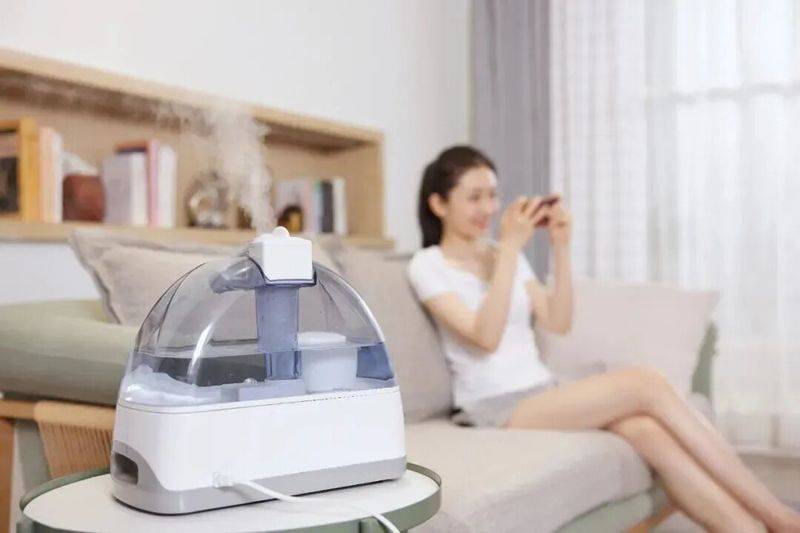
How healthy is the indoor humidity
Indoor humidity should be maintained at 40 to 65 per cent throughout the year, a range that is beneficial to human health. Low indoor wetness can lead to drying of the mucous membranes of the respiratory tract, which in turn causes a series of symptoms of discomfort such as ache, drying of the mouth, drying of the eyes, coughing and itching of the skin. High indoor humidity can create suitable conditions for the growth of fungi and dust mites, and can increase the risk of wet rashes and allergies。
Three ways to select the wetter
The ultrasound humidifier mistifies the water by high-frequency vibrations, wets it intuitive, silent and priced to the people. However, pure water needs to be used, otherwise white powder may be used to pollute the air. The evaporated wetter simulates natural evaporation, filtering water, direct use of piped water, avoids the problem of white powder deposition and is suitable for use by older persons and children, although it is less humid. By heating evaporation, electro-heat-based evaporation units are required to be low-quality, fungic, but energy-intensive and are used with care to prevent burns。
Key parameters match area wetting (ml/h) to core parameters, with rooms of 10-20 m2 selected from 200 to 300 ml/h and rooms of 20-30 m2 selected from 300 to 500 ml/h. Priority is given to wetteners with wetness displays and automatic activation。
The details relate to safe durability. In the bedroom, priority is given to noise 35 decibels to avoid affecting sleep; in the hard-water areas of the north, evaporation or evaporation is recommended。
Use the humidifier correctly
Preference is given to pure or distilled water, pure or distilled water, and new water is replaced daily. The piped water contains a variety of minerals in which white powders from which calcium, magnesium ion combined with carbonate root ion can plug vents, reduce the efficiency of the wetners and damage their internal parts. Chloro-ion and microbes in piped water are also likely to pollute the air with water fog. Wetifiers with efficient filtering systems can also be selected to filter calcium, magnesium ion and microbes out of the running water。
It is recommended to place a wetometer at home to stabilize indoor humidity in the range of 40 to 65 per cent by controlling humidity. Wetifiers can be disabled for between 10 and 20 minutes for every 2 hours of continuous use; if used, windows must be opened immediately。
The surface of the water tank can easily form biofilm or sediment if the daily water exchange and regular disinfection are maintained. Therefore, every day, every effort should be made to empty water tanks and dry the walls of the tanks before re-injecting pure or distilled water, so as to avoid residual water breeding bacteria. The humidifier needs to be thoroughly cleaned every two weeks, with 250 - 500 mg/l of effective chlorinators immersed and thoroughly washed and dry. If the wetter is not used for a long time, full disinfection must be performed prior to re-entry。
Reasonable selection of the position of the wetter should be made from thermal sources, household appliances and furniture, preferably on a stable plane 0. 5 to 1. 5 metres above the ground. At the same time, care is taken not to allow sprays to blow into human faces, especially when placed at desks or by bedside, in order to reduce inhalation of pathogenic microorganisms. In addition, the use of humidifiers in carpeted rooms is avoided to prevent carpets from absorbing moisture and becoming hotbeds for bacteria。
It is prohibited to add additional substances. Once a microbicide has been added, it may cause damage to the user's lungs and, in serious cases, even “moistor fungicide pneumonia”. In addition, substances such as vinegar, oil and perfume, which are inhaled by fog and can easily induce allergy or asthma, are not recommended for wetting。
The humidifier is a strong helper for drying during the winter, and the key to humidification is “proportional” and “clean”. Remember to change water and clean it regularly, keeping it between 40 and 65 per cent wet, so that it can truly be a healthy helper during the heating season。