Every reporter, zhang huaiwa, every editor, good luck
Another wave of policy dividends hit consumers. According to the latest information published by the ministry of finance's official network, we will adjust our import tariffs for some consumer goods, following their adoption by the committee on customs and excise of the state council and their approval by the state council. Effective 1 december 2017. The relevant head of the ministry of finance pointed out that, this time, we have made significant efforts to reduce tariffs on consumer goods, with the aim of expanding efficient domestic supply, better meeting consumption needs and helping to expand external openness。
The daily economic news reporter noted that the tax reduction involved 187 imports, with the average import tariff rate falling from 17. 3 per cent to 7. 7 per cent, a reduction of nearly 10 percentage points and a direct reduction to zero for some commodities, such as infant milk powder. At the same time, it is the fourth time since 2015 that we have reduced our import tariffs on some consumer goods。
Zhang jianping, deputy director of the academic council of the institute of international trade and economic cooperation of the ministry of commerce, stated in an interview with a journalist for daily economic news, that china's demand for daily consumer goods was very high, but that customs duties and value-added taxes on imports of daily consumer goods, combined with higher domestic logistics costs, had led to a much higher end-selling price of imported goods at home than abroad, and that tax reductions were important in curbing the outflow of consumption。
About $23. 6 billion in imports
The tariff reduction involved a wide variety of consumer goods, many of which were well-known daily goods for consumers。
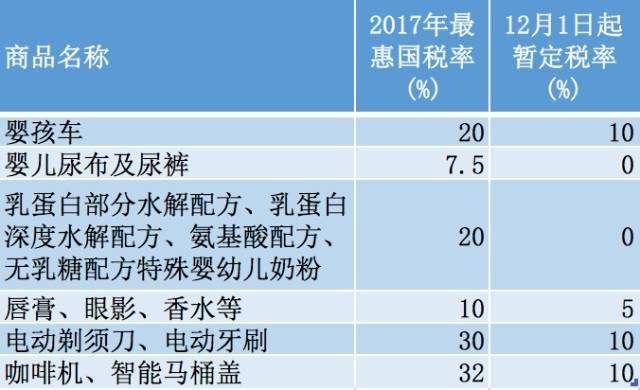
According to the head of the ministry of finance, the tax reduction was mainly related to three main areas of daily life. First, in the area of traditional shopping consumption, customs duties on imports of cosmetics, hairdressers, oral care products, cosmetic tools, parts of bags, clothing and boots were reduced. Second, to meet the emerging consumer needs of the population in areas such as food, cultural entertainment, physical fitness, and so forth, tariffs on imports of some seafood products, such as shrimp crabs, cheese, partially dried fruit, electric razors, coffee machines, smart toilet covers, bread machines, skiing gear, stationery, etc. Have been reduced. In addition, in the area of health consumption, import duties on products such as medicines, some health products, dental fixtures, special formulas for infant and child milk powder, and baby cars have been reduced。
The daily economic news reporter found that the provisional tariff adjustment scale for imports of some consumer goods published by the ministry of finance showed a relatively large difference in the rates of reduction for different imports. First of all, taxes on food commodities are not very high, for example, for products such as cheese, brazilian fruit and shrimp crabs, which usually fall in a single-digit range; while tariffs on commodities with higher value added have fallen more significantly, for example, for imported wines, from 65 per cent to 14 per cent; for electric smart toilet covers, from 32 per cent to 10 per cent; and for toothbrushes, from 25 per cent to 8 per cent。
Even more exciting is the fact that the three categories of tariff-coded goods will be imported at zero tariffs, with the corresponding ministries distributing infant milk powder, baby diapers and diapers, other diapers and diapers。
Researcher yang zhiyong of the institute of financial and economic strategies of the institute of social sciences said that the reduction of tariffs on imports of consumer goods, on the one hand, contributed to the expansion of efficient domestic supply and better meeting the consumption needs of the population, and, on the other hand, to the competition of imported products with domestic products, led to the transformation of the country's supply system and better adapted to changes in consumption demand。
According to the ministry of finance, in june 2015, january 2016 and january 2017, our country reduced import duties on certain consumer goods on three consecutive occasions, in the form of provisional rates, this time for the fourth time。
The relevant head of the ministry of finance indicated that the tariff on imports of consumer goods had been further reduced on the basis of previous tax reductions. “the consumer goods to which the provisional rates are applied are covered more widely, involving approximately $23. 6 billion in annual general trade imports; and, secondly, the tax reduction is greater, with appropriate reductions or an appropriate expansion of the range of commodities for some commodities for which the provisional rates have been applied in the preceding period.”
To help contain consumption outflows
Several experts interviewed by the daily economic news reporter stated that the reduction of tariffs was a positive signal for the expansion of consumer imports, which was aimed at meeting strong domestic consumer demand and consumption dynamics. So, what is the state of the domestic consumer market
According to the china consumer confidence index report published recently by nelson in the third quarter of 2017, china's consumer confidence index continued to grow steadily in the third quarter, increasing by two points over the second quarter, reaching 114 points, a record high. From 106 points in the fourth quarter of 2016 to 114 points today, china's consumer confidence index has grown in its fourth consecutive quarter。
In the context of buoyant consumer demand, domestic commodity difficulties in meeting consumer demand have led to a growing problem of consumption outflows。
According to data from the china electronic commerce research centre, in 2016 about 42 million chinese purchased foreign goods through cross-border electric power platforms, with a total consumption of about 1. 2 trillion yuan. This year, it is expected that 59 million chinese consumers will purchase foreign goods through cross-border power platforms, and that total consumption will reach 185 trillion yuan。
In addition, according to reports issued by the world tourism organization, the total external consumption of chinese tourists in 2016 amounted to $26. 1 billion, an increase of 12 per cent over the same period, or 20. 9 per cent of total global consumption. Since 2004, the increase in total overseas consumption of chinese tourists has been double-digit for 12 consecutive years。
In zhang's view, it is urgent that imports be expanded by lowering tariffs in order to stem the flow of consumption. “you will find that residents travel abroad and always bring back a box of `trophys', which is a more typical consumption outflow. Each year, the scale of chinese consumption outflows is hundreds of millions of yuan. It is therefore imperative that import tariffs be reduced and consumption outflows alleviated.”
Tax cuts are not exactly equivalent to price reductions

Theoretically, adjustment of import tariffs means that in the future consumers will be able to buy imported products at lower domestic prices, but industry has also pointed out that lowering tariffs is an effective way to expand imports, but does not mean that retail prices on the markets of imported goods will necessarily decrease。
In response, the relevant head of the ministry of finance indicated that tariffs were an important aspect of the combination of factors affecting the import of consumer goods and the need to expand imports. Since tariffs are imposed on the basis of commodity import prices rather than market retail prices, the sample shows that tariffs actually account for only 0. 5 per cent to 7 per cent of retail prices of goods, thus having a limited direct effect on reducing price differentials within and outside the country.”
A staff member of the customs department in tianjin told the daily economic news reporter that a reduction in the tariff rate would lead to lower import prices for the goods concerned, thereby increasing consumption demand. However, in addition to tariffs, imported goods are subject to vat and excise taxes, etc., and market pricing is also required when goods enter the circulation chain。
It is worth noting that mr. Zhang, the head of an export trade firm in beijing, pointed out that there are currently more sea fishing and substitute purchases of daily consumer goods such as milk powder, wet urine and perfume. “there are intermediate costs for surrogate purchases, and with lower tariffs, domestic consumers may even opt for direct domestic consumption, thus crowding out the surrogate sector.”
The expansion of imports through lower tariffs is an important means of meeting consumer demand, but efforts to tap the potential of domestic consumer markets still need to be stepped up. According to ping zhao, director of international trade studies at the china institute of trade facilitation, while importing goods fill gaps in the domestic market, domestic demand, as a large economy, depends more on domestic supply, especially as consumer demand escalates. Importing high- and medium-end products alone will not fundamentally change supply and demand tensions, and will accelerate the production and supply of new products by exploiting potential consumer demand。