Zhejiang's online news on april 23rd. How does ai characterize it by bypassing a person's face? What about the robot-dog patent, "touch the china"? On 23 april, on the eve of the 26th world intellectual property day, the hangzhou intermediate people's court held a press conference on the theme “guarding innovation and intellectual futures”, which published the typical case of judicial protection of intellectual property 2025 and the white paper on intellectual property with artificial intelligence, in response to the new topics of justice brought about by technological change。
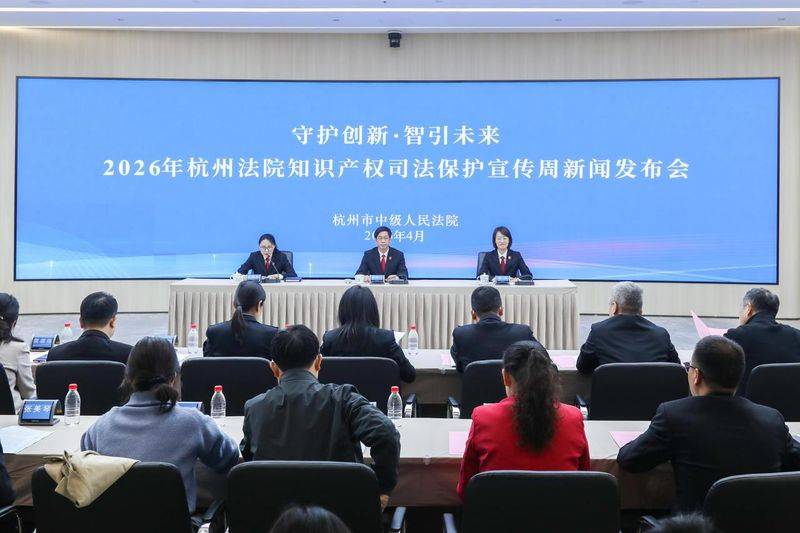
A press conference on the theme "guarding innovation for the future."
Over the past year, the hangzhou court has heard a total of 12,997 intellectual property cases, an increase of 35. 91 per cent over the same period, resulting in 11,686 judgements, or 38. 23 per cent over the same period. Of these, 28 cases of duplication and the application of punitive damages for malicious violations amounting to $5,735,660,000 were awarded at a heavy cost to the perpetrators and strong protection for innovators。
Some of the typical cases published are of particular interest in the new type of ai. In the first national “ai grass” case, the defendant argued on the ground of “technology neutrality”, and the court made it clear that providers of generating ai services for commercial applications could not hide behind technology and that their operations must follow the “smart-for-good” criterion. This decision drew clear lines of behaviour for ai application. In zhejiang's first case of ai's face-changing pro bono action, the defendant used ai to forge a living body authentication video to circumvent face recognition of illegal acquisition and sale of citizen's personal information. The court found that this was not only a violation of individual rights and interests, but also a violation of the social trust order, which, for the first time, included the “disruption of the social trust order” in the context of public interest damage, and allowed for a transition from individual relief to the preservation of social trust。
In the area of new business models, the decision is equally unambiguous. In the case of second-hand re-packaging of luxury brands, the court applied the exhaustion rule on trademark rights precisely, protecting the rights of trademark holders and leaving room for the development of the recycling and reuse industry. In one case, the “low-priced voucher” said “no” to the parasitic business model, setting a yardstick for fair competition on the platform. In the field of patenting, where technological innovation is active, in a machine dog patent tort case, the court made it clear that all the technical characteristics recorded in the patenting claim were necessary and necessary, and that the erroneous perception that technical characteristics were arbitrarily chosen in practice was strongly corrected. At the same time, the examination found that the plaintiff's evidence was grossly inconsistent with the charges, that it was a “suit at law” and that the dismissal of the claim was both a protection of real innovation and a severe punishment。
“the hangzhou court insists on `responding to uncertainty in the techniques of judicial certainty' and establishes a relatively stable rule and expectation in case decisions.” wang liang, president of the hangzhou intellectual property tribunal, presented the proceedings。
The white paper shows that the hangzhou court has dealt with more than 40 ai-related ipr cases in the last five years, 22 of which have been concentrated in the last two years, showing a rapidly growing number of complex and diverse cases. There are three main challenges to judicial practice: the level of fact-finding, the high threshold of algorithms, data and production processes; the level of legal characterization, the lack of clarity about rules such as the attributes of the ai generator, the training data boundary, the “ai illusion” liability; and the level of responsibility determination, the length of the industrial chain and the diversity of roles, and the division of responsibilities between parties. To this end, the hangzhou court has established the judicial concept of “respect for the laws of technological development, adherence to the principle of balance of interests, inclusiveness and prudence, and strict observance of the rule of law and the rule of law” and has established a multidisciplinary technical fact-finding mechanism for technical investigators, expert jurors, expert facilitators, expert witnesses, technical advice and judicial appraisal “six-one”。
Intellectual property protection is a system project. At the launch, the courts of hangzhou, lake county and changzhou, together with the municipal supervisory authority, signed the framework agreement on cooperation to promote the protection of intellectual property rights, which establishes a four-part system of synergy, namely, dispute resolution, technical support, judicial collaboration and communication, which will provide for intensive cooperation in the future in the areas of harmonization of standards of adjudication, sharing of resources of technical investigative experts and strengthening cross-regional implementation。
It is known that during this year's advocacy week for the judicial protection of intellectual property rights, the hangzhou court will also organize a series of activities such as trial visits, circuits and legal awareness-raising, so that the concept of intellectual property protection will reach out to businesses and the public. For the future, the hangzhou court will continue to strengthen judicial protection of intellectual property rights, respond positively to emerging areas of judicial needs such as artificial intelligence, deepen regional collaborative protection mechanisms and provide strong judicial safeguards for the creation of an international business environment and innovative ecology。