


This is a case in which a new digital currency was charged with a criminal offence of distribution in one of the northern governorates, where a certain person was accused by a people's procurator's office of creating a platform for trading, leading a marketing campaign that appeared to be complete: virtual goods (rs), multiple agents and recommended awards. However, mr. Zhengjie's defence, rather than obfuscating the appearance of the model, initiated a “reduced impact on data”. Using the original evidence submitted by the prosecution itself, + by means of data validation, he verified the trueness of the prosecution's allegations, eventually extinguishing the first-instance judgement in the case where all the other accused in the case had pleaded guilty, the person concerned was released five years before the sentence came into effect。
The “sales pyramid” and its logical omissions from the prosecution's perspective hole
The prosecution has built an accusatory system based on a seemingly solid logical chain:
Introduction fees: the charge of “rs” is a typical financial roll. Users must purchase a certain amount of rs to qualify for membership, which is defined as “payment of entry fees”。
Level structure: the platform establishes a pyramid structure of three or more levels of owners, team leaders and members, and binds offline relationships through recommended codes。
Pay-and-return: at the heart of the allegations of profit patterns is “headed”. A fixed percentage (e. G. 3 per cent) of offline members' purchases can be drawn as “recommended awards” and “management awards” from the performance of the team as a whole, whose benefits are directly linked to the number of people in development。
The essence of fraud: the perceived value of rdollars as mere “proxies” for the fraudulent collection of funds is exaggerated, and the sustainability of the platform depends on the constant influx of new member funds, which will eventually collapse and constitute fraud。
Core evidence: in the present case, the core evidence, in addition to that of the person concerned, is an assessment based on data from the forensic department, the number of accounts, the recommended relationship between accounts, the amount of the transaction and the composition of the source of profit。
However, the logic of the allegation seems to be complete, but its fatal lacuna is that while there are relevant underlying data, there is a lack of empirical proof of the flow of funds, the behaviour of users and the nature of profit。
2. Defence core: access to objective data, verification of entry fees and returns
Mr. Zhengjie's defence is typical of “the spear, the shield of the sword”. Instead of rejecting the prosecution's evidence altogether, he distilled the key data from it for a reverse argument。
I. User behaviour analysis: whether “initiative fees” and head starters exist
On the other hand, according to the case file material, the user can purchase the rmoney directly through open channels (e. G. An exchange), without the need for a recommendation, and if a recommendation is made, the reference is recorded directly from the back of the platform, regardless of whether it is purchased or not. Thus, it can be seen that membership is not subject to additional fees and that the recommended code is used only for binding relationships, but does not impose a requirement to develop offline. The purchase of r-dollars is an act of acquisition of goods and not an entry fee. The entry fee for distribution refers to the qualifying cost of developing offline and thus reaping returns, whereas in the present case, a large number of users did not enter the referral network on the basis of a recommended relationship, but purchased on their own initiative on the exchange。
The prosecution claimed that the platform had more than 22,000 member addresses and was intended to depict a vast distribution network. On the other hand, mr. Zhengjie analysed in depth the true behaviour of these addresses:
Are you pulling heads? Out of the 22,000 addresses, only about 2,600 have development downline behaviour, representing only about 12 per cent. This means that nearly 90 per cent of users are just ordinary buyers and holders who have not recommended anyone after buying résumés。
In addition, there is doubt as to the objectivity of the examination on which the opinion is based, namely, " v2 " . It does not reflect the overall transactions of the r-project and merely verifies the records of transactions of more than 20,000 accounts with the liquidity pool, which are only part of the user's data, but the r-currency itself, based on public inquiries, as at 22 june 2023, has at least 32,000 holding accounts, which means that the expert opinion only verifies funds data and accounts within the hierarchy and ignores transactions of more than 10,000 other accounts outside the hierarchy. As 90 per cent of the more than 20,000 data included in their own statistics do not contain any pull-out, the findings of the evaluation do not objectively reflect the operational status of the entire r project and cannot serve as the basis for determining the distribution of the crime。
Meaning: the crime of marketing requires that “the number of persons in development be the basis of remuneration”. When the vast majority of participants do not develop people at all, so-called “heading” cannot be the universal feature and the main driving force of the model. This directly shakes the behavioural basis for the distribution of crime。
Ii. Responsibility resources availation: locking the real sale nuclear
This is the most powerful link in the accusations of subversion. Mr. Zhengjie conducted an accurate “financial audit” of the profits of the core accused:
In the case of one of the first accused, a, it was found that up to 88 per cent of its total proceeds were derived from market differentials resulting from the sale of rs, sss and gadgets. The various incentives charged by the prosecution from the lower line of development represent only 12 per cent of their total income。
Model characterization: this proves that the main identity of a certain person a is that of a commodity seller rather than headhunter. At the heart of its profit-making model is low-buying high-sale market transactions, rather than taking off-line entry fees. This is fully in line with the features of the prohibition of marketing ordinance, which “remuneration by a team for the purpose of selling goods and based on the merit of the sale”, falls under the category of administrative rather than criminal offences。
Retrievation mechanisms for false testimony: the chain of “level pay”
The prosecution claimed that there was a “offline trade, 3 per cent” return mechanism. This was a thorough “existence test” conducted by zhengjie's lawyer: in the case at hand, a separate verification was made of some of the investors (40) identified by name, their trade address and the amount of the transaction, all of which were used as the basis of the prosecution's allegations and, in turn, the investment of r-dollar as a whole. On the other hand, counsel for zhengjie linked the investment addresses of the 40 investors to the original data previously submitted by the prosecution and found that 21 individuals were present on the invitee line。
Validation methods: to retrieve all trade flow data provided by the prosecution, to verify that it actually received a 3 per cent incentive from the offline, 21 in total, and the zongjie team, to verify the addresses of the 21 invitees, and to identify 21 member accounts in the basic data provided by the prosecution itself, each of whom they recommended. If, according to the prosecution's allegations, these recommended addresses are traded, the online address receives a 3 per cent reward. Moreover, according to the prosecution's allegations, these are rules established in smart contracts and are thus visible through chain inquiries. However, the prosecution did not do this verification, so the zongjie team verified all offline transactions at 21 member addresses using data validation methods. And the 3 per cent reward is important because it is the essence of the marketing, and there is a return。
And sin and not sin, and the result of that calleth forth。
Astounding results: on a case-by-case basis, a large number of addresses have been checked, and there is no transaction record of an online address, and there is an inflow of funds that can be clearly identified as a “3 per cent recommended incentive”. So-called returns exist only in statements and theoretical designs, and never in the chain。
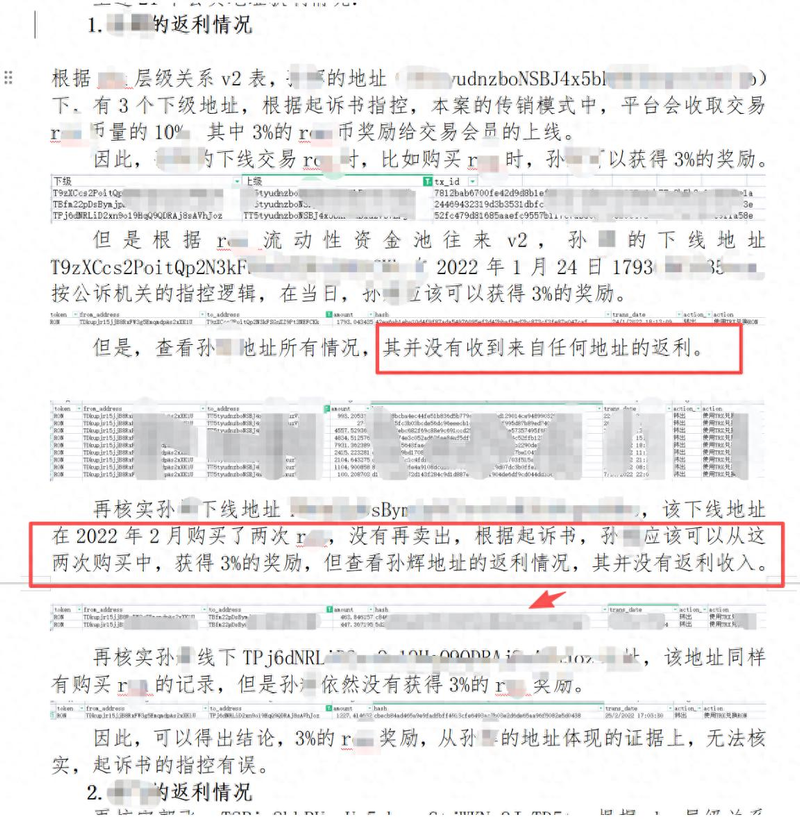
• the significance of the defence: this completely cuts the chain of evidence of “level pay”. Since there is no return, the alleged distribution method is an aeroplane。
Iv. Independent market certification: proof of the true value of the commodity
In order to prove that rcoin is not a distribution device but a virtual commodity with a real market, the defence has introduced external data:



