


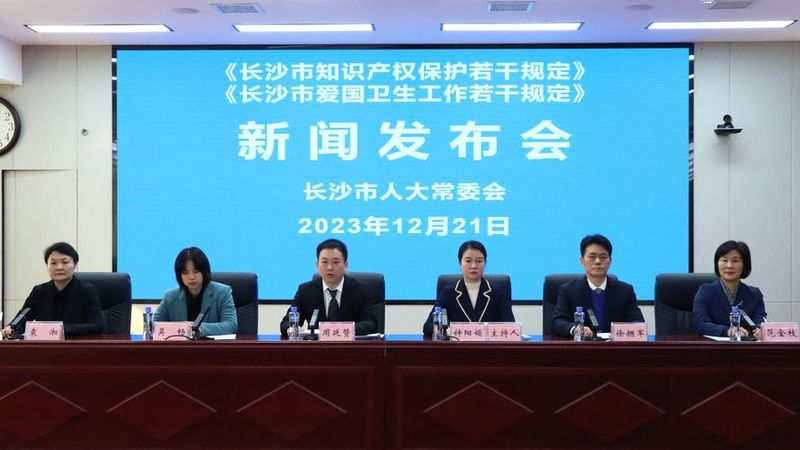
On the morning of 21 december, the changsha city people's standing committee held a press conference to officially issue certain provisions on the protection of intellectual property rights in changsha city (hereinafter referred to as the " intellectual property provisions " ), with effect from 1 january 2024。
The intellectual property provisions contain 15 articles, over 2300 words. “the space and provisions are small, but the articles are “dry goods” and the measures are strong and distinctive.” the party secretary and director of the bureau of intellectual property of changsha city stated that the introduction of the intellectual property provisions was an innovation in itself. Changsha became the first city in the 20-year-old party to have a local law on intellectual property protection。
Consolidating the reform gains of changsha intellectual property rights
“innovation is the first driving force for development, and protection of intellectual property rights is protection of innovation.” in recent years, changsha has consistently maintained intellectual property rights as a central element in the fundamental safeguards driving innovation and in the creation of a first-class business environment. The creation, application, protection, management and servicing of intellectual property rights have been at the forefront of the nation's efforts. It has been playing the role of “leader” in reforming the national intellectual property system. “in the intellectual property provisions, there are several provisions relating to the consolidation of changsha's innovations in intellectual property reform.” the member of the municipal intellectual property authority's party group, deputy director, xu chuan, said。
Changsha has been working on a collaborative intellectual property protection mechanism, the only provincial capital city in the country to have the intellectual property authority set up as a separate government department, and has also set up specialized intellectual property courts, the intellectual property inspectorate (now the ninth department), the intellectual property crime investigation unit and the changsha intellectual property protection centre, as well as public-interest, industry-based organizations such as the people's conciliation commission for intellectual property, which are the most robust of the national intellectual property protection agencies。
Article 3 of the intellectual property regulations defines the responsibilities of the various branches of government, stating that “the intellectual property authorities of the people's governments of municipalities and districts (municipalities) coordinate and coordinate the protection of intellectual property rights in their respective administrative areas and are responsible for the protection of patents, trademarks, geographical indications, etc.; the copyright authorities are responsible for the protection of copyrights; the market supervision authorities are responsible for the protection of commercial secrets; and the agricultural, rural and forestry authorities are responsible for the protection of new varieties of agricultural and forestry plants, respectively”. In addition, the various sectors of development and reform, education, science and technology, and public security perform intellectual property protection in accordance with their respective responsibilities。
Prior to this, changsha had included intellectual property protection in the context of credit incentives for district (municipal) and park performance appraisals and real-life performance appraisals, with full territorial responsibilities for intellectual property work. The intellectual property provisions further clarify that the people's governments of municipalities and districts (municipalities) shall develop mechanisms for evaluating the performance of intellectual property protections and for the performance of the duties of intellectual property protections by the subordinate people's governments, the departments responsible for the administration of intellectual property rights and the relevant authorities in accordance with the law。
The development of long-term mechanisms for “serious punishment of violations and assistance in defence of rights”
“improving the protection of intellectual property is about the innovative development of enterprises, the well-being of people and the quality of economic and social development.” he indicated that changsha had achieved good intellectual property protection in recent years, but that there were new areas of business, such as e-commerce, where intellectual property rights abuses, counterfeiting were more prevalent, and where the use of new technologies, such as the internet, block chains and ai, to protect intellectual property rights was not strong enough and the means were weak. Next, changsha will continue to deepen innovations in the management reform of intellectual property institutions, accelerate the construction of long-lasting mechanisms for “resisting abuses and helping to defend rights”, create a market-based, rule-of-law, internationalized leading intellectual property business environment, and set high standards for the protection of intellectual property and legitimate interests of innovation subjects。
In this regard, articles 5, 6, 7, 8, 10, 11 and 14 of the intellectual property provisions define a series of measures to severely punish violations and assist in the defence of rights. Article 5 states: “the municipal people's government shall establish a one-stop public service platform for intellectual property protection and shall improve the system of intellectual property protection that combines administrative protection, judicial protection and social co-governance of intellectual property rights”, and “the establishment of an early warning and defence mechanism for the protection of intellectual property rights”. At the same time, it provides that: “the guidance body for supporting the response of overseas intellectual property disputes provides guidance services for overseas intellectual property disputes, analyses, studies, etc., on significant events involving overseas intellectual property and changes in intellectual property law, and provides early warning of risks to market subjects.”
In june this year, the country's “national copyright demonstration city” was officially awarded a large number of businesses and businesses. Article 7 of the intellectual property provisions specifically provides for “copyright protection”: the authority responsible for copyright rights shall, on the basis of a priority protection list of copyright warnings issued by the state authorities concerned, issue an early warning notice of copyright to the city's main network service providers and strengthen the monitoring of violations. The communications brigade's radio and television department should strengthen the detection of unauthorized and illegal dissemination of copyright protection priority works through information networks。
In recent years, “business secrets” abuses have been frequent and business interests have been violated. Article 8 of the intellectual property provisions specifically provides for the “protection of business secrets” and market supervisory authorities shall guide market subjects in the establishment of sound mechanisms for the protection of business secrets, the protection of commercial secrets through clear regulatory rules, confidentiality agreements, confidentiality measures, risk screening and education training; encourage and support the establishment of sound systems for the management of business secrets by market subjects, institutions of higher learning, scientific research organizations, etc., in accordance with their own industry and technical characteristics; and strengthen the management of classified information, areas, persons involved in secrecy, vehicles involved, etc。
In order to address the issue of “identifying difficulties” in the protection of intellectual property rights, article 10 proposes that “the establishment of an intellectual property identification body in the region be encouraged by law. The authorities with responsibility for the administration of intellectual property rights should, in accordance with their respective responsibilities, direct the intellectual property identification bodies to professionalize, standardize and provide technical support for intellectual property protection”。
Helping long sand build a global research and development centre city
On 2 august this year, the people's council of the communist party of china, changsha city, and the people's government of changsha city issued their opinions on the implementation of the initiative to build a global r & d centre and build a competitive high ground for science, technology and innovation, as well as several policies for changsha city to build a global r & d centre, which explicitly called for “improvement of intellectual property protection mechanisms” and “enhanced protection of intellectual property rights”。
“building cities of global r & d centres, centred on strengthening science, technology and innovation.” seo jun stated that maximizing the important role of the intellectual property system in protecting and stimulating innovation, establishing long-lasting mechanisms for “corresponding to abuses and assisting in the defence of rights”, strictly protecting intellectual property rights and investing in a first-class innovation and business environment is the greatest support for cities in global r & d centres. To this end, in addition to the extensive identification of a series of initiatives to severely punish abuses and assist in the defence of rights, the intellectual property provisions (iprs) make special provisions in the areas of r & d talent development, recognition awards, technology protection, etc., to make r & d subjects more comfortable, comfortable and less committed in long r & d, to attract more r & d resources around the world and to contribute to the building of global r & d centres in changsha。
In the area of r & d, article 5 of the intellectual property provisions states: “encourage and support institutions of higher learning to offer intellectual property courses and develop intellectual property professionals; and encourage and support institutions of higher learning, scientific institutions and enterprises to bring in high-level intellectual property professionals at home and abroad in a variety of ways”。
In terms of talent recognition and reward, article 4 provides that the people's governments of municipalities and districts (municipalities) shall award recognition to collectives and individuals who have made outstanding contributions to the protection of intellectual property rights in accordance with the relevant national and provincial regulations. Natural and legal persons and organizations of illegal persons are encouraged to establish awards for the protection of intellectual property rights in accordance with the relevant provisions of the state。

In terms of r & d technology protection, article 11 specifically provides for “intelligence protection” and the departments responsible for intellectual property administration and related departments should strengthen intellectual property protection construction, using new technologies such as big data, artificial intelligence, block chains, and innovative ways of protection in areas such as lead and information verification, source traceability, real-time tort monitoring and online identification, evidence storage and online dispute resolution. Market owners are encouraged to use new technologies such as big data, artificial intelligence, block chains, etc. To protect intellectual property rights in accordance with the law。
Enhancing the arbitral orientation of conciliation for intellectual property dispute resolution
In recent years, disputes involving intellectual property rights have been growing year by year, and if they are brought before the courts, the pressure for litigation is enormous. For enterprises, “suits” are time-consuming and expensive to wait and afford. To this end, changsha has long established mechanisms for the settlement of intellectual property disputes, encouraging innovative subjects to settle intellectual property disputes through conciliation, arbitration, etc., and the changsha municipal people's conciliation commission for intellectual property disputes and the changsha arbitration commission, among others. There are currently 143 grass-roots intellectual property dispute mediation organizations in districts and parks, and as of november this year there were 4,486 cases of intellectual property dispute mediation and 1,264 successful mediations。
The intellectual property provisions strengthen the arbitration orientation for the settlement of intellectual property disputes, contribute to strengthening the governance of intellectual property claims and reduce the pressure on judicial cases. Article 12 provides for “conciliation”: encouraging trade associations, intellectual property services, etc. To establish professional, professional and commercial conciliation organizations in accordance with the law; supporting conciliation organizations in their efforts to mediate intellectual property disputes, leading parties to resolve intellectual property disputes through non-litigious means; and directing parties to settle intellectual property disputes, within the framework of the law, through non-mandatory means such as advice or persuasion, to settle intellectual property disputes by means of an application for administrative conciliation。
In the context of “arbitration”, article 13 expressly “encourages parties to intellectual property disputes to enter into arbitration clauses in contracts to resolve intellectual property disputes by arbitration” and requires arbitral institutions to “strengthen capacity-building of intellectual property dispute arbitration services to provide professional, quality and efficient arbitration services to the parties”。



