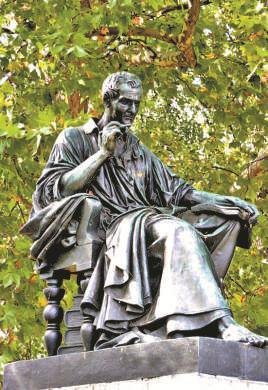
Rousseau in geneva, inscribed “the citizen of geneva — jean-jacques rousseau”
In the age of the enlightenment movement, i am afraid that no scholars, like rousseau, have sorely hated monarchy and all oppression and inequality among human beings. To that end, he had prescribed a diabolical drug in favour of the reconstruction of heaven over ruins through rational destruction of the traditions, values and order of old societies。
As the most passionate thinker of the 18th century french enlightenment, jean-jacques rousseau (1712-1778) was known for his social contract. The issue of social contracts was also addressed by european scholars such as locke and hobbes, long before rousseau, but rousseau's social contract theory was largely based on his concept of “consensual” and led to the following ideas: first, “publicity” has the moral attributes of absolute justice; secondly, citizens' obedience to “publicity” is freedom; thirdly, the promotion of the will of sovereigns and the moralization of citizens; and fourthly, the rejection of power-sharing and partisan politics。
As an extremely important concept in rousseau's legal thinking, “consensus” is similar to “absolute reason” proposed by hegel and represents a noble will beyond personal reason. According to rousseau, people are unequal in their natural state, and only a social contract can make people equal, and public agreement is the basis for achieving people's sovereignty and establishing a social contract. “an agreement can be the basis of all legitimate authority among human beings”, and the conclusion of a contract would naturally give rise to the will of the social community。
From rousseau's point of view, the relationship between public opinion and the community is so inextricably linked that “each of us, with its own and all its forces, is under the supreme guidance of public opinion, and we accept each member as an integral part of the community”. Thus, only consensual forms of domination are valid and people have an obligation to obey only legitimate powers, and once a community has been formed, differences of perception and individuality can be ignored in a consensual context and eliminated through political activity。
“the extent to which a few may disobey the will of the majority” is one of the basic propositions of the near-modern political thought in the west. In other words, is it justice in itself to order people to lead a life of justice? In response, rousseau, from the premise that the population has varying degrees of control over reason, considered that the “freedom of choice” does not conflict with “the actual well-being of the individual” and that “any person who refuses to obey will be compelled to obey”. The choice made by those who lack reason is essentially to place themselves in a “slavery” situation, so that for the majority of people with limited wisdom, the best choice should be made by the most rational. While this formally deprives the public of the right to choose, it actually preserves their freedom and well-being。
That is to say, it is not just a democratic process in which a minority obeys the majority, but more importantly, the will of the majority represents “consensus”. Citizens' obedience to “consensus” is to be subject to justice and, at the same time, to better enjoyment of freedom, which is what rousseau emphasizes as “sovereignity is consent, consent is freedom”。
Since citizens are subject to “publicity”, the question of “who creates and discovers it” naturally arises. Rousseau is convinced that, in a new and great era dominated by the masses of the people, the people gained full power and unprecedented freedom, which was previously enjoyed only by the monarchs and nobles. Since then, the people have ceased to be a group of “units” and have gained spiritual upgrading and have been conceived as the sole political sovereign. In the social contract theorise, these “consensual lawmakers” engaged in legislative work with near holiness and wisdom, close to the kind of “philosophical king” that plato aspired to, with all good deeds. To some extent, rousseau has introduced an extraordinary image of “gods” and attached it to sovereigns, implying irreversible and irresistible notions of destiny and historical patterns. This indicates that the notion of “consensual” is being given an absolute value that is beyond doubt and irrefutable。
Rousseau's highly rational and even ideologically idealistic kingdom, designed through “publicity”, means that the state, in addition to constraining the behaviour of its citizens, has the duty to reach and transform the soul of its citizens and to encourage moral indoctrination of its citizens, thereby helping every citizen to attain moral maturity. That is also why isaiah berlin believes that rousseau's concept of “consensual” has a strong positive liberal and nepotistic orientation。
According to rousseau, “in parliament, the representative is called upon to vote on a draft law, not so much to decide whether to vote in favour of or against the law, but rather to determine whether the law is in conformity with the will, i. E. Public interest or social justice”, and then to assert that the people's sovereignty cannot be divided, and that a parliament composed of representatives of popular opinion at all levels is merely a forum for finding “consensual” and that there should never be political blocs within which there should be an opposing interest. In the parliamentary voting and election process, the violation of “consensus” was an intolerable crime, and rousseau therefore viewed party politics as a poison that corrupted “consensus”, disrupted the political order and undermined the moral aspirations of the people. In short, the best way to prevent tyranny and deception is to give people strong power。
It should be noted that, in rousseau's theoretical system, “individual will can only express the individual's will, and so consent is not simply the sum of the individual's will”. This means that “publicity” is different from what is intended to be a collection of ideas and private will that members of society have formed from their own self-interest through simple mechanical calculations. The term “consensus” is the political position of every citizen in the public interest of society, reflecting the will of the community and no longer the individual interest. Therefore, “consensus” is not a general reference to “the sum of the will of all members of society”, but rather to “the sum of the margin remaining, except for the positive-negative part between individual wills”。
In conclusion, rousseau has designed a sacred moral system with its concept of “consensus” in an attempt to build a perfect moral ideal state on earth as the ultimate destination of human society. His intellectual courage is admirable and has had an extremely far-reaching impact on the many political thoughts of future generations. But what remains to be seen is that rousseau's “consensual” doctrine is not uncontroversial in the history of western legal thought, and that isaiah berlin, in liberalism and betrayal, and russell, in the history of western philosophies, has made sharp criticism of rousseau's social contract and his notion of “consensuality”, pointing out that rousseau's rational self-abuse and even denial of the free choice of individuals is “a dangerous path”。
In this regard, we should take a stand against rousseau's “consensual” doctrine. In the age of the enlightenment movement, i am afraid that no scholars, like rousseau, have sorely hated monarchy and all oppression and inequality among human beings. To that end, he had prescribed a diabolical drug in favour of the reconstruction of heaven over ruins through rational destruction of the traditions, values and order of old societies. This represents the ideal of a human society, despite the temptation of “improvement”. Therefore, as we move forward with the modernization of national governance systems and capacities in the new era, we need to focus on both abstract “public will” and specific individual rights; a high degree of recognition of the value of reason and balance of interests; and a constant improvement in the efficiency of decision-making on social issues, while respecting and guaranteeing civil liberties from a humanist perspective。
It is only by fully combining these elements that the concept of “consensus” can truly be used as an instrument for the construction of an ideal society, and perhaps that is the best interpretation of “life is free and everywhere in chains”。