


The newly amended companies act of the people's republic of china (hereinafter referred to as the new companies act) came into force on 1 july 2024. The new companies act requires shareholders in a company to pay their contributions within a specified time limit, otherwise they face penalties. The limited capacity of many shareholders to pay in cash is of concern in the form of intellectual property rights payments。
The financing of intellectual property rights (iprs) was a good way to encourage innovation, but, driven by the benefits, there was speculation among some shareholders that overestimated iprs. Some of the agencies in charge smelled “business opportunities” from which they acquired low-priced intellectual property rights in their left hand and “gold” assessment reports in their right hand. By paying thousands to tens of thousands of dollars for their services, customers can assess the original low-cost patents at hundreds or even thousands of times the price, thus paying the corresponding capital in intellectual property rights, resulting in a tumultuous flow of intellectual property. Over the past two months, journalists from the extremes have investigated this。
Institutional advocacy for higher paid prices for intellectual property and the brutal growth of grey industrial chains
The effective contribution of intellectual property rights is the act by which shareholders transfer to the company, in accordance with the law, their assessed and certified ownership and use of intellectual property rights, thereby fulfilling their obligations to finance the registered capital。
The new companies act and its accompanying regime provide that limited companies registered before 30 june 2024 shall pay their contributions at the latest by 30 june 2032 and companies established after 1 july 2024 shall complete their contributions within five years. Otherwise, companies may face fines ranging from $50,000 to $200,000, direct liability or fines ranging from $10,000 to $100,000, and businesses will be included in the list of business anomalies。
Under the new companies act, shareholders may be financed in monetary terms or in kind, intellectual property, land use, equity, claims, etc. Non-monetary property to be financed shall be valued, verified and not overvalued or underestimated。
According to statistics, the number of companies in the country increased from 1. 3. 3 million in 2014 to 4. 83 million at the end of november 2023, a 2. 7-fold increase, of which 99 per cent were micro-enterprises. In reality, some corporate shareholders do not have sufficient cash, in kind, land, etc. To pay their registered capital, and are concerned to do so in the form of intellectual property rights。
However, at the instigation of the agency, some shareholders used overestimated intellectual property rights (ipr) speculation。
The industry described intellectual property rights as including patent rights, trademark rights, copyrights, etc. The agency contributes effectively to the intellectual property rights of shareholders, the purchase of cheap, practical and new patents is “mainstreamed”, the purchase of software copyrights (known as “soft”) is less expensive, and invention patents are least used because of the cost of transfer。
According to mr. Ma, who was engaged in intellectual property assessment at the national level, soft and patent matching of shareholders by the chargé d ' affaires was acquired mainly through transfers, often in bulk, and the more expensive it was to buy. In the case of practical new patents, for example, there are many patents sold on the market for between $1,000 and $4,000。
Journalists are searching online, and such ads come on the face. The entry of an “intellectual property payment” on an electrician platform shows more than 3,600 businesses with 100 pages. The journalist consulted an intellectual property agency in a western city in the name of a construction engineering firm, which, according to ms. Sun, operated the operations of which she operated and whose clients had to spend between several thousand and tens of thousands of dollars on their behalf, thereby multiplying the registered capital. The largest customer registered capital for its services amounted to $210 million, along with clients registered capital of $65 million, $50 million and small clients registered capital of millions。
Multi-location agencies also promote high-profile performance online. According to video from the chargé d ' affaires, 78873 clients pay 76 million yuan in registered capital and 76,000 yuan in fees; 14592 clients pay 1. 63 billion yuan in registered capital and 350,000 yuan in fees. Also in the video, the head of the chargé d ' affaires stated that the largest client he had ever cooperated with had paid $550 million of the registered capital of intellectual property rights, and the agency had paid $7 million in monthly contributions。

According to the head of an agency acting as its deputy, its largest paid-in of intellectual property was $550 million
“registered capital can be paid 100 per cent in real money” “for real money and silver” “for hundreds of thousands of dollars in real money” ... Advertising by various agencies on the electric power company platform is confusing。
At the same time, the value added tax (vat) law, which will be in force as of 1 january 2026, provides for the non-reimbursable transfer of intangible assets (including intellectual property rights) by units and individuals to be included in the vat tax due at a rate of 6 per cent。
In the face of the “windows”, some of the agencies acting on behalf of them have seized on the issue of shareholders, advocated “one-stop” services, paid “lightly” for intellectual property rights and were exempt from vat until the new regulations were implemented。
On the one hand, many shareholders are anxious to pay their registered capital and have chosen to pay their intellectual property; on the other hand, more and more agencies are sniffing out business opportunities and fighting to help, and a hidden grey industry chain is growing savagely。
"one-stop" for the chargé d'affaires a. I., with an increase in the amount of money paid by the untrusted company
The “one-stop-shop” services of the chargé d'affaires include, inter alia, five steps: the acquisition of intellectual property rights for shareholders, the issuance of assessment reports by the chargé d'affaires, the transfer of intellectual property rights from shareholders to companies, and the issuance of certification reports and publicity by the chargé d'affaires。
Mr. Chen, an intellectual property agent, informed the press that there were two fees for the agency to pay for the intellectual property: assessment fees, certification fees, business fees and tax fees, i. E. Service fees, and the cost of purchasing intellectual property by shareholders。
Mr. Chen provided a statement of a paid offer for intellectual property rights which showed that the paid-in capital amounted to 50 million yuan and the service fee to 5,000 yuan; the paid-out capital to 50. 1 million yuan to 100 million yuan and the paid-off service fee to 7,000 yuan; and the paid-out capital to more than 100 million yuan, which would increase to 10,000 yuan. The transfer fee for intellectual property rights is divided into three tranches: approximately $1,000 per piece in soft copy; approximately $2,800 per piece in practical new patents; and $18,000 per piece at the most expensive cost of an invention patent。
Mr. Chen recommended the use of new and practical patents to complete the payment. He disclosed that, in general, a useful new patent could be assessed at $5 million and that there might be an audit risk if assessed at more than $10 million. He cited, for example, the commissioning of $50 million in registered capital and the purchase of 10 practical new patents。
Ms. Sun agreed with mr. Chen's recommendation. She told journalists that if the shareholders had a patent of their own, they could provide information on the certificate, which the agency would hand over to professionals for value assessment. If the shareholders do not have a patent, the agency may purchase the patent for them, and in either case the patent may add value by assessing it. Journalists claimed that they had to pay their registered capital of $70 million, and ms. Sun estimated that a service fee of $65,000 would be required and that a formal invoice could be issued。
For example, two intellectual property agents in one of the western municipalities were given programmes by journalists who had to pay their registered capital in the amount of $2 million. One agency's option is to pay the amount of $999 for “one-stop” services on the basis of a practical new patent, which takes two months, with full refund if the payment is unsuccessful. Another agency's programme was to help new applications with two soft sets of “one-stop” services at a cost of $4999 for three to five months。
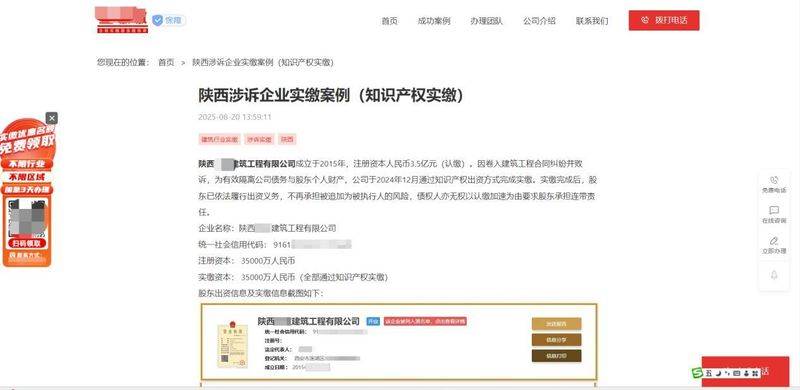
One of the chargé d ' affairess promoted cases involving the payment of intellectual property rights to enterprises
It is important to note that there are a large number of such enterprises that have been involved in litigation or discredited. A procuracy in one of the western municipalities claimed that a construction company in shaanxi had pledged $350 million of its registered capital, that it had lost responsibility for its involvement in construction disputes and that it had paid off through intellectual property rights in december 2024, in order to effectively isolate the company's debt from its shareholders ' personal property. It was found that the company had been marked as a “serious violation” of its “judicial record” of “restriction of high-consumption cases” such as “serious breach of law” of the “defunct executed person”. Moreover, on the electrician platform, a deputy agency specifically indicated in its brochure that “business disputes (untrusted, executed, litigated, pledged, etc.)” were increased by $1,000 for services。
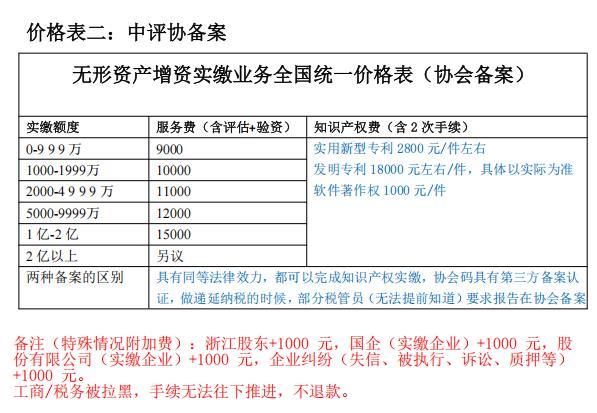
On a letter of quotation from an agency acting as a substitute for an increase in the actual payment of an enterprise's intellectual property rights
The value of patents has increased hundreds of times
Journalists' surveys have found that the key to the ability of shareholders to “pay little money” to finance their intellectual property rights is for the agency to obtain them at a low price and then to make a very high assessment, thereby achieving a sharp increase in value。
Numerous accredited journalists consulted found that intellectual property valuation was generally hundreds or thousands of times higher than the purchase price and that the results of assessments varied widely from agency to agency. One softly cost $780 million, in the case of an electrician platform, for an assessment of $1 million, or $2 million, in the case of a generic, practical and new patent, for an assessment of $3 million by a deputy, for an assessment of $5 million by a deputy, or even $20 million by a deputy, or for an invention patent, for an electronic power platform, for an assessment of between $10 million and $50 million。
According to information provided by the office of the chargé d'affaires a. I., the registered capital of a smart technology company is $3 million, of which $2. 45 million is paid through two practical new patents, namely, a “mobile-efficient flat tubing” “a walkable shoe lamp”. According to the agency's staff, the transfer fee for the two practical new patents is $4,000 each, while the final evaluation of the two patents is priced at $1. 47 million and $0. 98 million, respectively, representing an increase of over 300 and 200 times, respectively。
The staff member admitted that the transfer cost of a generic, practical, new patent was approximately $2,000, which could be assessed at around $1 million, and that a higher-value patent could be assessed at $5 million, “a patent of its own high value, which could be evaluated at a price that could be raised up. However, some of the patents, which are less practical and promising, may be exposed to risks such as tax audits in the later stages of the enterprise if they are valued too high.”
Related reports:



