At present, my country is at a critical stage in accelerating the building of a strong state of education. Education, as the foundation of nation-building and national renewal, has become more strategic, opening up unprecedented development opportunities, but also facing bottlenecks in the development of cutting-edge innovative talent, insufficient imbalances in the availability of educational resources and incomplete development of teaching and learning models adapted to the age of artificial intelligence, there is an urgent need to reflect further on the nature and value of education. Ten years ago, on 17 may, general secretary xi chaired a symposium on the work of philosophy in social sciences and delivered important statements proposing a major strategic task of “accelerating the construction of chinese identity philosophies in social sciences”, which set out the direction for the development of the country's philosophy and social sciences in the new era and provided fundamental adherence. Educational science is an important component of philosophy and social science. Building an autonomous knowledge system for educational science and chinese identity is a necessary requirement for the implementation of the spirit of the important 517 speech and an important support for the development of quality education. It is the historic mission of all educators to accelerate the construction of an autonomous knowledge system for pedagogical science, which will provide theoretical innovations to educate powerful nations and progress in human education。
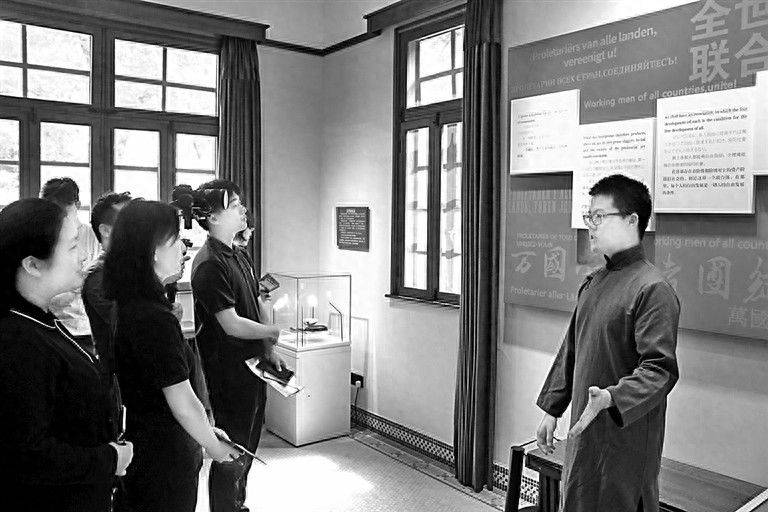
In the communist manifesto at the university of redan, shanghai, volunteers from the starfire volunteer corps (right one) spoke to the audience. Xinhua
Progress in education depends on building an autonomous educational knowledge system
The long-term development and continued progress of education depends on the construction of an autonomous knowledge system for education with chinese characteristics, chinese style and chinese style。
Progress in education is spearheaded by theoretical innovation. Every major leap in human society and every major development of human civilization cannot be preceded by intellectual change and intellectual advances in philosophical social sciences. The same applies to the development of education. In 1931, mr. Mayuski, then president of qinghua, introduced the “master's theory”, stating that “the so-called university is not just a building, but a master's name”. This concept has had a profound impact on our higher education. During the time of the south-west congress, a group of famous masters, such as ye zhang, wu zhang, ju and zhu qing, taught a great deal of thought in the humble school buildings, and nurtured an outstanding foundation in the fight against war, which vividly interpreted the central tenor of the “masterism”. In 1940, mr. Chen tsulqin, the father of early childhood education in china, introduced the theory of “living education” and applied it to the practice of running the country's first public teacher-training school for early childhood education, which he founded, thus contributing to the development of early childhood education in the country. These indicate that the development of educational practice is guided by the development of educational theory。
China's education problems are addressed by its educational theory. Looking back at the course of our educational development, there has been a tendency to follow the foreign model blindly and introduce hard foreign theories, the root causes of which are the lack of an autonomous educational theoretical system to guide educational practices and support reform and development. In the 1930s, our pioneer in comparative education, mr. Han zazen, advocated a “new education chinaization movement”, arguing that “a system of education that could be called `china' would never be modelled on the stereotypes of any country and would have to be built on its own”, stressing that it was an event of “the long-term research and experimentation of experts”. China's own educational problems are being addressed by strengthening the autonomous knowledge system in the field of teaching。
An autonomous educational knowledge system is an important indicator for the education of powerful countries. In the seventeenth century, the united kingdom became one of the most important sources of modern educational thinking, and francis bacon proposed “pedagogy” as an independent sphere of knowledge, while john locke proposed “gentlemen's education” with a distinctive characteristic of british education. In the nineteenth century, germany defined “excellent universities and academia” and laid down the basic system of modern education, with helbart writing “general education science” as the first educational writing in the history of education with a scientific system, the university of berlin established by william humboldt, creatively introducing and implementing the concept of “a combination of teaching and research” as a model for the then-global research-type university. The 20th century of the united states, with its violent confluence of ideas, including progressiveism, factorism and permanence, has not only profoundly shaped indigenous american educational practices, but has also had far-reaching implications for global educational development. Therefore, the educational power that we have built is not only a rallying ground for quality education resources and first-class talent, but rather a source of advanced educational ideas, educational ideas and theories。
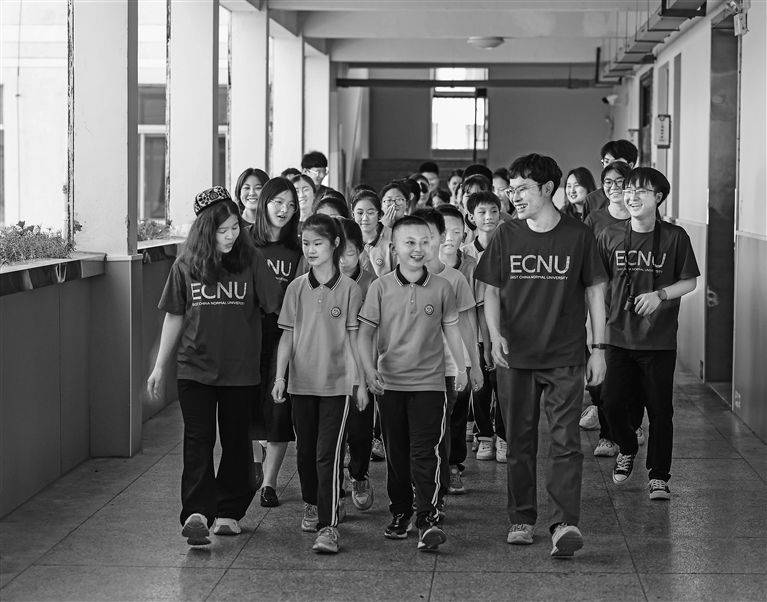
In zhejiang province, students from the university of pedagogical education led the children to the school. Xinhua
Rooting practice is a necessary requirement for building an autonomous knowledge system for education
Educational science is rooted in the fertile ground of educational practice, and chinese practice of living education is a logical starting point and a necessary requirement for building an autonomous knowledge system of educational science。
China's educational practices have an irreplaceable theoretical value. China is one of the first countries in the world to have an early school. It was also one of the first countries to have a government-run school. It was also one of the first countries to combine education with national governance. In long-term educational practice, china has built the largest educational system in the world, with the largest school-age population in the world, facing the most complex educational problems in the world and creating a “educator spirit” unique to china. These are the wealthiest, most unique and most vivid materials for building an autonomous knowledge system for education。
It is an important path to the development of pedagogy by taking root in educational practice, distilling educational experience and shaping educational philosophy and, consequently, the theoretical system of education. In recent years, for example, qinghua has adhered to the notion that “the teaching of children is a non-releaseable duty of teachers” and that “learning to grow is a non-releaseable duty of students” and has launched large-scale, live, interactive, exotic and decentralized online teaching, which has resulted in “the so-called classroom, not only the classroom, but also the teachers and students. There are teachers and students in the classroom. The understanding of the classroom and university boundaries has been further developed through the understanding of where the students are and where the classroom extends to”。
Moving from chinese educational practice to chinese educational theory requires tireless efforts. Indigenous practice does not automatically translate into theory and requires a rigorous methodological path to complete the logical leap from “experience” to “concept” to “theory system”. Educational practice is symptomatic, and only through analytical research can the educational theory of mastery of nature be developed. Educational practice is specific and can only be summarized in order to form a universal educational theory. Educational practices are fragmented and only through integration can systematic educational theory be developed。
A realistic path to building an autonomous knowledge system for education
Following the path of building an autonomous knowledge system in the field of education, it is important to continue to build on china's national context and respond to the needs of the times, and to explore viable paths based on indigenous practice and centred on theoretical originality。
The secretary-general of xi jinping's important statement on education is fundamental to the development of educational innovation, theoretical innovation and methodological innovation to ensure that autonomous knowledge systems are built in the right direction. Key issues such as the “three attributes” of education, the “six attributes” of education power, and the “five major relationships” that education power must address are to be considered as the basis for building an autonomous knowledge system for education. China's approach to building an autonomous knowledge system for education is based on china, learning from abroad, exploring its history, grasping its present and caring for its future。
The best traditions and best practices of education in china are fully exploited, indigenous concepts and theories are extracted from the rich historical accumulation and dynamic reform practices, and the cultural roots and empirical foundations of autonomous knowledge systems are firmly established. China's ancient philosophy of “step-by-step” education, such as “learning by means of teaching”, still holds important value today and requires further in-depth study. Since the reform and opening up of the country, major achievements have been made in terms of universal nine years of compulsory education and rapid access to higher education. We have accumulated good practices in education, the construction of socialist universities and the promotion of modern university governance in china, which provide strong support for the development of chinese pedagogical theory. Educational research should take full advantage of this unique advantage by refining new rational theories and summarizing new and regular practices。
In keeping with the major realities of the development of education, the theoretical breakthroughs in response to the age have brought to light the vitality of autonomous knowledge systems in resolving the real problems of education in china. The process of theoretical innovation is the process of identifying problems, screening them, studying them and solving them. Educative science must focus on critical issues in the building of a strong educational power, focus on pains, congestions and dilemmas that constrain the quality of education, respond to the distress of the population in the field of education, undertake systematic research, focus on the critical absorption and innovative application of international advanced educational experience and beneficial educational theory in a country-by-country context, focus on refining solutions to specific problems into a universal model of programmes, focus on research to refine china's pedagogical iconic concepts and original theories, and provide solid support for achieving systemic leaps and qualitative changes from the major to the powerful。
A forward-looking, future-oriented, proactive response to the deep challenges of the scientific and technological revolution and global educational change, building an autonomous knowledge system that is age-oriented, forward-looking and leading. In 2025, unesco released the report " ai and the future of education: change, dilemmas and directions " , noting that artificial intelligence is shifting from a passive tool to an interactive actor with learners, which will systematically reshape teaching and learning systems and present new challenges to teacher roles, student learning methods, educational equity and ethical governance. Pedagogical science should proactively take advantage of the opportunity to study in depth the paths, ways, effects and risks of artificial intelligence-enabled education, and take the lead in exploring new models of teaching and learning in artificial intelligence-enabled age, with the results of high-quality research contributing to the achievement of education that will accompany everyone throughout his or her life, education that is equitable and accessible to everyone, education that is appropriate to everyone, and education that is more open and flexible in order to contribute to the development of global education。
The day of light (1205/15th edition, 2026)