


In recent days, an annual resolution in the field of international intellectual property - the international association for the protection of intellectual property rights (aippi) hangzhou resolution 2024 (hereinafter referred to as “the resolution”) - has been officially released to the public in chinese and english。
This was the first time that the resolution had been adopted in china in 127 years。
This 13-page english-language resolution, co-authored by thousands of intellectual property professionals around the world over more than a year, covers research topics arising from four topical topics, including patents, trademarks, copyrights and the exercise of rights。
The technical advice of these terms, which are concise, terminological and sophisticated, is the consensus and feedback of the professionals involved in the work of the front-line disputes and operational obstructions in the details of global intellectual property legislation。
Subsequently, the resolution will be submitted not only to the world intellectual property organization (wipo) and the world trade organization (wto), but also to the legislative, executive and judicial bodies of the world's major countries and regions to inform the development of intellectual property-related laws and policies by relevant international organizations and governments。
Intellectual property rights are the cornerstone of incentives for innovation. All countries protect and promote innovation through laws and regulations that empower creators, inventors and enterprises with legal rights over their inventions, brands and original creations。
Intellectual property protection is highly dependent on international cooperation. Over the course of more than a hundred years, previous resolutions have contributed directly to the construction and improvement of a global bottom-up system of intellectual property protection, such as the trademark law convention signed in geneva in 1994 (the trade marks law treaty)。
How did the 2024 resolution come about? What does it mean when the resolution was first adopted in china
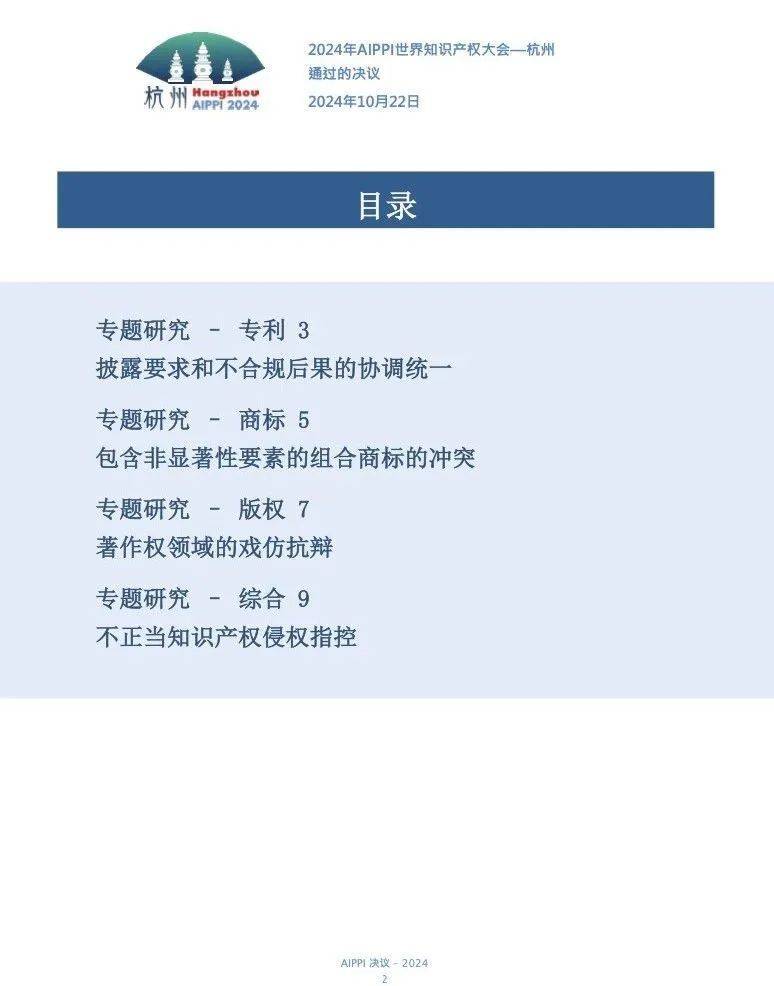
(aippi annual resolution issued to the public)

New global consensus on intellectual property rights
A month ago, the hangzhou international expo hosted a four-day conference that brought together some 2,300 intellectual property practitioners from 92 countries and regions, including lawyers, patent (or trademark) agents, judges, academics, scientists and engineers, and business people. A significant number of them are intellectual property lawyers with multiple roles。
There are more than 30 parallel academic events, such as seminars, forums, lunches, etc.; coffee cafes, lunches, receptions, dinners, and more extensive business social circles。
In hangzhou, the lawyer claudio castanheira from rio de janeiro, brazil, met not only his colleagues at the firm's headquarters in spain, but also with old and new partners from around the world, with numerous opportunities for cooperation。
Modern enterprises often plan global intellectual property protection programmes simultaneously when they generate innovative concepts. This scenario vividly simulates the mode of operation of international intellectual property rights. It is the unique way in which these professionals work in close cooperation, which underpins the cross-border movement of hundreds of thousands of intellectual property rights globally each year, thus advancing innovation。
These individuals, who appeared in hangzhou, are members of the international association for the protection of intellectual property rights (aippi). Founded in 1897, aippi was one of the world's first international intellectual property ngos and the leading non-governmental intellectual property advisory body of wipo under the united nations。
Since its inception, aippi has made proposals for legal changes to countries through monitoring and studying legislative changes, and has worked closely with international organizations to promote harmonization of national intellectual property protection measures and related laws and regulations and to improve international intellectual property protection。
This stems from a real need to complicate the extraterritorial protection of intellectual property rights due to the wide variety of legal provisions of states in the field of intellectual property rights, in particular the different requirements for applications from foreigners. In order to address this problem, states began working in the nineteenth century to conclude bilateral or multilateral agreements or conventions on the protection of intellectual property, which is now largely achieved through participation in international conventions on intellectual property in most states。
Mr. Oshan, president of aippi, described the participation of the founding members of aippi in the drafting of the paris pact for the protection of industrial property. The paris pact, which entered into force in 1884, marked the beginning of international cooperation on intellectual property rights and later developed into the foundation of wipo (established in 1967)。
Other important international conventions include the madrid agreement providing for an international trademark registry system, which entered into force in 1892; the berne convention for the protection of literary and artistic works, which entered into force in 1887; the patent cooperation treaty (pct), which entered into force in 1978, and its implementing regulations。
The world congress on intellectual property of the international association for the protection of intellectual property (aippi) in 2024, held in hangzhou, was held under the theme “by balance protection and innovative development of intellectual property rights”. It was also the first time that the aippi conference had been held in china in 127 years of existence, and it had been hosted by china trade promotion。
On the closing day, the executive committee of the general assembly considered and adopted the 2024 aippi hang canton resolution. This eight-page english-language resolution covers research topics that have emerged from four topical topics in the field of intellectual property, relating to patents, trademarks, copyrights and the exercise of rights. The overall entry is between 10 and 17 and is concise and compact。
Patents: harmonization of disclosure requirements and consequences of non-compliance (harmo)I'm sorryI'm sorry, i'm sorry
Trade marks: conflicts between combinations of trademarks containing non-significant elements coI'm sorry, i'm sorry
Copyright: defense of copyright in copyright
• general: unjustified allegations of abuse of intellectual property (“ip”) rights
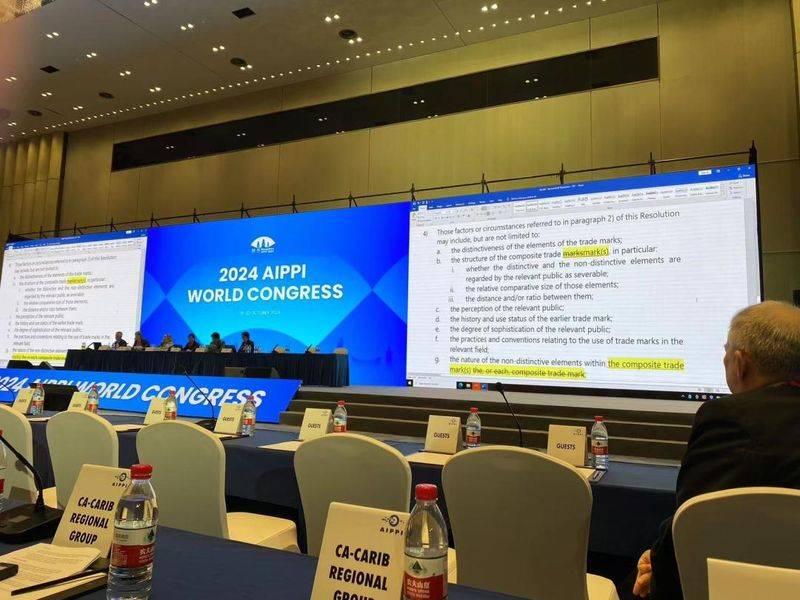
(read aippi draft resolution verbatim to reach consensus)
Liqin

Lower disclosure requirements for united states patents
For many participants, participation in the resolution-making process is crucial. The resolution is the instrument through which aippi effectively influences the policies of states, and the annual general assembly is the venue where members focus and adopt resolutions。
Osansanichi stressed that during the hangzhou congress, the four resolutions resulting from four research topics would be finalized only by agreement among all members of the aippi。
Patents, as an important component of intellectual property rights, are the most topical topic on the table。
Another identity of osanichi is that of the patent agent and head of japan's long-standing concession firm. He was not only familiar with the patent application process, but was also deeply involved in litigation and was therefore very concerned about the patent section of the resolution. While inventions are new solutions to technological problems, patent regimes are “open for protection”。
Osanichi stressed that once patented, inventions would be protected and would bring commercial returns to inventors. At the same time, countries would require inventors to make technological details available to society, thereby promoting overall innovation。
The topic of this year's patent section is considered by oshan sang-sang to be a highly relevant topic for the united states。
He cited, for example, china, japan and the united states, the high level of disclosure requirements for applicants under the united states patent system, the relatively small number of requests in china and the modestness of japan。
Aippi vice-president of the china chapter and honorary director of yan shen's law firm, yang, also shares the view of oshan sangichi. He explained that, under existing provisions, if a patent application was submitted in the united states, the applicant would be obliged to disclose all available technology to the united states patent office and, once a search report from a country other than the united states had been received, the search report would also be transmitted simultaneously to the united states patent office and, if not in english, the english translation would be submitted within three months. This requirement has led applicants around the globe to focus on the timetable, and the agency to have a dedicated person to handle relevant united states applications, entailing higher costs and burdens. Because the patent might be declared invalid in the united states in the future because of this defect if information was not submitted in a timely manner。
The discussion in the general assembly was therefore divided into two parts: first, could there be international coordination on this issue? Secondly, if existing technologies are not disclosed on time, is it necessary to impose such strict penalties after the fact
Finally, part of the resolution describes it as: “in the proceedings of the patent office, the submission of existing technical documents that are easily accessible to the patent office shall not be required” and “an applicant, or any other person involved in the preparation or examination of a patent application, shall not be required to disclose any available technology to the patent office”
The plenary discussion of the patent resolution was greatly timed out due to intense live debate。
“the decision-making process is heavy, but the process is educational, as the understanding of these hotspots has been deepened through in-depth discussions among members.” oshan commented。
Aippi vice-president maria a scungio is a partner of a new york-based firm. She described the greatest challenge to an intellectual property challenge as technology and commerce were always on the front line, while laws and regulations could only be followed up passively. In addition, intellectual property challenges often have multiple elements at the same time (e. G. Copyrights and trademarks) and are also cross-border. Therefore, cooperation with lawyers in other jurisdictions is usually required to find an appropriate solution。
To date, more than 700 resolutions have been adopted by the aippi assembly in a way that promotes global technical consensus among professionals。

What does landing in china mean
This year, the aippi assembly first landed in china, and the annual resolution was first adopted in china, no doubt recognizing china's global intellectual property status。
According to the director-general of the world intellectual property organization (wipo), deng hun sen, “the holding of the aippi world intellectual property congress in china was a milestone that highlighted the international character of intellectual property rights and the importance of strengthening the global intellectual property ecosystem。
In china’s view, the conference is a new starting point for china’s deep involvement in global intellectual property governance and will greatly facilitate cooperation between the intellectual property community in china and abroad。
According to osansan, after only 40 years of development, china has created an excellent system of intellectual property protection。
This year, the general assembly set up a special chinese forum to invite officials of china's state intellectual property administration, as well as two judges from the hanzhou chamber of deputies and the supreme french court, respectively, to provide an update on the review and protection of intellectual property rights in china。
Ahmed g. Abou ali, president of the egyptian chapter of aippi, observed that china, as a world economic leader, was increasing its protection of intellectual property rights over the past few years. In his view, this process has allowed chinese enterprises to apply for more patents globally and to become more involved in global regulatory systems。
Aippi south korea also believes that china, as a world leader in intellectual property, is expected to play a more active role。
Stephen freischem, secretary-general of the german industrial property protection association (grur), was not a regular visitor to china. He observed that china had evolved from zero to leading position in the area of intellectual property protection and would continue to play a leading role, which was why the general assembly had been held in china。
Stephen noted in particular some of china's groundbreaking jurisprudence in the area of ai and considered that the holding of a congress in china would enhance understanding between china and the world. On the one hand, every enterprise interested in china's large market closely follows developments in this jurisdiction, which is also the visual impact of chinese rules on the world's intellectual property. On the other hand, intellectual property professionals from many remote areas of china can also enhance international exchanges through their participation。
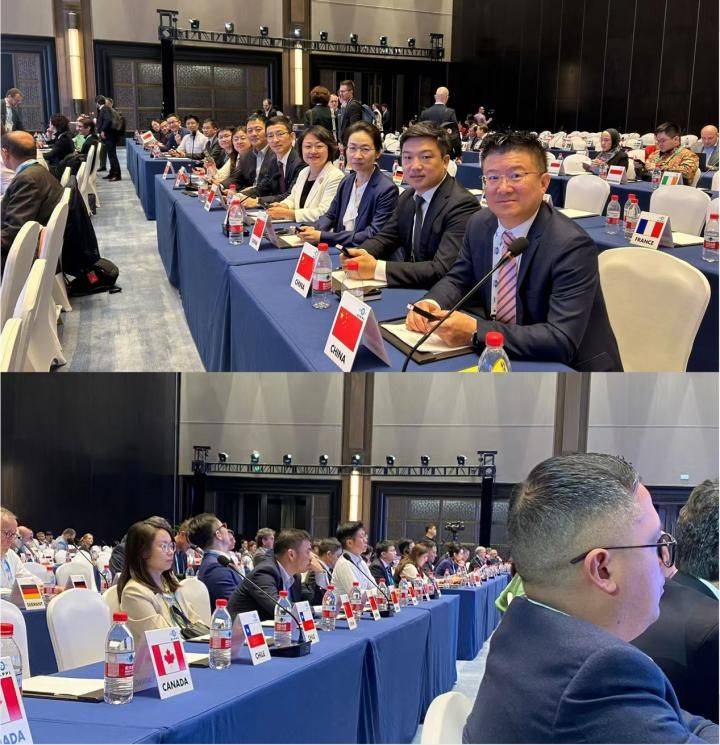
(part of chinese delegates active in the plenary meeting on trademarks)
In the past, domestic governance of intellectual property rights in china has been carried out almost simultaneously with international cooperation. Since the 1980s, china has been a party to relevant intellectual property conventions and has complemented domestic intellectual property laws, forming the legal framework for intellectual property protection in china。
On 30 june 1980, china joined wipo and became the 90th member of the organization. In 1982, the aippi china chapter was established with the approval of the state council. These events marked the beginning of china's active participation in international cooperation on global intellectual property rights and its gradual importance。
The secretary-general of aippi china, li yi, participated deeply in more than a dozen aippi world intellectual property congresses and contributed throughout to their landing in china. He was impressed that “for this opportunity, the first generation of intellectual property owners in china worked for it for almost 20 years and waited for 12 years”
According to li, until 2014, the selection of cities for the general assembly was decided by the executive committee of the aippi by a vote, similar to the olympic process. The chinese chapter had failed twice, and it was only in 2012 that it was successfully granted the right to host the 2020 conference, which was subsequently postponed to 2024 to be officially held in china owing to, inter alia, the epidemic。
According to the director-general of the china chapter of aippi, the china chapter has over 690 individual and collective members, mainly from intellectual property services, universities, intellectual property research units, enterprises, etc. He indicated that over the past few years, the china chapter had been more closely involved in the discussions of the resolution, and that the representative of china had been fully involved in the discussions in the general assembly, contributing to china's wisdom and chinese programme。
Participation in the process brought a fresh feeling to many chinese participants。
Mi chunmei, founder and managing partner of the intellectual property agency of jishinwo (beijing), inc., has been participating in the aippi annual meeting since 2017 and was appointed as one of the co-chairs of the trademarks committee of aippi china branch in 2020. At the beginning of this year, zhang rei, deputy director of the trademark department of china patent agency (hong kong) ltd., began to lead the organization in his capacity as the author of the china chapter thematic report。
They were particularly impressed by the process of reaching consensus in the general assembly. At the beginning of the year, mi chunmei and zhang rei received a questionnaire containing 24 questions on the topic of “conflicts involving combinations of trademarks with less prominent expressions”. However, after four months of research leading to the submission of the chapter reports and participation in multiple rounds of communication, they had found that the general assembly draft resolutions that had culminated in the resolution contained only four less controversial issues, owing to the greater differences among states on most of the issues。
Over the past four decades, china has made rapid progress in the development of intellectual property rights with the growth of its economy。
According to statistics, china is now one of the most important users of the three major international registration systems of wipo patents, trademarks, and visual design, and chinese applicants are among the world's highest on the basis of the international patent applications submitted by the pct, the international application for the hague appearance design and the application for international registration of madrid trademarks。
The global innovation index 2024, published by wipo, shows that china is ranked one to 11th in terms of global innovation compared to 2023, with the number of 100 science, technology and innovation clusters at the global level reaching 26, two years in a row。
According to lisa jorgenson, deputy director-general of wipo, “wigand technology ltd. Has been in first place in pct applications for seven years in a row. China's intellectual property authority, the busiest receiving authority in the world, processed about 75,000 international applications last year.” lisa said。
“i do not want to compare the situation of china with that of any other country, and china will follow a path that belongs to it.” oshan-san said。



