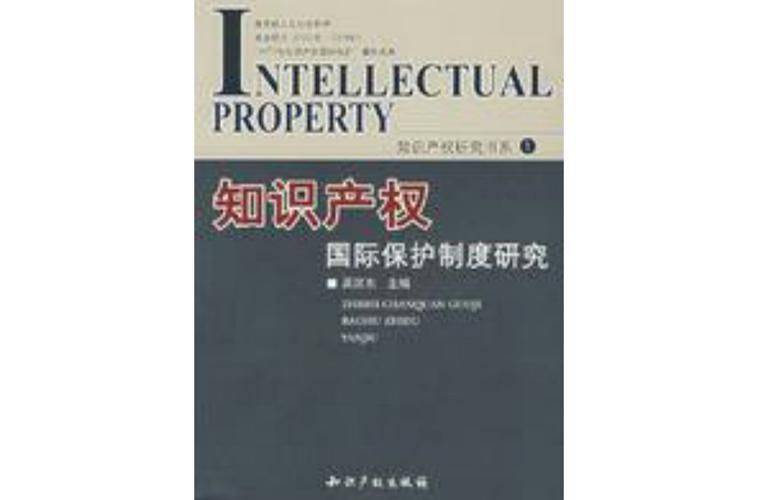
To explore the transformation and development of the international protection regime of intellectual property, jo lin changchun polytechnic university, jilin changchun, 13000 quest: the concept of intellectual property is an accident of history, and as science and technology develop, the intellectual property itself is changing, especially under the protection of the law. The main thrust of this paper is to explore changes in intellectual property protection systems at the international level and their development. Keywords: intellectual property; protection; system; change; developing chart classification number: d997 bibliography code: a article number: 2095 - 4379 - (2017) 18 - 0235 01 julien (1990 - ), female, han, jilinonan, changchun polytechnic university, postgraduate studies, research direction: civil and commercial law. The content and outreach of intellectual property rights are deepening, and the emergence of intellectual property rights can be seen as a collective concept, in the context of legal history, whose shape of realization is, on a large scale, historical fortuitous and can be said to be the result of a series of complex environments that are constantly changing. In today's law, it is used as a private right and as a policy tool that can adapt knowledge and provide a basis for resolving conflicts between different subjects. In substance, the intellectual property regime is designed to deal with the ownership of knowledge products and balance interests, and it has an incentive and a regulatory role. The intellectual property regime could be further improved through the transformation and development of the international protection regime for intellectual property. First, the extension of the object of intellectual property rights, as a traditional private right, whose object cannot be limited to international conventions or legal provisions, should be understood in terms of the legal nature of objects that are difficult to protect in their entirety. Because of the vulnerability of such intellectual property rights to violations, the state is required to take advantage of compulsory laws to remedy their rights holders. This does not mean, of course, that the law does not clearly define intellectual products and that there is no right to exist as an independent object. With science and technology as the primary productivity and the information age, intellectual property rights must be constantly produced and protected, and it is foreseeable that the object of intellectual property rights will be well expanded in the future. Second, the subject of intellectual property rights in the context of a pluralistic intellectual property right (ipr) has become more diverse, particularly in some ethnic tribes, where protection of tk is provided. Through the protection of classic intellectual property rights, it can be seen that the core of traditional knowledge is the intangible element, which is distributed in the public domain and can be used by everyone, although innovation may have some reliance on these elements, making the subject of these elements the subject of protection, i. E. Intellectual property. At the international level, the first policy was to preserve those elements, which could be actively used rather than preserved because of scientific and technological developments, the eradication of these shared heritages and the development of new results. When there is a sense that these common heritages are not preserved and that they all want to develop their potential value, and if everyone is free to use them, then they need to be changed and protected, making the protection of traditional knowledge urgent. Thirdly, the expansion of intellectual property has become an international problem. In international conventions, the constant creation of additional categories of rights and the extension of the period of protection of rights in both internal and external law are proof that only the international protection of property rights is evolving, that the pace of rule-making is accelerating, that the level of protection has increased and that the content of intellectual property rights has been on the rise in attacks. This expansion is due mainly to the development of science and technology and the adaptation of legislation to meet the needs of society, and to the pressures of the legislative branch, which are evident in the protection of the interests of developed countries. This expansion is also more evident in our country, where the content of the right to knowledge has been expanded to some extent by each amendment. Iv. It is important to improve the social status of intellectual property rights in the regulatory model of intellectual property rights, which can be divided into two levels, one at a macro level, where the executive branch of the country can use intellectual property rights in accordance with the law and review them and provide services, which is only a sign of the difference between the property rights system and other systems, and the other at a micro level, where the holders of rights can use intellectual property rights and may transfer, plan and lead, among others, to improve the competitiveness of enterprises through the development of new knowledge and the development of organizations. There is no parallel between these two levels of understanding of their concepts, and knowledge is important for their management. We have a relatively overlapping body in this area, which is detrimental to the functioning and promotion of the intellectual property system. There are nearly 10 departments in the country, and if they are added to the property rights body, the number of administrations will be higher. Given the rapid development of the international protection regime, we should also establish a unified regulatory body for strong coordination of intellectual property rights. While such overlapping institutions can create conflicts of authority, conflict and management exist side by side, and we can establish a unified administrative body to approve, review and authorize property rights, taking into account the practices of other countries, in addition to defending our interests in international trade and participating more in international social events. Fifthly, by way of an examination of intellectual property rights, we can see that since the creation of the intellectual property system, it has been a system of continuous change and development, that the progress of the times will inevitably lead to a new breakthrough in intellectual property rights, that the diversification of the subject matter is taking place and that the pattern of protection is constantly evolving, and that such a trend is a source of reflection, particularly in terms of intellectual property policy and legal aspects, for the strategic protection of national intellectual property rights and for the advancement of the international community. [reference] [contribution] [1]. Study of domain names and related rights - the legal nature of domain names - [j]. Network legal review, 2004(4).[2] the philosophical interpretation of intellectual property rights by the wu handong. J]. Legal research, 2003(5). 5 3 2 . Law and order fair legality vision 2017 06 (lower) multi-dimensional data