Logistics change is happening for all, and “reducing efficiency gains” is key. It is true that high costs and low efficiency are persistent industries. Asking why, most people think of “dispersion” and “layer subcontracting”. But if we continue to ask, why would the logistics industry be caught in a “dispersion” and layered subcontracting? Many have never looked into it. Behind this is the most invisible point in an industry — double taxation。
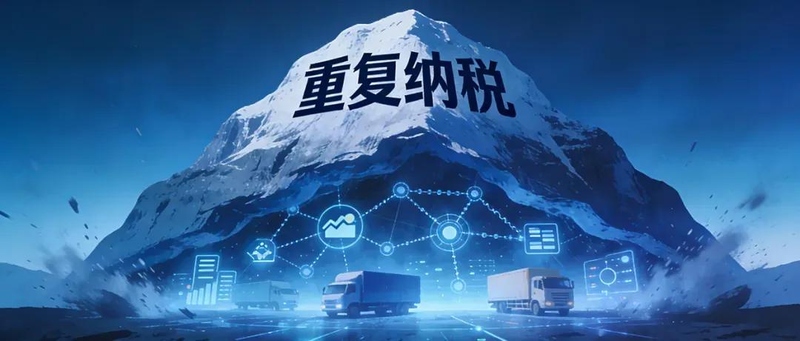
If you're a logistics owner and an individual driver can't write a vat invoice, you're going to pay the tax to the irs for fuel, road bridges, etc. As a result, more than 10 times more taxes are paid, the more they are done, the more they are compensated。
There are two ways before you, one of which is to subcontract out the business and make a direct difference without worrying about the invoices. The other one is the “teambroker” who has actively contacted you regularly. The former earn less, the latter break the rules and, on balance, you pick the first one. You see, this is how the logistics industry's "discretion" and "subcontracting."。
At the same time, the problem of “vote” has made it difficult for the logistics industry to “reducing efficiency gains”. With a reference to “downloading”, logistics owners think first of all of the cost of reducing the cost of transporting drivers and then of reducing the negative cost of taxes. When freight costs do not move again, the question of “a few points?” becomes a daily issue for them, which is not in the same dimension as the national strategy to “reduce logistics costs”。
It is therefore necessary to confront the core of the problem — double taxation — if the transformation of the logistics sector is to be driven up to achieve high-quality, sustainable downside efficiency。
The digital wave has provided new solutions to traditional industry challenges. Networked freight flows, which are digitally linked from the transport plan to the full process of freight settlement, are not only efficient and consistent in breaking the “duplicate tax” trap, but also in settling real logistics operational data, providing a basis for continuous optimization of operations and implementation of “reducing efficiency gains”。
However, the elimination of the industry's “grey billing” economy by cyber-freight did not completely eliminate the “duplicate tax” but brought pressure to bear on the platform itself. Owing to the large scale of operations that serve tens of thousands of logistics enterprises and a large number of individual drivers, the problem of double taxation faced by network freight is more concentrated and prominent, and even slows down the pace of digital upgrading。
In a step back, logistics enterprises “re-tax” and, further, network freight forwarders “re-tax”. Is “duplicate taxation” in the logistics industry a dead cycle
Actually not。
A solid foundation has been built up for the digitalization of the entire logistics process since the 2016 “carless transport” pilot. The digitalization of long-term deep-tilled logistics as a business for the head of the industry has a deep appreciation of the difficulties and pains in the development of networked freight transport. Over the years, together with industry partners, we have continued to push for tax reform centred on “digital tax plus reverse billing + three to nine”. Today, this effort is finally dawning。
First of all, there is a clear movement towards “digital taxes”。
In june 2025, the state council's regulation on the reporting of tax-related information for enterprises on internet platforms was issued, marking the movement of the platform economy, including online shipments, from “vote and tax” to “multiple tax”. Cyber-cargoing is based on data, longer than data, and a provincial and municipal platform has been set up in operational highlands to monitor the operation of the network. Data regulation is at the forefront and has a “multiple tax” base。
Second, the “reverse billing” pilot for online freight is about to start。
Similarity between the resource recovery and logistics industries: at the end, a large number of individual operators are connected to each other and all face “cancellation”. In april 2024, the state tax administration allowed the resource recovery facility to “inversely issue a bill”, i. E., when the scrap steel was purchased, the company, with the consent of the individual, issued a direct invoice, thereby making compliance deductions. At present, the “reverse billing” pilot of cyber-freight will also be forthcoming。
Finally, “tribunal 3 to 9” is in progress。
The operational costs of truck drivers are highly standardized, and the value added tax included in expenditures on fuel, maintenance, road bridges, insurance and so on represents approximately 7. 3 per cent of freight revenue. If a 3 per cent vat is levied on the driver, his actual combined tax is close to 9 per cent of the freight charge. Thus, allowing the platform to offset the driver-side gains at 9 per cent of the transport industry tax would achieve a tax balance that would be cost-effective for both drivers and platforms. The model is well established in the field of agricultural acquisitions and is expected to be replicated in the logistics sector。
Capturing the real problem and creating real value are fundamental to the long-term evolution of all business models. Face the elephants in the room, and we can see the real dawn when the traffic breaks out of the shackles and turns off。